Friday, August 31, 2007
The numbered hexmap in other genres
Post-apocalyptic
Western
Pirates
Pulps focused on exploring Lost Worlds and distant continents
Basically, you need a genre where wandering the map and finding trouble would be a cool thing.
Thursday, August 30, 2007
Wolverine's bad side

In case you can't tell, that's Weapon X on the far left. I'm sure other folks can come up with more ineptly drawn/inked Logans, but I don't own a pile of X-Men books. I think I've bought one issue of X-Men in my whole life, the one where Rachel Summers tries to kill the Beyonder and hilarity ensues. Back in '91 or '92 I did read the entire run of Wolverine's solo series, but I was borrowing those mags from another guy in my dorm so I don't have them any more.
What is a campaign?
Figure 1: The red circle is a war, the dark red circle inside is a campaign.
In modern roleplaying terms, a campaign is basically the intersection of a group of players and a GM's setting. My copy of the World of Greyhawk plus the PCs equals the Bandit Kingdoms Campaign, or the Wild Times Campaign.
Figure 2: The red circle is the GM's setting material or handful of modules or whatever. The blue circle is a group of PCs. Their interaction, the purple region, is the campaign
But at the start of the hobby, I don't think either of these definitions described what Gygax or Arneson was doing. I think the following diagram more accurately describes what was happening in those games.
Figure 3: Greyhawk/Blackmoor? The campaign is the ongoing GM sandbox, the red circle.
The red area is the GM's setting. Various groups would interact with the single campaign, all of which could thereby indirectly influence each other. If the green PC group slew the Dragon of Apple Hill and took all the loot, that monster and treasure would not be available to the blue group on a later visit to Apple Hill. I'm pretty sure I'm reading this right, as the section on campaign time in the DMG makes it clear that not all players necessarily come to all of his sessions because their PCs might be on a long journey not involving other players. This dovetails nicely with this line at the beginning of Men & Magic: "Number of Players: At least one referee and from four to fifty players can be handled in any single campaign, but the referee to player ratio should be 1:20 or thereabouts." That many players makes a hell of a lot more sense if you don't assume that every player comes to every session and they all act as a single party. That's how minis campaigns with multiple players work, right? Not every meeting of the campaign involves everyone putting their army down on one big board.
When you stop thinking about a campaign as these PCs in this setting and these players with this GM, then all those old stories of campaign hopping make a lot more sense.
Figure 4: The early hobby, before Runequest ruined it all. (Just kidding, folks.)
The green player(s) can operate the same PCs in both Gary Gygax's and Dave Hargrave's game (or whatever) because the effect on either GM's sandbox is negligible. Especially when you can just sic a rust monster on the laser pistols some player brought back from Arduin.
Am I reading the old style of campaign correctly? Is there something more here than semantic wankery? I think so. I think if you want to do a sandbox game like the old guard, then you need to give up the idea of equating the player group and the party. The player group is whoever from a large list of people happens to show up on D&D night. The party is the folks among those who attend that all agree on a single course of action. I think to do this sort of campaign, instead of taking my list of every cool gamer I know and whittling it down to four people, I need to invite everyone.
Wednesday, August 29, 2007
5 links, all bloggy
Strange Maps - Lots of game fodder here. What gamer doesn't like crazy maps?
Center of the Donverse - My good buddy and personal Traveller guru Don McKinney finally has a blog! Entertain us, Don! Dance, monkey, dance!
Books to Escape Reality - Susan's new book blog. In my experience she has fabulous taste in books and is spot-on excellent in recommending stuff for other people, rather than projecting her tastes onto others.
Stupid Ranger - I just found this one recently. I can't quite make up my mind whether I like it or not, but I love the name!
more Wilderlands musings
But thoroughly investigating the Wilderlands has been extremely helpful, because the methods used to make that sandbox work are well worth imitation. Devin Parker said this in a comment on my earlier Wilderlands post:
I'm a huge cheapskate, so I always come back to the advice that Brian Gleichman gave on RPGnet many moons ago: look at the product you're salivating over, list the things you think are cool about it or imagine it contains, and then make your own version based on your perceptions of the product. Sure, you may miss out on some surprises, but you also don't get disappointed, and you save cash.I think that's some pretty damn good advice. Which is not surprising, as Gleichman is one of the smartest cats I've met in the world of online RPG discourse. The biggest thing that caught my eye about the Wilderlands was the simple combination of a numbered hexmap and a key full of brief, punchy encounters. If the PCs happen to wander into hex 0312 or whatever, here in a nutshell is the adventure they can have. Many moons ago we did something like this in my Bandit Kingdoms campaign. The memory of exploring those little 1-mile hexes of the Bandit Kingdoms still sticks in my friend Pat's memory as a highlight of an overall pretty good campaign. (For my own part, I still fondly recall the time those pechs petrified his PC and he had to play his henchmen scrambling to get their stony boss out of the Dungeon of Doom. As a DM I live for moments like that, where the PCs plans all hilariously go to crap. But I'm getting off topic here.)
So I found that the good folks at Noble Knight Games would sell me some old Judges Guild numbered hexmaps and those babies are on the way to me as I type this. It's clear to me now that one of the reasons my poster-sized Wild Coast map and my recent Beyond Vinland map and my Brythunian Age map (Wow, anyone remember that project?) weren't working as I wanted was because the hexes weren't numbered for easy keying of encounters. I wouldn't have realized that was the problem without the Wilderlands.
This simple discovery, that I needed a numbered hexmap, has caused me to really dig into the Old Books once again. This time, I'm pouring over the Little Beige Books and the First Fantasy Campaign and the 1st edition DMG and my Arduin books and such looking for procedural advice. How did the old guys structure their campaigns, and how can that inform my play? I don't want to run Greyhawk or Blackmoor or Arduin or the Wilderlands, I want to use their methods to develop my own material. Just the same way that Ron Edwards, in Sorcerer & Sword, argues that we should stop running S&S games in Hyboria and instead look at how and why Howard constructed his world as a way of informing our own world-building.
The final piece of advice I can glean from the Wilderlands is to not be overly system-focused. Although the most recent incarnation of the Wilderlands is ostensibly a 3.5 product, you can use a crapload of the stuff in the Wilderlands for nearly any version of D&D, as well as many other systems. I want that. I want a campaign world where if I choose to once again run a campaign under an older version of D&D, it won't be much trouble for me. Or if I want to run some non-canonical MERP or something like that. And I really want to be able to use much of this same setting stuff for Encounter Critical. Will that mean Damnation Vans and Robodroid Warlocks in the same setting as clerics and beholders? You bet your ass it does.
More on this topic as my thoughts percolate more.
Tuesday, August 28, 2007
my favorite comic
Suddenly, I knew exactly which comic was my favoritest in the whole wide world, because my mind was swept up with the amazing possibilities of adding the Enforcers to one particularly old Marvel rag.
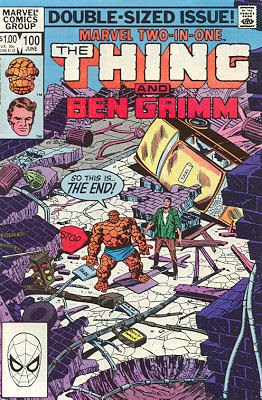
Marvel Two-in-One is my favorite comic series from back in the day. I buy almost all my old comics out of the cheapass bins, but Two-in-One I'll actually pull out of the expensive back issue boxes. The formula for this comic has always been very simple. The Thing plus some guest star get together and then lotsa fights happen. Sometimes they team up to beat down a baddie, other times the Thing and the other character just wail on each other. Either way, my favorite superhero always had the front and center of the story, unlike many of his appearances in the Fantastic Four. I got nothing against the rest of the FF, but they don't amuse me the same way brooding orange rockmen do.
I've not read the full run of Two-in-One yet, mainly because I'm not really a full run level collector. I think the only full run in my comics box is the DC mini-series Spanner's Galaxy. But I've got a haphazard collection of issues, and just today I snagged the two Essential collections on eBay for less than 20 bucks, including shipping. Hot dog, I can't wait for that box to arrive in the mail!
Number 100 was the last issue of Two-in-One, but it was immediately followed by a Thing solo series that was pretty good. The Thing wasn't quite as nutty as its predecessor, simply because the title didn't have to shoehorn in a random guest star each month. But I still grab back issues of it when I can.
I'm not going to scan in the highlights of Two-in-One #100, because if I start I'll end up scanning the whole frickin' issue. It's that jampacked with awesome. Instead, I'm going to hit some bullet points of what makes this issue so much fun. If anybody request scans of a particular item on this list, maybe I'll post some pics later this week.
Why Marvel Two-in-One #100 is super-rad to the max.
- The cover itself is a bit of a freak-out. How the hell can Ben Grimm co-star in a book headlined by the Thing?
- The story opens with a splash page of John Byrne's rocky version of the Thing beating up Jack Kirby's lumpy version of the Thing. This is a retelling of the awesome events of Marvel Two-in-One #50, where the Thing travels back in time and fights himself. I don't have that issue, but it's reprinted in the second volume of the Essential.
- Our hero travels back to the parallel alternative timeline dimensional universe where he fought himself only to find New York completely ruined. Turns out in this reality Galactus won.
- We're treated to several flashback panels where Ben Grimm (the Thing that was cured of monster-itis back in issue 50) relates how Galactus beat all the heroes and stripped the planet of its bioessence. Included in this sequence is the single worst drawing of Wolverine I've ever seen in a comic. As a kid I didn't even recognize the dude!
- Suddenly blue meanies show up and beat the Thing unconscious!
- Ben wakes up in the ruins of the World Trade Center, where the frickin' Red Skull now rules New York with an iron fist! The blue guys are the Skull's army of 'synthezoids'.
- Meanwhile plain ol' Ben Grimm gets some homeys together, jack a Nazi jeep and some uniforms and bluff their way into the Skull's lair. That's one of the things I love about the Thing: you turn this guy's powers off and he's still one of the biggest badasses in comics. How many times have you seen a hero get all emo when they lose their special magical abilities? When the Thing is depowered he just goes right on jawjacking and smacktalking!
- Speaking of talking smack, the Red Skull torturers him with a weird energy gauntlet device and the whole time the Thing is saying stuff like "Get bent!"
- The big final fight is the Thing in round 2 against the synthezoids and Ben Grimm beating the hell out of Nazis. The Red Skull tries to off the Thing with a face full of the Dust of Death, but our boy just blows it back at the Skull. Somewhere in another reality a little different than our own, the Thing stone cold killed the Red Skull. I'm a big fan of codes against killing in my superhero comics, but sometimes you gotta make an exception. Skullfaced Nazis ruling post-apocalyptic New York is one of those times.
- The Thing heads back to the 616 and does some trademark emo Thing brooding.
Seriously, aside from the pisspoor Wolverine, this is my idea of the perfect comic.