Thursday, January 01, 2015

This may seem somewhat familiar...

Official Wyrminghall Background Info

Lo! You have heard the story of the Dragon-Knights of old, now hearken to the tale of kind King Ægidius founded the realm known as the Little Kingdom. The former alehouse bully achieved this feat by subduing the great dragon Locheed and claiming its great hoard of treasure. He was able to achieve this victory with the aid of a phased plasma rifle in the 40-watt range. The king imprisoned his pet dragon in a great pit and built over it a great feast-hall, which became known as Wyrminghall, owing to the great wyrm contained below it. From his mighty hall the king founded Order of the Wyrm, a small order consisting of His Majesty and his nine bravest vassals. Although he paid nominal tribute to Alfred the Great, the lord of Wyrminghall ruled the Little Kingdom free of outside interference. 

Despite the king's ineptitude as an administrator, the Little Kingdom flourished, owing in large part to the fear of neighboring kings. None dared make war against the realm, for fear that the last thing they saw would be a flash of green scales shimmering in the bright sunlight, followed by an enveloping gout of fire. Another factor in the success of the kingdom was the influence of Queen Matilda, wife of the Lord of Wyrminghall. More shrewd than her husband, she was also known as a witch. It was said that she first expanded the pits below Wyrminghall, adding a series of vaults to better protect the treasures of the realm and fiendish traps to guard the vaults as well as a series of dungeons and torture chambers for the benefit of local tax evaders. Some tunnels below the hall are said to be the result of the dragon attempting to burrow his way out of bondage to the king. Another tale suggests that some of the excavations originated from deep below the hall, made by the the undergnomes known as the smurfnibblins in an attempt to locate the gold and silver of the king. 

The first Lord of Wyrminghall enjoyed a long reign, as many as eighty winters by some accounts, before dying in bed of a bad sniffle. His wife ruled as regent for several years until their son returned home from fighting as a mercenary in France. The son of the original king and queen of Wyrminghall, George, ascended to the throne. Barely adequate as a warrior and terrible at everything else, the second Lord of Wyrminghall's reign was short and disastrous, with most of the Dragon-Knights dying in battle against marauders or seeking service with a more worthy liege. The second lord died without issue, leaving the tattered realm in the hands of his henchman Sir Suovetaurilius. Eventually the hall was abandoned completely. What remained of the Little Kingdom was absorbed into the Kingdom of Wessex. Much later, Wilchester the Mad, one of the founders of the Invisible School of Thaumaturgy at Christminster University, briefly took up residence in the now ruined hall. No one knows when the dragon left Wyrminghall to return to its native Wales, but all authorities agree the beast is long gone from the vicinity.

Tuesday, December 30, 2014

Wyrminghall Campaign Info

Here I am trying to blog while my buddy Pat has put on the RiffTrax version of the Star Wars Holiday Special.  I haven't seen this thing in its entirety since the original broadcast.  Anyway, I wanted to talk today about my new FLAILSNAILS game.  Here are the basic details.

  • We'll begin with some standard dungeoneering.
  • The game will run from about 4 to 6 am Central Time (UTC -6) on Fridays.  Please don't sign up if you aren't regularly available during this time.
  • Since this is a FLAILSNAILS game, you can import some sort of terrible PC from other games.  PCs above 3rd level will be subject to the standard FLAILSNAILS handicapping chart.  Or you can make a PC of your own using the rules below.
  • The rules will be based upon Lamentations of the Flame Princess.  A free no-art version of the Rules & Magic book is available for download here.  For those unfamiliar with LotFP, it's not that different from D&D Basic/Expert.
    • Since the setting is pseudo-historical (mid 12th century England plus elves), some items on the standard LotFP price list are not allowed.  I'll get a revised price list up eventually, but for now the key item is no plate armor of any type.  (FLAILSNAILS visitors wearing platemail may find their armor subject to Chronotonic Degradation, whatever that means.)
    • Clerics must pick a religious affiliation that they obsessively champion: Christianity, Judaism, Islam, Satanism, and Paganism are all legit options.
    • MU's and Elves must pick a starting Blasphemy.  This is some sort of idiosyncratic, heretical belief about the universe.  Basically all arcane casters are cosmic conspiracy nuts.
    • Fighters can begin play as Knights if the player so desires.
    • Halflings are ridiculously, horribly French.
  • Interested?  To get into the player pool, fill out this brief Google Form.  On Wednesday or Thursday I'll contact some folks from the pool to put together a party.
Questions?

Monday, December 22, 2014

Timeliness is next to Godliness

One of the most mocked and most important lines in the first edition Dungeon Masters Guide is “YOU CAN NOT HAVE A MEANINGFUL CAMPAIGN IF STRICT TIME RECORDS ARE NOT KEPT” (page 37).  

This is one of those great moments when Uncle Gary speaks directly to us, the Dear Readers.  It is also one of the places where EGG breaks out the dread ALL CAPS.  Two more good examples of the latter can be found on page 39, where we find the rule that PC magic-users gain “1 (and ONLY 1) spell” when they level up and that hench-MU’s will “ABSOLUTELY REFUSE” to share spells.  I’m also fond of the all caps Afterword on page 230.  You might have missed that bit, as it is right above that charming succubus drawn by Darlene Pekul.

Anyhoo, today I want to yank out two words from the above all caps sentence to focus on: meaningful and strict.  I feel if that line is to be anything more than throwaway Gygaxian bloviating, then we need to parse out those two words in particular.

How does one have a meaningful campaign?  I think there are two main ways of answering that question.  The first is to do the artsy-fartsy thing, weaving a big theme into your campaign.  Despite my use of the term “farsty” I am totally on board with this sort of thing, providing one aspires to grand themes while at the same time making sure to leave room in the campaign for regular type players.  But then, I‘m perfectly happy having Johnny Beat-Up-The-Orc play at my table.  If you only want roleplaying artistes in your superthematic game then you’re probably better off running Nobilis or Dogs in the Vineyard or whatever game the cool experimental rpg folks are up to nowadays.  (Don’t let me talk you out of running D&D as hippy-dippy performance art if that’s what you really want.  Just warn players ahead of time, please.)

But that’s not the kind of meaning I think Gygax is going for in his declaration about time in the campaign.  I suspect he meant something much simpler and more fundamental about player agency in roleplaying games.  Meaning in this sense is created by player choice leading to comprehensible (if not always expected) consequences.  Keeping track of time allows for the natural unfolding of those consequences, whether we are talking about short term items, like a torch going out, or medium term, like lycanthropy or some other dungeon-induced disease, or long term, like building a castle or the aging rules catching up with you after your consistent, ridiculous abuse of the haste spell.

Now let’s talk about the strict part.  Sometimes when reading the DMG the trick is grokking the general principle and ditching Gary’s idiosyncratic execution.  So maybe the one day between sessions = one day of campaign time rule doesn’t fit your campaign.  Chuck it out.  But the basic concept, that you need some standard of how time flows in your game, remains valid.  Pendragons use of one year per session proves that other standards work well to produce different kinds of meaning.  Since I like to roll dice, I’m considering d6 weeks between sessions for my next campaign.
    

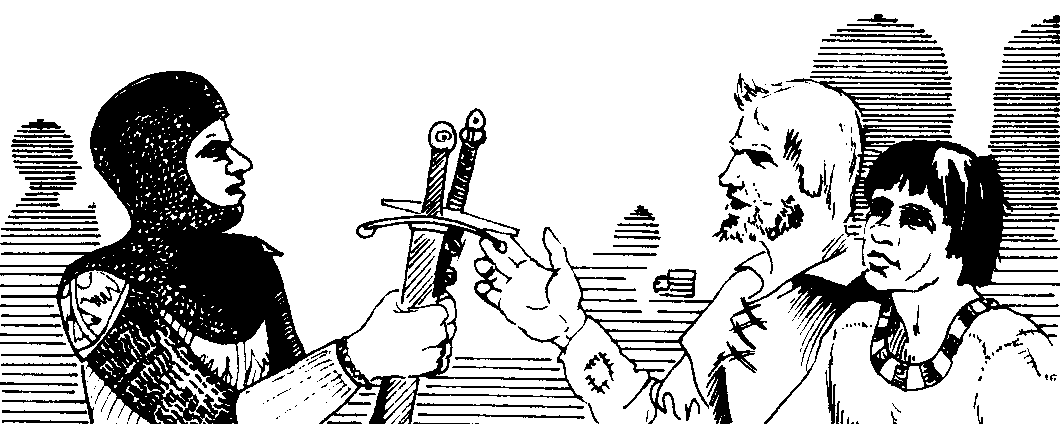
This illo (DMG p 36) has very little to do with the blog entry.  It’s just the pic nearest the passage I yammer on about in this post.  I like to imagine the guy in the chainmail is saying to these guys “Dude!  Be my henchman and you get your choice of either of these super sweet longswords as a signing bonus!”  Beardy McDarkeyes is clearly tempted, but Moptop Jones seems nonplussed.

Wednesday, December 17, 2014

Update

So I've got a serious offer to write a second dungeony dragony type book, even though the first one is still delayed.  (I've seen a sample of the new layout and a draft of the cover and they are both hella sweet, by the way.)  I don't feel right talking about the business details of the new thing, except to say that if I were to take this offer, here are the things that would have to come together for me:

1) The book would have to overlap with my research interests here at school.  So either a Wessex book or a book in which Romantic poets beat up goblins.  The former would be a hex-and-key, hey have some dungeons, and treasures and whatnot book.  The latter would be more like what if Masks of Nyarlahotep was set in 1816 London.  I'm up for either but I have a LOT of material already for Wessex and since my classes next semester are set to kick my ass*, I should really choose the path of least resistance.

2) I told my new player group that if I take this gig the system and setting will be determined by my writing needs and most of them were cool with that.  So I've got the green light from them.

3) As I've been thinking this through I've come to the conclusion that I need to get back in the saddle with respect to blogging and flailsnailing (yes, it's a verb now).  But I can't do this without all y'all backing me up.  I need some cool peoples to step up and promise to give me sixteen shades of hell if I let a week go by without a blog post of some kind or two weeks without running a game online.  I probably don't have time to follow the sweet new releases or to keep up on the gossip, but I am going to make time for the thing itself.

So that's the deal.  New Wessex stuff, a new dungeon, new blog posts, as long as you promise to hassle me if one week from today there is no new post or if I haven't run a game in 2 weeks.


*In my program only a fool takes two PhD seminars in one semester and I am that fool come January.

Sunday, September 07, 2014

Jeff goes Phandelving

So on Friday night David, Thaddeus, Kara, Katy, Ben, Mark and I gathered around David’s newly purchased plastic folding table.  I first meet Thaddeus, Kara and Katy at the orientation for new graduate assistants a year ago and they’ve been friends ever since.  David and Mark are new to my department this year, and as such they may labor under the impression that I know what I’m doing, as I was one of the leaders for their orientation.  But they’ll wise up soon enough.  Ben is Katy’s boyfriend and is the only person in the group who isn’t in grad school for English studies.  He has a real job, working for the local megacorporation that secretly controls all our lives.  As a group, they have a wide variety of role-playing experience, much of it in the 3e/4e/Pathfinder range of D&D variants.

For this get together I had purchased, opened and even slightly read the 5e Starter Set.  I hadn’t followed the development of this set very closely, so a lot of it was new to me.  Since the box comes with 5 PCs and I wasn’t sure how many people would show up, I also printed the pregens from this post at Beyond the Black Gate.  Thanks to Chris Sheppard for pointing that out to me.  Three of the Starter pregens were selected: the dwarf cleric, elf wizard and halfling rogue.  The rest of the party were Malakus the Wizard, Gorum the Butcher and Frodoric the Halfling (renamed Frankoric for reasons unknown) from Beyond the Black Gate.

Selecting the characters took longer than I thought it would, so we didn’t get too far into the adventure.  As per the book the party started out in Neverwinter.  I told the players that they were all drinking individually in this seedy bar when one by one they all figure out that everyone in the room knows Gundren Rockseeker.  I decided that dude is the Bill Brasky of dwarfs: twice as big as any normal dwarf, with a beard of three different colors, and capable of legendary exploits.
bill-brasky.jpg
To Gundren Rockseeker!
As they are enjoying another round of toasts to the health of their infamous friend, who should walk in but the dwarf himself, who immediately begins buying rounds like Ragnarok is scheduled for tomorrow.

The next thing the party knows, they regain consciousness hung over as hell and walking alongside a donkey cart.  Gundren in finishing his speech thanking them for agreeing to escort these supplies to Phandalin and rides off on his horse.  (Gundren Rockseeker is the only dwarf big enough to ride a fullsized horse.  Everyone knows that.)  So of course the players needed to futz around with the cart for a while and inspect its contents and try to secret the beer barrels away in their backpacks (not happening).  And then there was the debate as to whether or not to just got back to Neverwinter and sell the stuff.  Standard player behaviour.

Later, the party stumbles across two dead horses, one of them obviously Gundren’s.  They search for clues but soon come under attack by goblin archers.  The combat went fairly smooth except for a couple of minor problems:
  • I spent an extra moment or two hemming and hawing over whether there was such a thing as a Ranged Touch Attack in this edition or if hitting with a firebolt, etc. was the same as shooitng someone with an arrow.  I still don’t know the right answer.
  • I forgot about the stupid fire-and-pop-back-down ability of the goblins.  This is partly my fault, as my prior rules knowledge kept telling me that of course goblins don’t have special abilities.  But the decision to put all the monster stats in an appendix in the back of the adventure also kept me disoriented.

But this was a test run anyway.  Goblins were slaughtered and looted (at least the ones that weren’t burnt to crisps) and the party eventually tracked the little blighters back to their lair.  That’s all we got to before we were all pooped out, especially me.  I was double booked that night and had come from a grad school thing where I had made tacos for a dozen people.  That’s how busy grad school is for me nowadays: I had scheduling problems on Friday night.

Overall, the new system seemed pretty decent.  I’m not sold on it as a replacement for my B/X rulebooks, but for my purposes it seems like a perfectly cromulent iteration of D&D thus far, much moreso than 4e.  And it seems to have a lighter touch to it than 3.x.  However, the adventure itself isn’t really lighting anyones jets.  Many people at the table, myself included, were annoyed by the plot rails we felt attached to.  I understand why many adventures are structured that way nowadays, but I just don’t want that sort of set-up.  My guess is that we’ll finish the goblin lair next session and move on to something else.  Whether we switch systems or not, we’ll see.  But we’ll probably go on some other type of adventure.  You know, like a bigass dungeon or a wide open sandbox.

Monday, September 01, 2014

Vorpal Wind

So here's one of my favorite bits of dodgy old background material from an obscure RPG.  And incidentally, it totally works as a half-assed justification for campaign-hopping FLAILSNAILS shenanigans.

Vorpal Wind

A Vorpal Wind is one of those complicated things that’s real hard to explain, but easy to describe (especially when you made it up in the first place.)

Not too long ago a vast interstellar war occurred in another dimension.  During the final battle the KKjhasn decimated the Gak’n”e fleet leaving the KKjhasn the rules of the known universe.  But the Gak’n”e flagship (a super-heavy dreadnought with an experimental ‘weave’ drive) escaped.  The KKjhasn gave chase to the only surviving Admiral with his prize ship and soon had the Gak’n”e boxed in, ready for the capture.

Well, the Gak’n”e Admiral (Bob was his name), couldn’t bear to see his arch-enemy, the evil Commander Karok, pluck his prize ship, so Bob (the Gak’n”e Admiral) decided it was time to test the ‘weave’ drive in a desperate attempt to escape.

Bob rang the ship’s engineer, “Give me full power Scrottie,” Bob said, “I want to hit weave-9!”

“Aye Cap’n, Ah woul’, bu’ ah cain get noo powwerrrr!!!” Scrottie replied.

“Just do it, Scrottie,” Bob ordered firmly, “If she blows, she blows.  And Scrottie, it’s Admiral, not Captain.”

Scrottie did as ordered, by shutting down all other ship systems he managed just enough power to engage the weave-drive at the untested nine factor.  Unfortunately for all on board Scrottie had to down the life-support systems in order to get the power necessary to hit “weave-nine.”

The weave-drive was designed to literally “weave” the ship through the dimensional fabric that separates all alternate realities, without ripping or tearing the thin substance.  Instead, due to damage sustained during the terrible battle, the drive malfunctioned and shredded a gaping hole in the fine vorpal fabric.  The ship plummeted at ever increasing vorpal speeds ripping through one dimension after another and upsetting for the first time the laws of dimensional separation.

Dimensional pressures became unbalanced and the result was deadly Vorpal Winds blowing in seemingly random patterns between neighboring dimensions.  The winds tangled up time-flow and caused all manner of other physical and dimensional side effects.  The Vorpal Winds have now stabilized somewhat and though they appear to have no pattern, a determined player can figure them out.

--pages 9-10 of Excursion to the Bizarre by Brian Carlson and D. Wolfgang Trippe.

Friday, August 01, 2014

Re-reading Is Fundamental

I think it's a common enough occurrence that when we re-read something we find new stuff in a text.  We either notice stuff we missed the first time around or we can connect it to new thoughts in our head.  That's why I reread the 1st edition DMG from cover-to-cover every couple of years (Though it's been more like three right now.  That's grad school for you, I guess.).  And there's a line from an Frantz Fanon piece that I didn't understand when I was assigned it as an undergrad and I didn't understand it when I was assigned it again the first year of my Masters degree.  Just last spring I was assigned the same chapter a third time and I think I've finally got the gist of that one sentence now, but I don't understand it well enough to trot it out casually in a discussion, or to make it a key component of a paper.  Maybe that'll come later, after further wrestling with the piece some more.

Which brings me to an idea I've been pondering for a while now: levels of spell comprehension.  Because the world needs one more way to make M-U's more complicated, right?