Wednesday, November 09, 2016

Apparently PCs are very sound sleepers

Here's a crowdsourced thing from G+ I wanted to preserve for posterity. The challenge was to come up with cool alternatives to the "wake up in a dungeon cell" method of starting a scenario. Thanks to everyone who contributed!

How do we start this crazy adventure? (d100)
01-02 PCs wake up in a mausoleum inside a haunted graveyard.
03-04 PCs wake up at the starting inn, but it is on fire.
05-06 PCs wake up getting shaved and tattooed and branded, before being hung up to give transfusions to diseased cultists. =)
07-08 PCs wake up in a wagon during a high-speed chase.
The PCs wake up hungover after a bacchanal
09-10 PCs wake up slung and tied over a horse.
11-12 PCs wake up on a sinking ship.
13-14 PCs wake up standing over their sleeping bodies.
15-16 PCs wake up tied to the belly of a boar
17-18 PCs wake up washed up on a beach after a shipwreck
19-20 PCs wake up falling from an airship
21-22 PCs wake up on a tower during a storm
23-24 PCs wake up during surgery... alien surgery.
25-26 Wake up with a knife to their throat
27-28 Wake up in a village, only they are still alive.
29-30 The PCs happen to be travelling down the road together when a horse-drawn carriage comes barreling around a turn towards them.
31-32 PCs wake up in a wizard's laboratory, decapitated. Fortunately for them they are being magically kept alive and just need to find their bodies. Also somewhere nearby there is a single golem that follows voice commands.
33-34 Pcs wake up in the inn. Water surrounds their beds. The inn is floating down river on a flash flood.
35-36 They wake up in individual coffins
37-38 They wake up strapped to various torture devices in a dungeon. Good way to introduce themselves as the torturer interrogates them.
39-40 PCs wake up each holding a fragment of a treasure map.  Between them they do not have the whole thing.
41-42 They wake up in each other's bodies. Sally the halfling thief is now playing a dwarven male fighter. They have to find each other in the city.
43-44 They wake up in a pitch black room that smells, and they are waist deep in acid. Something splashes nearby (they are in a giant's stomach, it unfortunately has worms. Big worms).
45-46 Being dragged from the sea by strange man-frog fishermen in walrus leather.
Wake up in a crater, smoking.
47-48 PCs wake up (unarmed and without their gear) with a headache, in a caged wagon, including an armed guard escort, and they are traveling in place they are not familiar with.
49-50 Same as above above, except they are traveling through an unfamiliar village and while being insulted and mocked by villagers, and being pelted with rotting vegetables and waste. They are quite aware of the shouts of "Witch!, Burn! Warlock! Demon Worshipper! Burn!" that can be heard amidst the other slanders, taunts, and insults
51-52 PC's wake up to find a rather large dragon attacking. As each pc is slain, they wake up once again, only they are not anywhere near their home,. They are all in a strange outdoor place with a glowing extra-dimensional gate or portal that is quietly powering down. The summoning wizard/wizardess is standing immediately before them.
53-54 PCs wake up in the menagerie garden of the Emperor
55-56 Wake up in a conference room with Dr. Doom.
57-58 PCs all wake up (with hirelings too) naked in bed together. A big bed.
59-60 They wake up underwater, surrounded by a maze of coral and seaweed. They have gills.
61-62 Wake up in hot air balloon that is descending
63-64 Wake up inside Kansas farm house In a tornado, tumbling through sky.
65-66 Wake up at your moms house, have an existential crisis, realize you need to go kill something and  take its gold.
67-68 They don't wake up. They never sleep. Insomnia has been constant for a month and now at four a.m. the dark sends a strange guest
69-70 They wake up outside of an already raided dungeon, unfamiliar magic items in hand
71-72 They hit middle age and none of their dreams ever happened and there are dragons out there and the bills are getting higher
73-74 They emerge spontaneously from the forehead of Zeus
75-76 They reverse-nirvana out of oneness with the universe and somebody in a dungeon did it
77-78 They wake up mid-brawl with each other. A neat sum of XP is offered the sole survivor. They were pregens, they roll up characters who were placing bets. The survivor won the privilege of guiding them into a dungeon
79-80 PCs wake up covered head to toe in unknown rune-tattoos
81-82 They wake up in a mesmerists room in Victorian London. He says that was a pretty good session but they need to regress again to find out where the special snowflake treasure went. They wake up in a dungeon.
83-84 They go to sleep on the night of the equinox and pass through The Gates of Ivory and Horn...
85-86 Waking up in a morgue has been done by Torment of course, but it has more applications than that.
87-88 They wake up under an upturned, burning wagon
89-90 The players (not the PCs), wake up naked in this strange temple. There is an old person in priestly robes staring at you
91-92 PCs wake up in the tavern, but the village is completely empty of other people. Half-eaten meals and cooking fires still burning. Footprints end mid-stride.
93-94 Wake up inside tubes full of fluid, which are slowly draining while an alarm sounds.
95-96 PCs wake up shrunk to 3 inches tall and inside an iguana terrarium. 
97-98 PCs wake up naked in the Sultan's harem as scimitar-wielding eunuchs enter the chamber.
99-00 PCs wake up chained to barrels of gunpowder, longs wicks sizzling towards their doom.

Tuesday, November 08, 2016

The Deadliest Page

So it's early into the evening of Election Day here in the good ol' U.S. of A. and the present political climate has me sufficiently freaked out that I have started drinking.  So please forgive me if parts of this post are incoherent.

Anyway, I wanted to take some time before I get fall down drunk to tell you about the Deadliest Page of the original Dungeon Masters Guide.  There are several pages in the DMG that will severely ruin your PC's life.  My favorites include page 28 (where we find out that not wearing a helmet will FUCKING KILL YOU), page 225 (the gods damned ENCUMBRANCE RULES), and page 80 (the item saving charts will WRECK ALL YOUR COOL MAGICAL SHIT).  But the deadliest page of the first edition Dungeon Masters Guide is page 182.  Imma explain why.

There are two rules for wandering monsters on this page that I have NEVER seen applied.  Not in my own campaigns and not in anyone else's.  (If you've used them, please let me know!)  Rule the first is the Psionic Encounter rules.  The basic idea seems to be that psionic monsters are attracted to psionic powers or--and this is the kicker--spells that resemble psionic powers.  A lot of low level spells appear on the list titled Spells Resembling Psionic Powers: cure light wounds, detect evil, detect magic, charm person, feather fall, enlarge, ESP, invisibility just to name a few.  The upshot of this rule is that if your party casts ANY of these spells there is a 1 in 6 chance that the next wandering monster comes from the Psionic Encounter Table rather than the normal wandering monster matrix.  This table is no joke.  Not only does it include all the standard psionic monsters like intellect devourers and mind flayers, but all the sundry denizens of the Seven Hells and the Abyss also show up on it.

This means that under AD&D1 rules as written it would be theoretically possible for a 1st level cleric on their first adventure to cast detect evil and find nothing, only for Demogorgon to show up a few rounds later.

The other, and I think more important, section is Patrols.  The DMG asks DM to designate all outdoor areas as either inhabited or uninhabited.  One of the key differences between the two is that inhabited areas are patrolled.  In fact a full 25% of wandering monster encounters in inhabited areas will be with patrols.  A patrol looks like this:

  • Commander: a fighter (or ranger, if appropriate) level 6-8
  • Lieutenant: figher (or ranger) 4-5
  • Sergeant: figher 2 or 3
  • 2-3 first level fighters
  • (All of the above have plate, shield, lance, flail, and longsword, mounted on warhorses
  • 12-24 zero-level soldiers with chain or scale armor, bow or xbow, and some hand weapon, mounted on riding horses
  • either a cleric 6-7 or an MU 5-8
In other words, 1 in 4 encounters in inhabited areas involve a shit-ton of cops trying to ruin your murderhobos' day.

Saturday, November 05, 2016

Ard times for MU's

So this exchange appeared in my tumblr feed yesterday:


That's pretty darn great if true, but a citation is lacking, so I hit up the online Oxford English Dictionary.  Here's the entry for the suffix -ard:

-ardsuffix


Etymology: < Old French -ard-art, < German -hart-hard, ‘hardy,’ often forming part of personal names as Old High German Regin-hart Raynard,Ebur-hart Everard; also in Middle High German and Dutch a formative of common nouns, generally pejorative, whence adopted in the Romance languages. Used in French as masculine formative, intensive, augmentative, and often pejorative, compare bastardcouardcanardmallard,mouchardvieillard.

 It appeared in Middle English in words from Old French, as bastardcowardmallardwizard, also in names of things, as placardstandard (flag); and became at length a living formative of English derivatives, as in buzzarddrunkardlaggardsluggard, with sense of ‘one who does to excess, or who does what is discreditable.’ In some words it has taken the place of an earlier -ar-er of the simple agent, as in braggerbraggarbraggardstanderstandard (tree). In some it is now written -art, as braggart; in cockade, orig. cockard, corrupted to -ade suffix.

The OED's first definition of wizard ("A philosopher, sage... Often contemptuous") confirms this negative connotation.

My conclusion is that etymologically wizards are close to mad scientists, in that both concepts express the fear that there is such a thing as too much knowledge.  That's basically what I do in the latest version of my Wessex campaign already.  Magic-users are twisted by their secret knowledge into cosmic conspiracy kooks.  Their paranoid insights into the universe are considered blasphemies against the established order of the universe, even when they are true.

Wednesday, August 17, 2016

You, the universe, or both have gone very wrong

Why did you become an adventurer? (d30)

  1. Early one morning you saw the sky crack, then break, revealing strange worlds behind the sky.  You haven't been able to live an ordinary life ever since.
  2. You came home one day and the sister you buried a year prior was alive and well.  No one else in the family remembers her illness or death, yet her tombstone still stands in a nearby graveyard.
  3. You used to work as a computer technician in a futuristic domed city, but woke up one morning the idiot child of the village blacksmith.
  4. One day the bucket of the village well brought up blood instead of water.  No one else seemed to mind, but you sure as hell did.
  5. After the eclipse everyone else spoke a different language.  You're pretty sure the folks back home thought you'd been possessed by a babbling demon.  You've only now just picked up the basics of your new native tongue.
  6. Returning from a visit to a distant kinsman, an ancient forest covers the exact spot your village used to occupy.  You turned around and the trail you followed was gone.
  7. You were caught up in a war between shadowy angels and titanic metal gods.  At the final battle you took a blow to the head.  When you came to you were still on the same charred and bloodstained field, but everyone and everything else was gone.  None of the locals remember the war or its combatants, yet you have a dozen scars from it.
  8. One night you came home after a long day in the fields.  The womenfolk wailed and the menfolk cowered.  Your own brother drove you out of the house with a cleaver in one hand and a holy symbol in the other.  Later you found your own gravestone.  According to it, you've been dead 3 years.
  9. You worked up the nerve to ask the elder of the clan what had happened to the shadows.  Why were they no longer a luminous rainbow glow, but instead dark and spooky?  Without answering, he had you driven out of the community.
  10. On the day after midsummer everyone you knew started calling you by a different name, as if it had always been your own.  They also began blaming you for a wide variety of petty crimes.  Then you realized your face had changed as well.  Who are you?
  11. You used to live by the sea until one night a brass galleon with a skeletal crew slid into the harbor.  A skeleton prince wearing a flaming crown blew a silent note on a bronze horn.  Everyone in your village marched aboard the galleon, as if in a daze.  It sailed away, leaving you alone forever.
  12. In all your dull life you never expected to see an aerial battle right above your village.  Dragons and demons and flying ships exchanged strange fires and multi-colored lightning.  One of the dragons fell.  Only then did you realize how far up and how huge the combatants were.  The dying dragon crushed everyone and everything you ever cared about.
  13. You used to be a dog.  Slightly smarter than most dogs, but just a dog.  Your young owner treated you cruelly.  Then one day you and your owner swapped bodies for no discernible reason.  The dog ran away--no doubt fearing revenge--but you had to run too because you couldn't successfully imitate your former owner.
  14. One day you awoke in a mass grave.  It was only after you climbed out of a pile of rotting corpses that you realized you had no idea who you were or how you got there.
  15. No one else back home can see the hole in the sky or the baleful gaze of the hideous cosmic beast that watches us through it.  You couldn't work in the open fields any more, knowing it was always looking over your shoulder.  You had to flee.  It still watches.
  16. You used to be the whole universe, one vast ecstatic cosmic consciousness.  But then more and more of your all-body became numb and alienated.  Now you're just this tiny lump of ambulatory meat and you don't know what  happened or why.
  17. You don't know on what strange battlefield it received its wounds or whether it was a giant or a god or something else, but it stumbled into the village green and promptly died.  Everyone else in the village entered into some weird frenzy, gleefully tearing the corpse apart and devouring it raw.  As you fled in horror they started to change into unhuman things.
  18. Twice a year every year you had taken the old ferry, for as long as you could remember.  This time when you reached the far bank of the river it was a totally different place.  You turned around and the ferry was gone.  So was the river.
  19. You used to be a professional circus freak, the Hideous One-Headed Four-Limbed Abomination.  Then one day the sky flashed a weird color and suddenly everyone else was deformed just like you.  The poor bastards don't even remember their former three-headed, six-limbed glory.  You're not a freak anymore, but you're out of a job and still kinda feel like one.
  20. One day you started growing at a prodigious rate--or perhaps everything else shrunk--until your head cracked open the sky.  You grew and grew until you were normal size in a much bigger universe outside your old one.
  21. You were born with a special gift: You can dimly remember your past and future lives, as if your consciousness were a tangled thread in the weave of time.  People back home thought you were a witch.  Maybe they're right, but the whole burning-at-the-stake thing they tried was still super rude.
  22. One day the earth shook and the land shifted.  Your home and all your kin sunk beneath the waves, which was surprising seeing as how you lived a hundred leagues from the sea.  You'd have drowned, too, if not for that log you clung to.
  23. One day cracks opened in the sky.  You suddenly fell upwards and landed someplace else.
  24. One day you noticed an extra door in your home.  From the darkness beyond a gnarled green hand beckoned.  You're still not sure why you followed or who that goblin was.
  25. You used to be an astronaut.  Your single seat orbital spacecraft passed through a strange energy field and you lost all contact with mission control.  You splashed down in a world that doesn't seem to be Earth.
  26. The block of ice you were frozen in thawed out.  Apparently your home civilization has been gone for a whole ice age.
  27. Back in the day you were a glorious 7-dimensional hyperbeing.  Then the war in heaven came.  An omega angel wielding a meson blade sliced off a 3-dimensional appendage, which fell down to ordinary spacetime.  You may look like an normal person, but you're really a living amputation in a fallen world.
  28. The glowing blue rain turned everyone else in your home village into hideous snake people.  They told you they still loved you, even though you're now the local freak.  But you couldn't cope and fled.
  29. You were a footsoldier in the last of the Psychic Wars, but an Oblivion Bomb has scrambled most of your memories of the conflict.  Your not even sure how you ended up on this particular planet.
  30. You used to be a god.  Your whole pantheon fought in Ragnarockaggedon, but your side lost.  To escape the Cosmic Regulators and the inevitable trial for Crimes against Divinity, you dispersed your god-power and implanted your essence into a mortal body.

Sunday, June 05, 2016

klutzing around with the Dungeoneer/Journal


The Dungeoneer #19/Judges Guild Journal #22 is an odd duck of a magazine.  The Journal was the flagship periodical of the Guild, while the Dungeoneer began life as one of the early D&D fanzines, this one launched by the great Jennell Jaquays and friends.  Jaquays et al. produced six issues before they sold to Bob Bledsaw.  (JG also reprinted the first 6 issues as a single book usually called Dungeoneer Compendium, though the cover says its The Dungeoneer: The Adventuresome Compendium of Issues 1-6.  Whatever you call it, I rank it right up their with the first 3 Arduin Grimoires as one of the best supplements from the good ol' days.)

The Guild decided to merge the two publications and this is the first issue of the merger, hence the two half-covers.  Take a moment to enjoy the cover art.  I don't know which I like better, the spell lady magic missle-ing the hand that created her, or the party looking up into the hole in the ceiling, not knowing some red gobliny dudes are waiting up there for them.  (Extra nerdy note:  The character sheet in the top illo is clearly from an OD&D game that used Supplement I: Greyhawk.  Score an extra nerd point in the comments by explaining how I know that.)

After this weird hybrid, the next three magazines put out by Judges Guild would be issues 23 through 25 of The Dungeoneer Journal, followed by issue one of Pegasus.  The latter magazine ran 12 issues.  An issue #14 came out in 1999 and #15 was, I believe, a PDF only from around 2004.  Did Pegasus #13 ever get published?  I honestly don't know.  What I do know is that while I've never been a collector of Judges Guild campaign installments or Journals, I've never been disappointed with issues of Dungeoneer, Dungeoneer Journal, or Pegasus.  As a whole, I give these periodicals two hearty thumbs up.

I'm not going to run through everything in this issue, because I intend to focus on one article.  But here are some of the other cool things inside.
  • "Critical Hits and Funbles on Non-Humans" by Glenn Goddard.  Two functional looking percentage charts, similar in many ways to Dave Hargrave's charts.  My fave result for sheer gruesomeness is probably "spine ruined."
  • "Dungeons Diseases" by the great Lewis Pulsipher.  I'll admit this one disappointed me intially.  I was hoping for disgusting fungal infections, orc rot, rectal bees, etc.  Instead it's a comedy piece commenting on certain kinds of players.  Example: Mapitis in which the "victim becomes more interested in maps than monsters.  He incessantly asks questions about angles and distances."
  • "Jewelry" by the also great Steve Marsh.  One page of charts of various things that can be jeweled.
  • The regular Monster Matrix column includes a nifty critter called the Balloon Beast by Gregg and John Pittenger.  It's a shame that this monster has not been folded into the umpteen varieties of beholder variants.  The Waldweibchen by Kurt Smeby is a great example of the kind of grumpy and mercurial fairy that D&D needs more of.
  • "Mac's Packs" by Thomas A. McCloud is another example of the "fast pack" concept.  4 pre-packaged sets of adventurers gear in a container (backpack or sack) sold at a discount.  Personally, I lean towards charging more than regular because of the premium on convenience.  Still, neat stuff.
  • "Adapting the Book of Demons" also by Lew Pulsipher.  I can't leave something with the words "Book of Demons" off this list, but it's about making a demonology game product work better with bog standard D&D assumptions.  I'm not certain, but I suspect the work in question is the same Book of Demons that ended up bundled into Gamescience's The Fantasy Gamer's Compendium.  At the moment I can't locate my copy of the latter to confirm, but, as I recall, one of the reasons I've never made much use of this Compendium is that all of its components seem written for a fairly idiosyncratic campaign.  Pulsipher seems to be dealing with that exact issue in his article.
  • "Metallurgy and FRP," also by Steve Marsh, is a one column piece on considering how the rise and fall of demand brought on by new technologies can impact the relative value of metals in your campaign.
  • "Dungeon Generator" by Charles L. Evans is exactly what it says on the tin.  It resembles the one in the Gamescience product The Book of Tables, but I can't confirm if they are the same just now.  My guess is that both Gamescience products are sitting next to each other on some bookshelf or another.
  • "Traveller Rumors" by Bill Paley is one page with 13 adventure seeds for any campaign.  I'm pretty sure that the planets mentioned in the text (Pickering, Salivarius II, Credosh III, Bendex III, Krestmast, Samelos XII) do not appear in any known canonical sector.
  • "The Old Hill" is an adventure by Steve Marsh written for Chivalry & Sorcery. It is set in a pocket universe called a Garden World, one of "a series of interlocking planes of existence... They were the lesser hearths of each of the Vali or Star Powers summoned by the Norns when they wove the world... Then came the blight of Upharsin and many things changed."  This isn't the first time I've really grooved on Marsh's sense of cosmic history.  In the adventure itself PCs can be struck by the literal Wrath of God as well as fight an angel, a daughter of Lilith, and a really grumpy tree.  I also live this bit from the introduction: "Some of the inspiration for this came from Ed Simbalist and from William Glenn Seligman.  An Erol Flynn movie ran as background for the typing and mapping.  I especially want to thank Lee Gold for her helpful comments."  Lee Gold is the matriarch of Alarums & Excursions, the long-running D&D apa-zine.  Ed Simbalist is one half of the team that created Chivalry & Sorcery.  And Bill Seligman is the author of one of the best Dragon articles ever written, "Gandalf was Only a Fifth Level Magic-User."
None of those articles or the ones I haven't mentioned are why I started this piece.  Instead I want to talk about Kevin Fortune's "Using Klutz Factors."  This is a short piece in the long tradition of making magic-users roll dice to cast spells.  I've tackled this sort of thing before myself, as have many others.  What I want to give to you today is NOT a simple transcription of Fortune's system, but a slightly spruced-up version.  My two main objects with the system as presented are 1) too many percentile rolls and 2) some multiplication of percentages.  By switching to mostly d20-based rolls and adding an extra chart to remove the math, I feel like the result preserves the spirit of Fortune's system while trimming the fat considerably.  I've also limited myself to the first 14 levels of experience and 6 levels of spells.  Gandalf may have been higher than 5th level but I don't care much about anything higher than Expert level anymore.

Revised Klutz Factors

after Kevin Fortune, Dungeoneer #18/Judges Guild Journal #22 pages 7-9 (Aug/Sep 1980)

I. What You Gain

No magic-user likes limitations on their power and this system, which requires a casting roll for every spell, is pretty limiting compared to a lot of versions of D&D.  However, it comes with one big advantage for MU's: you may keep casting the same spell but the Klutz Factor doubles each time, until a Klutz effect (a fumble) prevents you from casting again.  This system actually sounds like it would work well for those BX referees who stick to the hard version of the spellbook rules, which say that if your MU can cast 2 first level spells a day and 1 second level that is the maximum number of spells allowed in your book (see page B16).  Some DMs might even want to forbid players from doubling up on spell memorization under this scheme (e.g. no 2nd level MUs memorizing 2 sleep spells).

II. What You Need to Track

Each MU has a Klutz Factor for each level of spell they can cast.  This is a three variable factor, so in a 2-d presentation like this screen, it'll take two charts to get to.  Every time your MU changes INT or their level, you'll need to look this back up.  Use Tables 1 and 2 to find your character's Klutz Factor.

Table 1: MU Level versus Spell Level

The A's in parentheses are spells someone of that level shouldn't be able to cast.  They don't figure into Fortune's original tables, but I added them in case you wanted someone to fumble a high level scroll under this system or something like that.

Once you have the letter code for each spell level you can cast, cross index the result on Table 2 to find the Klutz factor for each level of spell your MU can cast.  You should probably record this number adjacent to the spells/per day indicator on your character sheet.

Table 2: Intelligence to Klutz Factor


This Klutz Factor is a d20 thing.  When an MU fails to cast a spell you've got to roll over this number to avoid a spell fumble.  Every subsequent time you cast the same spell in a day, this number doubles.  That looks absolutely disastrous for low-INT magic-users, but you need to blow the casting roll to even reach this point in the process.

One of the downsides of this system, probably the one that trips me up the most, is that you need to look this stuff up for NPC magic-users.  Since I'm super lazy about such things, here are all the Klutz Factors for an MU of 11 Intelligence.

Table 3: Typical MU Klutz Factors


Example: Andrigal of the Weeping Beard, a 3rd level MU, attempts his second web of the day.  His normal Klutz Factor, as a default Int 11 NPC, is 6 for second level spells.  Since he has attempted web once today, his Klutz Factor is doubled to 12.  His chances to cast are the same as always (see below), but if he fails the casting roll then he will fumble the spell on a second d20 roll of 1-12.  Note that his 3rd and subsequent web spells of the day are all going to be fumbles IF he blows the spellcasting roll, but he can risk it as many times as his shriveled heart desires.

III. The Casting Roll

Before the Klutz Factor comes into play, Fortune's system calls for a casting roll similar to that employed in Chainmail, but d20 based and expanded to cover a wider range of levels.  On the chart below an I indicates Instantaneous success (the spell goes off), a D indicates a Delay, the MU must keep chanting and gesticulating for d3 rounds before the spell goes off (d3 turns for non-combat spells), and an N indicates No Effect.  According to Fortune's system only when a No Effect occurs is the Klutz Factor check made.  Though I'd also consider using Klutz Factor rolls for when someone took damage while working through a Delay effect.

Table 4: Spellcasting Chart


For many campaigns, it would make sense to allow the players to record these numbers for their character.  But when I've tried a similar system before I kept this sort of info behind the screen because I like to keep some of the workings of magic a mystery to the players.  Note that a system like allows for a campaign where high level casters don't necessarily reshape the world in their image.  Wizards know that high level spells are unpredictable enough they should only be used in emergencies.

I've added the numbers that are highlighted/in parentheses for situations like a low level MU casting a spell directly out of some higher level character's spell book.

IV. The Klutz Effects

Okay, so your favorite pet magic-user has rolled an N effect on their casting roll and then rolled high enough on the follow-up d20 that a fumble has occurred.  Throw a d10 and consult the chart below to see what actually happens.

Table V: Klutz Result Chart

1. Spell has normal effect, but on the wrong side of the conflict.
2. Spell has reverse effect on target.
3. Spell has normal effect, but only on Magic-User who cast it.
4. Spell has no effect and caster Mind Blanked, unable to cast for rest of day.
5. Spell has normal effect but Magic-User drained 1-4 points of Intelligence for rest of day.
6. Spell has no effect and Magic-User drained 1-4 points of Intelligence for rest of day.
7. Spell has reverse intended effect on wrong side of conflict.
8. Spell has reverse effect, but only on Magic-User who cast it.
9. Spell negated and Magic-User loses ability to cast a random spell for 1-4 days.
10. Spell klutzed so badly that Magic-User is scared to use it again.

Obviously once you have the whole system in place this last chart is the sort of thing that can be added to and/or modified to suit the spirit of the campaign.  Also, Fortune includes a few lines about overcome the fear effect of number 10, but it references the mechanics "Bravery," "character roll," and "Conversion Chart" without explaining what those things actually are.

So there you have it.  Another system for making MUs more complicated and a bigger pain in the ass to play.  I'm normally pro-MU and anti-complication, but I'm also pro-rolling more dice and anti-magic is as reproducible as a grade school science demonstration.

Wednesday, May 04, 2016

Old wine into new skins

Hey, remember me?  The semester is over and I have half a minute before my summer class begins, so I decided to write about a little something.  This is an idea that’s been brewing since January when that venerable institution the Guardian ran a story titled “Fairytales much older than previously thought, say researchers.” Yeah, I read the Guardian sometimes.  I usually treat inflamations of my chronic anglophilia with a bottle of Newcastle and old Doctor Who reruns, but sometimes I need stronger medication.

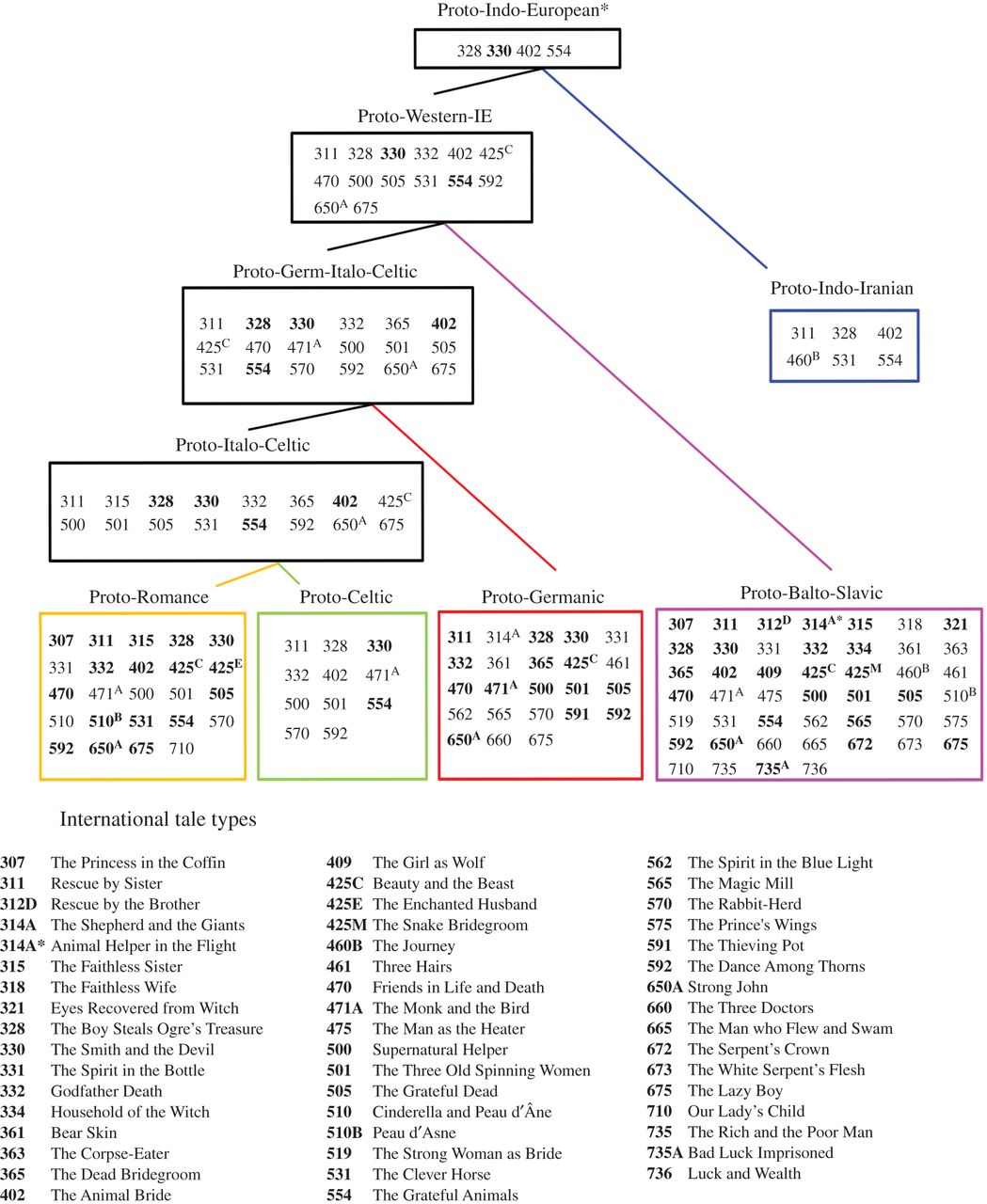
Any, these researchers da Silva and Tehrani did some big data type analysis to a corpus of international fairytales and basically built a family tree.  Here’s the key chart from their paper:


F4.large (1).jpg
The three columns at the bottom look like they’d make pretty sweet band names.

What you’re looking at is a family tree of fairy tales grouped by language family.  The thing that blew me away about this chart is the small box at the top, which suggests that humans have been telling and retelling the same four stories since French and German and English and Spanish and Slavic and a whole bunch of other tongues were all the same language.  That puts the origin of these fairy tales around 2500 to 4500 BC.  Some folks identify the original speakers of this Proto-Indo-European (PIE) language as the kurgan (barrow)-builders living in the region between the Black Sea and the Baltic.   You know, like the villain from the one and only Highlander movie.
“I have something to say: It’s better to burn out than fade away!”

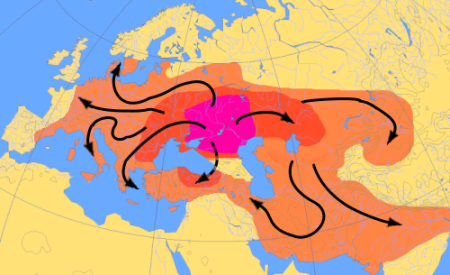
The kurgan fairy tales then spread with the Proto-Indo-European language as it migrated and diverged into the dazzling array of linguistic variety we see today.  Here’s a map of the initial movement from the center:
Back in 2010 (when this blog was still a daily thing) I wrote a five part series on D&D set in this long lost era called Imperishable Fame.  Today I want to talk about incorporating the four Proto-Indo-European fairy tales into a typical faux European vanilla fantasy setting.

First, let’s talk about the tales themselves.  They’re identified in da Silva and Tehrani’s research paper like so:

328 - The Boy Steal’s Ogre’s Treasure
330 - The Smith and the Devil
402 - The Animal Bride
554 - The Grateful Animals

The Smith and the Devil is bolded because the researchers are flagging it as an even more likely component of the PIE corpus than the others.  My basic idea here is that we should be mining these tales for plot elements to our games.  After all, they represent our joint heritage in the exact sort of mytho-poetic imaginative nonsense we engage with in D&D every day.  I’ll get to some ideas of how to do that at the end of the post.  For now, I want to give some details on these four tales.

The numbers for each of the fairy tales on da Silva and Tehrani’s are what is called their ATU number.  That stands for Aarne-Thompson-Uther. Folklorists  Aarne and Thompson put together a huge ass taxonomy of hundreds of structurally similar stories and a cat named Hans-Jörg Uther later revised it into a four-volume work called The Types of International Folktales: A Classification and Bibliography.  For a similar work on a smaller scale, see S. John Ross’s The Big List of RPG Plots.

I spent the better part of this semester getting my hands on Uther’s book, so I could get the details on these tales beyond their names.  About the only library in Illinois that has a copy is at the University of Chicago, and they are not very good sharers.  My school is part of a consortium of 84 schools and academic libraries in Illinois that allow for easy inter-library lending.  I get books shipped in from all over the state quite regularly.  UC’s library is conspicuously not a member.  I finally ended up having to get Iowa State University’s copy shipped to me, which is slightly embarrassing.  As a native inhabitant of Illinois, I have been inculcated from birth to look down with disdain on neighboring midwest states that lack a Chicago.

Anyway, let’s look at these tales.  Or rather, you might call them meta-tales.  They’re the raw plot elements out of which fairy tales are built.

328 - “The Boy Steals the Ogre’s Treasure”
In this ancient tale a group of brothers (numbers vary) arrive at the house of an ogre, or possibly the devil.  For some reason they stay the night.  The ogre/devil decides to murder them in their sleep, but the youngest brother (occasionally the kid sister of the brothers) somehow foils the plan by swapping caps with the daughters of the monster.

Later the brothers take service in the king’s court.  The brothers, jealous of the young hero, claim to the king that the youngest sibling can steal the ogre’s/devil’s treasure.  (Some versions dispense with this intro and instead start out with the youngest sibling seeking out the ogre for revenge of past mistreatment or to help a friendly king.)  Possible treasures include a magic horse, bedspread, carpet, parrot, lamp, sword, musical instrument, or some sort of poultry.  The magic treasure may be made of gold and/or silver.  The youngest sibling acquires the treasure by cunning and guile.

Later the brothers, now presumably more jealous than ever, claim that the youngest sibling can kidnap the ogre or devil.  The hero puts on some sort of disguise and somehow persuades the monster to lie down in a coffin to measure it.  The youth nails the coffin shut, trapping the monster.  The youth is given a princess for a wife.

As you can see, there is a lot of room for variation here as these tales mutate over time to better fit local needs.  For instance the classic English tale of Jack and the Beanstalk is considered a major variant of ATU 328.  Incidentally, Jack and the Beanstalk is one of the key inspirations (along with its RPG successors, the Against the Giants series and the more obscure Judges Guild module Under the Storm Giant’s Castle) for my adventure Broodmother Skyfortress.  Last I heard that project is finally going to  be printed just in time to not make it out for GenCon.

330 - The Smith and the Devil
In this tale a smith sells his soul, sometimes because he is impoverished.  The buyer of the soul is typically the devil, but it could also be death itself.  Later this smith gives shelter to Christ and St. Peter as they travel the earth in disguise.  [Obviously these characters would be different in a pre-Christian telling.]  As a reward for his kindness, his divine guests grant the smith three wishes.  St. Peter warns that the smith should use one wish to get his soul out of the devil’s clutches and into heaven instead, but the smith ignores him.  Instead, the smith wishes up three magic items.  The first two are a tree and a bench/chair to which people stick like glue at his command.  The third item is usually a knapsack that can draw people into but sometimes it is a pack of cards with which the owner always wins and occasionally it is something else entirely.

When the devil or death shows up to carry the smith off to his eternal doom, the smith tricks him into sticking to the bench/chair and the tree.  In order to be released from this trap, the devil/death agrees to terminate the contract for the smith’s soul.  In some versions trapping the devil/death like this results in a period where no one can die.  After freeing the smith’s soul, the devil/death winds up inside the knapsack, which is placed on the smith’s anvil.  The devil/death is pummeled with the smith’s hammer.  Later, the smith discovers that he cannot die.  Neither heaven nor hell will admit him.  He grows tired of life and eventually tricks his way into heaven using the knapsack or cards.

In some versions of this tale the hero isn’t a smith, but an allegorical figure such as Misery, Envy, or Poverty.  These versions focus on the intentional gaining of immortality by tricking the devil into trapping himself inside a tree.

402 - “The Animal Bride”
A father, possibly a king, cannot choose among his sons (usually three of them) to inherit his property/kingdom.  He sends all of them on a year-long quest.  In some cases the quest is to learn a profession.  In others it is to bring back a special object, such as textiles (yarn, linen), fine chain, a ring, a horse, or the smallest dog they can find.  At the end of the year, the father will name as his heir whoever best succeeds at the task.

The youngest son, who is sometimes explicitly a fool, goes into the forest and enters into the service of some sort of animal.  Cat, rat, frog, and mouse are the common options.  As payment for his service he is given the most beautiful example of the object that the father requires.  Owing to the jealousy of the older brothers, two further tasks are set.  The final task is to bring home the most beautiful woman or to bring home the most beautiful bride.

For each subsequent task the young fool returns to the animal, who promises to help.  Some event disenchants the animal (burning, mutilation, decapitation, or simply crossing a river) and the animal resumes its original form of a beautiful princess.  In most versions the young fool and beautiful princess return to the father to win the final task.  In some variants they first trick the parents, either the son returns in rags and is ridiculed or he returns dressed as a prince and is not recognized until a mole identifies him.  Or else the trick is that the princess arrives in animal form and yet wins the tasks assigned to the brides to determine which is best.  The last (third) bride task is to attend a feast, where the animal turns back into her human form.

In some versions the son renounces the inheritance and goes with his bride back to her realm.  In some others the young fool burns the animal skin in hopes of preventing his bride from resuming animal form.  She is offended and abandons him.  He must go out on a final quest to win her back.

554- The Grateful Animals
This tale appears to have atrophied over the millennia and now tends to appear in the record as part of another story.  

In it a traveller meets three animals.  One is avian, one aquatic, and one terrestrial.  Each of them is in trouble and the traveller aids them.  In some versions it is the traveller’s brothers, who accompany him on his journey, that are the source of the distress.  The traveller either prevents woe of some sort befalling the animal or compensates for the misdeeds/carelessness of his brothers.  Each animal promises to help the traveller later.  

The traveller falls in love with a princess.  Her father sets three impossible tasks that must be accomplished before he will permit their marriage.  The traveller calls upon the aid of his animal friends, who help him complete his task.

So here we have these four echoing voices from the linguistic dawn of Western civilization.  What can we as DMs do with them?  As much as I am onboard for the “here’s a dungeon, stop asking stupid questions” mode of D&D, a little bit of backstory to hang a campaign on can be really helpful.
Oops!  There goes my anglophilia flaring up again.

If you need a little raw material for your campaign, why not start with the oldest stories we have handy and build from there?  These stories possess that oddly familiar strangeness that undergirds many fairy tales, that sense of the uncanny that Freud discusses in his essay Das Unheimliche.  Below are six thoughts per story, thumbnail sketches of what they can do in your campaign.

The Boy Steal’s Ogre’s Treasure
  1. If nothing else, you can introduce one or more treasures into your campaign, magic items in the form of a golden/silver horse, bedspread or carpet, parrot or poultry, lamp, sword, or musical instrument.  With the exception of the sword, those are some pretty out of the ordinary magical treasures.  On top of that, you know at least two previous owners, an adventurer who married into royalty and possibly the devil himself.  Sure the Golden Chicken of King Koraz is the best magic item in the campaign world, but it’s annoying as heck all the people who want it back.
  2. The devil apparently has several daughters.  What is their deal, anyway?  Do they want dad’s magical silver lamp back?  Did one or more of the brothers sleep with one or more of them, leading to a race of half-devils?
  3. The brothers may have made off with the caps belonging to the devil’s daughters.  What strange properties are possessed by diabolic sleepytime headgear?
  4. Somewhere out there is a coffin that has been nailed shut.  Inside sleeps the devil himself, or some campaign equivalent thereof.
  5. If the devil has daughters, who is their mother?
  6. Are the brothers still in the service of the king?  Are they even more annoyed now that their kid brother (or sister) has married into the royal family?

The Smith and the Devil
  1. Like the previous story, having the devil stuck somewhere seems like a fun opportunity.  Can he trick the PCs into chopping the tree down with a magic axe or maybe a herring?
  2. Who is this smith?  What has he made?  Perhaps he is one of the great artifact-crafters of your campaign world.  He traded his soul for magic smithing powers.  Maybe he made the magic item(s) in the previous story.
  3. If the story is over, what happened to the smith’s magic items?  Maybe his knapsack or pack of cards made it back to earth.
  4. What kindly divinities go about your campaign world giving out wishes in exchange for a little hospitality?
  5. What other strange events might have been triggered by the day/month/year when nobody died?
  6. The PCs need some critical magic item made or repaired and only the legendary Wandering Smith, unable to die and unwilling to live, can do the job.  Can they find him and convince him to assist them?

The Animal Bride
  1. Hey, man.  Have you heard?  The new king’s wife is a lycanthrope!
  2. If everyone thinks something like the One Ring or the Ring of Gaxx is in your dungeon, then all the brothers might be leading or sponsoring NPCs parties to get it.
  3. On the other hand, a bunch of pain-in-the-asses princes scouring the campaign world for the smallest dog they can find is a really funny concept.  Maybe one of them wants to hires the PCs for an expedition to the fabled Isle of Minimals?
  4. I’m fond of the ending where the hero tells dear ol’ dad where he can stick his stupid contest and goes to live happily ever after in his wife’s magic animal person kingdom.  Maybe the old man wants the PCs to track junior down to deliver a royal apology?
  5. Then there’s the endings where the hero pisses off his new bride and she leaves him.  Could the PCs help locate the Hidden Queendom of the Swanmays?
  6. How is this band of brothers related to the ones that visited the ogre?  Is the king here the hero of that tale grown old and somewhat silly?

The Grateful Animals
  1. Even if he possesses no other powers, surely there’s some hash to be made of an NPC who is friends with a bear, an eagle, and a shark.
  2. Ordinary animals talking may be a step too far for some groups.  It might held to make the three animals into magical semi-divine rulers, like the King of Snakes, Duchess of Eagles, and Mayor of Fiddler Crabs.
  3. The three animals of three types theme lines up a bit with the shapeshift powers of some versions of the druid.  Perhaps the animals taught shapeshifting to the hero, who is now the Druid King.
  4. If we’re in shapeshifting animal territory anyway, we might as well posit the animal bride of the previous story as one of the animals.  Does she whisk off to aid her totally platonic adventuring buddy at the drop of a hat?  And how do their spouses feel about that?
  5. Seriously, what is up with all these douchebag older brothers?  Is it a natural consequence of the fact that it’s the runt of the litter that must rely on social skills like storytelling to survive, thus all older brothers are memorialized as envious bullies?  Maybe every bard in your campaign needs a couple of mean older bros.
  6. We’ve got three stories with three beautiful princesses.  Are they sisters?  Are they the same princess?  What are they up to while all this crazy stuff happens around them?

So, off the top of my head, those are the ideas I can squeeze out of the fragments of these old, old stories.


Fairy tales may come and go, but Clancy Brown is forever.

Sunday, July 05, 2015

XP and Alignment

Idea #1 - XP for rescue and assistance

Maybe rescuing someone from the clutches of the bad guys ought to be worth some XP.  100xp per level of the person rescue might be a good starting benchmark.  Count low level but important people as higher level for purposes of this calculation.  (E.g. the richest merchant in the land might be a 1,000 point rescue, even though he's a 3 level chump.)  Whether this XP is in addition to or in lieu of XP for reward money is up to the stinginess of the DM.  If the PCs mistreat or further endanger the poor wretches, XP ought to be reduced.

"Assistance" is worth half as much as rescue, and could be interpreted broadly.  Help a treant find the missing piece to the 5,000 piece puzzle he's spent 150 years trying to complete would be worth treant HD x50.

Idea #2 - XP multipliers by Alignment

Lawfuls - Double XP for rescue and assistance, double XP for chaotics defeated (suddenly, a reason to be lawful!), half XP for lawfuls defeated

Neutrals - Double XP for treasure, double XP for any monster defeated by non-combat means

Chaotics - Double XP for Lawfuls defeated, double XP for any treasure not split with other party members

Obviously all this doubling is going to speed up advancement.  More importantly, by giving characters different goals it forces the party to negotiate over why the heck they are even in the dungeon.