



We Won The 3 Castles Award (Again)
-
Like Red & Pleasant Land before it, Nebulith, our Japanese-themed LOTFP
book, just won the prestigious (and very heavy) Three Castles Award.
This award ...
Monday, June 30, 2008
WoAdWriMo site is up!
The all-new, all-different woadwrimo.org is up and running! Please check it out, stop by the forum and maybe start a new thread or something! Big thanks to Kyle of AnimalBall Games for doing all the hard stuff and to Gameblog reader Lori Johnsen for the new WoAdWriMo logo.
Saturday, June 28, 2008
Influences & Influenza
So just as I'm finally getting over this nasty summer cold I get blindsided by a sinus infection that just lays my ass out. But the antibiotics are starting to kick in and I'm starting to feel human again. Meanwhile, Jim Raggi has challenged all his readers to blog about their own influences when running D&D. I still feel like freeze dried crap, so I'm going to just dash off a short list and go lay down.
Literature: anything by Lovecraft or Howard, Vance's Dying Earth
Comics: various offbeat Marvel titles from the 70's and early 80's, Kirby, Bill Mantlo
Film: Star Wars, Empire Strikes Back, both Conan flicks, the Beastmaster, Excalibur, Big Trouble in Little China
Animation: Thundarr the Barbarian, Superfriends
Music: Conan the Barbarian soundtrack, Star Trek II soundtrack, Dio, Orff, Wagner
Game Art: Erol Otus
Game Authors: Gary Gygax, Tom Moldvay, S. John Ross, Dave Hargrave, Dave Arneson (primarily his First Fantasy Campaign)
There's probably more that I can't think of right now, but that'll do.
Literature: anything by Lovecraft or Howard, Vance's Dying Earth
Comics: various offbeat Marvel titles from the 70's and early 80's, Kirby, Bill Mantlo
Film: Star Wars, Empire Strikes Back, both Conan flicks, the Beastmaster, Excalibur, Big Trouble in Little China
Animation: Thundarr the Barbarian, Superfriends
Music: Conan the Barbarian soundtrack, Star Trek II soundtrack, Dio, Orff, Wagner
Game Art: Erol Otus
Game Authors: Gary Gygax, Tom Moldvay, S. John Ross, Dave Hargrave, Dave Arneson (primarily his First Fantasy Campaign)
There's probably more that I can't think of right now, but that'll do.
Thursday, June 26, 2008
My self-engineered doom approaches
Worldwide Adventure Writing Month '08 is next month. I'm still working on little things like getting a website up and running and a new logo, but don't let that stop anyone from getting started on writing their adventure.
Content here might be sparse for the next 30 days, but please feel free to check out the WoAdWriMo blog. And if the WoAdWriMo scene isn't lighting your jets, then maybe try some new blog on my blogroll. Max over at malevolent & benign has been doing some excellent work lately with both Encounter Critical and the Rules Cyclopedia.
Content here might be sparse for the next 30 days, but please feel free to check out the WoAdWriMo blog. And if the WoAdWriMo scene isn't lighting your jets, then maybe try some new blog on my blogroll. Max over at malevolent & benign has been doing some excellent work lately with both Encounter Critical and the Rules Cyclopedia.
Wednesday, June 25, 2008
Just so you know, THIS is Vancian magic
 Selections from Jack Vance's The Dying Earth.
The tomes which held Turjan's sorcery lay on a long table of black steel or were thrust helter-skelter into shelves. These were volumes compiled by many wizards of the past, untidy folios collected by the Sage, leather-bound librams setting forth the syllables of a hundred powerful spells, so cogent that Turjan's brain could know but four at a time.Spells are almost alive with power. Memorizing a spell is kinda like putting a demon in your head.
Turjan found a musty portfolio, turned the heavy pages to the spell the Sage had shown him, the Call to the Violet Cloud. He stared down at the characters and they burned with an urgent power, pressing off the page as if frantic to leave the dark solitude of the book.
Turjan closed the book, forcing the spell back into oblivion. [...] Then he sat down and from a journal chose the spells he would take with him. What dangers he might meet he could not know, so he selected three spells of general application: the Excellent Prismatic Spray, Phandaal's Mantle of Stealth, and the Spell of the Slow Hour.
In this fashion did Turjan enter his apprenticeship with Pandelume. Day and far into the opalescent Embelyon night he worked under Pandelume's unseen tutelage. He learned the secret of of renewed youth, many spells of the ancients, and a strange abstract lore that Pandelume termed "Mathematics".Magic as hyperdimensional mathematics, similar to Lovecraft's The Dreams in the Witch-House.
"Within this instrument," said Pandelume, "resides the Universe. Passive in itself and not of sorcery, it elucidates every problem, each phase of existence, all the secrets of time and space. Your spells and runes are built upon its power and codified according to a great underlying mosaic of magic. The design of this mosaic we cannot surmise; our knowledge is didactic, empirical, arbitrary. Phandaal glimpsed the pattern and so was able to formulate many of the spells which bear his name. I have endeavored through the ages to break the clouded glass, but so far my research has failed. He who discovers the pattern will know all of sorcery and be a man powerful beyond comprehension."
So Turjan applied himself to the study and learned many of the simpler routines.
"I find herein a wonderful beauty," he told Pandelume. "This is no science, this is art, where equations fall away to elements like resolving chords, and where always prevails a symmetry either explicit or multiplex, but always of a crystalline serenity."
The Magician climbed the stairs. Midnight found him in his study, pouring through leather-bound tomes and untidy portfolios... At one time a thousand or more runes, spells, incantations, curses, and sorceries had been known. The reach of Grand Motholam--Ascolais, the Ide of Kauchique, Almery to the South, the Land of the Falling Wall to the East--swarmed with sorcerers of every description, of whom the chief was the Arch-Necromancer Phandaal. A hundred spells Phandaal personally had formulated--though rumor said that demons whispered at gus ear when he wrought magic. Pontecilla the Pious, then ruler of Grand Motholam, put Phandall to torment, and after a terrible night, he killed Phandaal and outlawed sorcery throughout the land. The wizards of Grand Motholam fled like beetles under a strong light; the lore was dispersed and forgotten, until now, at this dim time, with the sun dark, wilderness obscuring Ascolais, and the white city Kaiin half in ruins, only a few more than a hundred spells remained to the knowledge of man. Of these, Mazirian had access to seventy-three, and gradually, by stratagem and negotiation, was securing the others.
Maziriam made a selection from his books and with great effort forced five spells upon his brain: Phandaal's Gyrator, Felojun's Second Hypnotic Spell, The Excellent Prismatic Spray, The Charm of Untiring Nourishment, and the Spell of the Omnipotent Sphere. This accomplished, Maziriam drank wine and retired to his couch.
Tuesday, June 24, 2008
What is this strange "jumping" of which you speak?
My birthday was on Sunday, which I spent sicker than a dead dog at a plague convention. That was partially my fault though, as I spent the previous evening attending an awesome wrestling extravaganza. That only aggravated the illness I was already suffering from. But this post isn't about the TNA house show. Maybe I'll write that one tomorrow.
Instead I want to tell you about the killer present I got from the team of my sister and my mom. They went into cahoots. Sis got me an Atari 2600 console in great condition and mom got me a box of old cartridges, almost all of which have their boxes and documentation intact. It's a sweet set-up for some crappy old videogaming. I've mostly been playing Space Invaders (Which I adore. One of my oldest webpages is a tribute to that game.), direct descendants of Space Invaders, and Pitfall! It's been probably 20 years since I read the instruction booklet for Pitfall! Dig these excerpts:

Whoa! Hold up there a moment, Tex! How the hell am I supposed to use the button and the joystick at the same time?! I'm not some sort of supernerd who devotes his entire waking existence to mastering such complicated videogaming techniques!

Ahem,

Also, Demon Attack has the best cover art and promo blurb ever invented.

Marooned on the ice planet Krybor,
you watch legions of
eerie creatures scream overhead.
They hover ominously.
They give you no quarter.
Attack and destroy them--or be destroyed!
Armed with your Laser Cannon,
you confront the
ultimate challenge: Survive!
Is it just me, or would "They hover ominously" work as a band name?
Instead I want to tell you about the killer present I got from the team of my sister and my mom. They went into cahoots. Sis got me an Atari 2600 console in great condition and mom got me a box of old cartridges, almost all of which have their boxes and documentation intact. It's a sweet set-up for some crappy old videogaming. I've mostly been playing Space Invaders (Which I adore. One of my oldest webpages is a tribute to that game.), direct descendants of Space Invaders, and Pitfall! It's been probably 20 years since I read the instruction booklet for Pitfall! Dig these excerpts:

Whoa! Hold up there a moment, Tex! How the hell am I supposed to use the button and the joystick at the same time?! I'm not some sort of supernerd who devotes his entire waking existence to mastering such complicated videogaming techniques!

Ahem,

ACTIVISION, YOU OWE ME
Also, Demon Attack has the best cover art and promo blurb ever invented.

Marooned on the ice planet Krybor,
you watch legions of
eerie creatures scream overhead.
They hover ominously.
They give you no quarter.
Attack and destroy them--or be destroyed!
Armed with your Laser Cannon,
you confront the
ultimate challenge: Survive!
Is it just me, or would "They hover ominously" work as a band name?
Spitballing: The Superhero Sandbox
Would supers games benefit from a vigorous sandbox-like approach to mapping and statting out the parts of the heroes' home city? You could use the Wilderlands/Traveller numbered hex approach.
1032 McSleazy's - bar containing 3d6 cheap thugs and d6-1 wise guys
1034 Museum district - see submap 3
1036 warehouse lair of Professor Doominstein and his Funtime Cyborg Jamboree
Or you could assign each neighborhood some stats. A make-your-trait system like Risus can be handy for this.
Argentville
declining neighborhood trying to recapture former glory(3) domain of the O'Bryan Mob(2) best bakeries in the city(2)
Heck, you could probably get a lot done with just some encounter tables with built-in change conditions.
Uptown Patrol Encounters, Night
2 Mr. Ripper encounter [capture to remove from chart]
3 d8 teen punks with nothing to do
4 Petty crime in progress, d8 cheap hoods [break up 6 times to swap with spot 3 on the chart]
5 Mugging in progress, d4 muggers [bring in 10 muggers to swap with spot 6]
6 d12 carousing hooligans, nothing more severe than drunk & disorderly conduct
7 Robbery in progress, 2d6 cheap thugs
8 Monster rampage
This way diligent heroes can actually make the city a better place, one neighborhood at a time.
1032 McSleazy's - bar containing 3d6 cheap thugs and d6-1 wise guys
1034 Museum district - see submap 3
1036 warehouse lair of Professor Doominstein and his Funtime Cyborg Jamboree
Or you could assign each neighborhood some stats. A make-your-trait system like Risus can be handy for this.
Argentville
declining neighborhood trying to recapture former glory(3) domain of the O'Bryan Mob(2) best bakeries in the city(2)
Heck, you could probably get a lot done with just some encounter tables with built-in change conditions.
Uptown Patrol Encounters, Night
2 Mr. Ripper encounter [capture to remove from chart]
3 d8 teen punks with nothing to do
4 Petty crime in progress, d8 cheap hoods [break up 6 times to swap with spot 3 on the chart]
5 Mugging in progress, d4 muggers [bring in 10 muggers to swap with spot 6]
6 d12 carousing hooligans, nothing more severe than drunk & disorderly conduct
7 Robbery in progress, 2d6 cheap thugs
8 Monster rampage
This way diligent heroes can actually make the city a better place, one neighborhood at a time.
Friday, June 20, 2008
clipped from my local paper

"The candidate must enjoy detailing cars, running a chain saw, using a shovel, and operating a computer."
Could this ad be for anything else but an archvillain advertising for a henchman?
Thursday, June 19, 2008
Out of the fire, into the frying pan
So it turns out that I wasn't the only one getting a weird vibe from the Exalted game. Doug (the GM) has decided to put the game on hold and review what went wrong and where. Things didn't go exactly as he hoped, but as Phil Vecchione once pointed out on Treasure Tables, being a good GM doesn't mean every campaign has to be a home run. Our best games are built by what we learned in the ones that didn't go so well. So I'm hoping that Doug runs a game again soon. He's fun to play with.
In the meantime, Stuart (of Neitherworld Stories) will be running Keep on the Shadowfell for the group. I still haven't bought the 4e books. I don't think I'm going to, but I want to give this new edition as fair a try as I can. I flipped through Stuart's PHB last night. I noticed that the equipment section probably passes the "Morgan Ironwolf Test", as it allows a starting PC to own a sword, shield, and chainmail with some money to spare on other equipment. (But where are the lances?) Doug looks set to play a dragonborn warlord and Pat said he's going to run a "laser cleric". I think I'll probably end up playing anelf magic-user eladrin wizard. He will, of course, wear a hat.
In the meantime, Stuart (of Neitherworld Stories) will be running Keep on the Shadowfell for the group. I still haven't bought the 4e books. I don't think I'm going to, but I want to give this new edition as fair a try as I can. I flipped through Stuart's PHB last night. I noticed that the equipment section probably passes the "Morgan Ironwolf Test", as it allows a starting PC to own a sword, shield, and chainmail with some money to spare on other equipment. (But where are the lances?) Doug looks set to play a dragonborn warlord and Pat said he's going to run a "laser cleric". I think I'll probably end up playing an
return of morning video
Avenged Sevenfold, "Afterlife"
I'm not super-familiar with this band, but this song seems a lot more poppy than I remember them. The guitars still rock, though.
Wednesday, June 18, 2008
So, I kinda got in trouble this morning.
My wife was reading over my shoulder as I wrote part 2 of my T&T post. The line "I have been unable to find the cable that allows the digital camera to talk the computer." did not amuse her at all. So today I had to do my level best to find that dang cable. No luck. But I did find the cable that allows her digital camera to talk to the computer. I'm not sure that's going to help me, since she didn't know that cable was missing as well. Either way I was able to swap memory cards between the two cameras and copy a couple pics to the ol' hard drive. First up, here's the T&T box in relation to some other books.

Now here's the box unpacked.

I suck at close-ups, so I put some of the components on a scanner for this next graphic. Click for a bigger pic.

And finally, here's a close-up of that Vampirella Wizardess.
 There's also a blond elf in a Leia bikini that manages to pull of the look without looking like yet another bimbo slavegirl, but I prefer the dark-haired lasses.
By the way, thanks to the anonymous reader who suggested I get a card reader. I wasn't fully conscious that such things existed.

Now here's the box unpacked.

I suck at close-ups, so I put some of the components on a scanner for this next graphic. Click for a bigger pic.

And finally, here's a close-up of that Vampirella Wizardess.
 There's also a blond elf in a Leia bikini that manages to pull of the look without looking like yet another bimbo slavegirl, but I prefer the dark-haired lasses.
By the way, thanks to the anonymous reader who suggested I get a card reader. I wasn't fully conscious that such things existed.
T&T 30 Top 10 part 2
Five More Things Jeff Likes About Tunnels & Trolls 30th Anniversary Edition
Nifty Weapon Selection
This is something that T&T has always had, but I still wanted to mention it. Each weapon is weighted for minimum Strength and Dexterity to wield, as well as dice of combat effectiveness. So two warriors with differing stats will probably have different ideal weapons. I really dig that. Also, unlike most of the other fantasy RPGs I've seen, the weapon list is not a direct descendant of one of Gygax's lists. Instead, the weapon list has its own crazy set of hang-ups and preferences. Very groovy. And instead of limiting Wizards to daggers, they can use any weapon that does less than 3 dice of damage. That's a very neat mechanic and opens up a fair amount of choices for the spellslingers.
Kindred
D&D'ers know kindred as "races", but I think I like the term kindred better. The Common Kindred are Dwarf, Elf, Fairy, Hobb (rather than switch to Halfling, St. Andre justed dropped the last two letters), and Leprechaun. Instead of flat bonuses to stats, each race gets multipliers, so that Dwarves are literally twice as strong as humans, while Fairy's get one-quarter Strength. One cute bit is that most PCs start with a small amount of silver pieces, while Leprechauns get a pot of gold pieces.
Then there's Rare Kindred, which include a lot of the playable races from Monsters! Monsters!, St Andre's game of getting back at those smug humans. M!M! holds a special place in my heart because one of the greatest modules of all time, Rat on a Stick, was written for it. But I'm probably weird for loving an adventure where you play a goblin selling fast food in a dungeon. Anyway, the basic deal is that, GM willing, you can play a Dragon, or a Skeleton, or a Troll, or several other baddie races.
Box Full O' Toys
I have been unable to find the cable that allows the digital camera to talk the computer. Otherwise I'd be sharing some photos in this section, because I absolutely love how this set is put together. First of all, the box is a little tin container measuring approximately 5" x 7" x 1". Fiery Dragon published this under license from Flying Buffalo, so if you've ever seen one of Fiery Dragon's other tin boxes you should have a good idea what I'm talking about. Rather than coming off completely, the lid is hinged. One gripe I have with my copy is that the locking dimples on the non-hinged side don't line up. The lid and box should snap into place, but they don't quite. I use a rubber band to keep mine together.
Of course the real fun begins once you get inside the box. The main rulebook is 120 pages wire bound. That's the kind of binding that looks kinda like the coil binding that notebooks for school come with, but instead of one long coil there's a series of rings. This style of binding allows the book to lay flat. I hate it when rulebooks refuse to lay flat. Whenever I get a PDF done at the Kinko's, I always get wire bound And now that I think about it, Encounter Critical could really use a wire bound edition. The book itself is laid out very cleanly. It lacks an index, but the Table of Contents is functional.
The box is chock full of other stuff. Two more little booklets. One of which is the monsters and treasure booklet, the other of which I'll talk about in a little bit. You also get a CD-ROM chock full of stuff: 2 character sheets, expanded equipment lists, lengthy combat examples, the Buffalo Castle module, and old T&T computer game. Great stuff!
The box also contains counters with more art by Claudio Pozas. The sorceress who takes fashion tips from Vampirella doesn't seem to fit in with the tone of the rest of the counters, but I'm not really complaining. To go with the counters you get two little tactical grids. These dungeon grids are really cute. They've got the stonework effect similar to S. John Ross's nifty Flagstones font, but in full color and sprinkled with little dungeon tidbits like bones and bloodstains and such. Much more fun than a blank battlemat.
And you get dice! Two smallish d6's in a nice marbled blue effect. I don't normally dig marbled, speckled, or otherwise munged dice. I want to be able to read my dice, not display them in a museum. But the marbled effect on these little guys is much more subtle than most and I really like it. The numbers are big and bright white, so there's no concern about reading them. I'm seriously considering tracking down some more of these little suckers. There's room in the box for a few more.
Two RPGs for the price of one!
In the comments to part one of this post Captain Rufus complained "I keep wondering which version of T&T to pick up, but there are like 3 or 4 out there that at least someone says is great. Makes me totally confused." I was totally in the same boat a while back, but here's the easy answer to that conundrum, Captain. The T&T 30th Anniversary box comes with two different editions! The 120 page rulebook I mentioned above is the 7th edition of the game by St. Andre's numbering. The box also comes with a little 32-page booklet labeled "Alternative Rules" that present a whoel 'nother version of T&T. To my eye (and I am by no means a T&T expert) the smaller book looks like it rolls back some of the changes introduced in this new edition, so you basically get New Coke and Classic Coke in the same bottle.
Talents
At least one cool cat has tried to tell me that the new Talents rules weren't sufficiently old school. Well, I don't give a crap because these rules are awesome. Talents are open-ended widely applicable skills your PC can pick up. And they aren't defined by anyone but you and your GM. There's no list of Talents to choose from, only an example or two. I like that a lot. Talents basically allow you to do Saving Rolls (the basic "how to do anything but whack a guy or cast a spell" that's the heart of T&T) in new and interesting ways. Well, those ways are interesting as long as you're on your toes. You don't get any help beyond the simple permission to go forth and be cool.
Nifty Weapon Selection
This is something that T&T has always had, but I still wanted to mention it. Each weapon is weighted for minimum Strength and Dexterity to wield, as well as dice of combat effectiveness. So two warriors with differing stats will probably have different ideal weapons. I really dig that. Also, unlike most of the other fantasy RPGs I've seen, the weapon list is not a direct descendant of one of Gygax's lists. Instead, the weapon list has its own crazy set of hang-ups and preferences. Very groovy. And instead of limiting Wizards to daggers, they can use any weapon that does less than 3 dice of damage. That's a very neat mechanic and opens up a fair amount of choices for the spellslingers.
Kindred
D&D'ers know kindred as "races", but I think I like the term kindred better. The Common Kindred are Dwarf, Elf, Fairy, Hobb (rather than switch to Halfling, St. Andre justed dropped the last two letters), and Leprechaun. Instead of flat bonuses to stats, each race gets multipliers, so that Dwarves are literally twice as strong as humans, while Fairy's get one-quarter Strength. One cute bit is that most PCs start with a small amount of silver pieces, while Leprechauns get a pot of gold pieces.
Then there's Rare Kindred, which include a lot of the playable races from Monsters! Monsters!, St Andre's game of getting back at those smug humans. M!M! holds a special place in my heart because one of the greatest modules of all time, Rat on a Stick, was written for it. But I'm probably weird for loving an adventure where you play a goblin selling fast food in a dungeon. Anyway, the basic deal is that, GM willing, you can play a Dragon, or a Skeleton, or a Troll, or several other baddie races.
Box Full O' Toys
I have been unable to find the cable that allows the digital camera to talk the computer. Otherwise I'd be sharing some photos in this section, because I absolutely love how this set is put together. First of all, the box is a little tin container measuring approximately 5" x 7" x 1". Fiery Dragon published this under license from Flying Buffalo, so if you've ever seen one of Fiery Dragon's other tin boxes you should have a good idea what I'm talking about. Rather than coming off completely, the lid is hinged. One gripe I have with my copy is that the locking dimples on the non-hinged side don't line up. The lid and box should snap into place, but they don't quite. I use a rubber band to keep mine together.
Of course the real fun begins once you get inside the box. The main rulebook is 120 pages wire bound. That's the kind of binding that looks kinda like the coil binding that notebooks for school come with, but instead of one long coil there's a series of rings. This style of binding allows the book to lay flat. I hate it when rulebooks refuse to lay flat. Whenever I get a PDF done at the Kinko's, I always get wire bound And now that I think about it, Encounter Critical could really use a wire bound edition. The book itself is laid out very cleanly. It lacks an index, but the Table of Contents is functional.
The box is chock full of other stuff. Two more little booklets. One of which is the monsters and treasure booklet, the other of which I'll talk about in a little bit. You also get a CD-ROM chock full of stuff: 2 character sheets, expanded equipment lists, lengthy combat examples, the Buffalo Castle module, and old T&T computer game. Great stuff!
The box also contains counters with more art by Claudio Pozas. The sorceress who takes fashion tips from Vampirella doesn't seem to fit in with the tone of the rest of the counters, but I'm not really complaining. To go with the counters you get two little tactical grids. These dungeon grids are really cute. They've got the stonework effect similar to S. John Ross's nifty Flagstones font, but in full color and sprinkled with little dungeon tidbits like bones and bloodstains and such. Much more fun than a blank battlemat.
And you get dice! Two smallish d6's in a nice marbled blue effect. I don't normally dig marbled, speckled, or otherwise munged dice. I want to be able to read my dice, not display them in a museum. But the marbled effect on these little guys is much more subtle than most and I really like it. The numbers are big and bright white, so there's no concern about reading them. I'm seriously considering tracking down some more of these little suckers. There's room in the box for a few more.
Two RPGs for the price of one!
In the comments to part one of this post Captain Rufus complained "I keep wondering which version of T&T to pick up, but there are like 3 or 4 out there that at least someone says is great. Makes me totally confused." I was totally in the same boat a while back, but here's the easy answer to that conundrum, Captain. The T&T 30th Anniversary box comes with two different editions! The 120 page rulebook I mentioned above is the 7th edition of the game by St. Andre's numbering. The box also comes with a little 32-page booklet labeled "Alternative Rules" that present a whoel 'nother version of T&T. To my eye (and I am by no means a T&T expert) the smaller book looks like it rolls back some of the changes introduced in this new edition, so you basically get New Coke and Classic Coke in the same bottle.
Talents
At least one cool cat has tried to tell me that the new Talents rules weren't sufficiently old school. Well, I don't give a crap because these rules are awesome. Talents are open-ended widely applicable skills your PC can pick up. And they aren't defined by anyone but you and your GM. There's no list of Talents to choose from, only an example or two. I like that a lot. Talents basically allow you to do Saving Rolls (the basic "how to do anything but whack a guy or cast a spell" that's the heart of T&T) in new and interesting ways. Well, those ways are interesting as long as you're on your toes. You don't get any help beyond the simple permission to go forth and be cool.
Tuesday, June 17, 2008
Waitasec, what's this?
Okay, so I was reading the fourth trade of Grant Morrison's Doom Patrol run when I noticed something on the cover. Check it out:

What's the first thing you notice there? Is it Flex Mentallo's superpowered bicep? His leopard-print crotch? (It's okay. I won't tell. Little Flexie was the first thing I spotted as well.) Howzabout the Pentagon he's squatting over? Maybe the waiter from the Tea Room of Desolation caught your eye. All those things leap off the page. But look towards the upper right of the image.
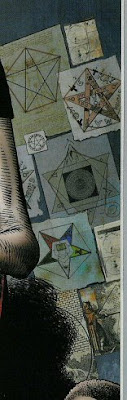
When I saw both these diagrams AND the Pentagon on the same cover I had a pretty good idea where the storyline would be going. I don't recall if I first encountered the "Pentagon-as-magical-containment-device-for-horrible-entity" thing in Principia Discordia or the Illuminatus! trilogy, but it definitely appears as a plot point in the latter. But Morrison manages to make that trick work a second time. He's good at that.
But let's zoom in on one of these pentagrams:

This is funny to me, because that's the emblem of the Order of the Eastern Star, a masonic appendant body. "Appendant body" is Mason lingo for an ritualistic organization that was founded by and/or is subordinate in some way to mainstream "Blue Lodge" masonry. Those scary 33rd degree masons all the conspiracy kooks like to talk about? They get degrees 4 to 33 from the Scottish Rite, one of the more popular appendant bodies. There are literally more appendant bodies than you can keep track of. I'm not sure I could name all the appendant bodies that meet in my own lodge building. Heck, some guys belong to so many they can't recall the names of them all and sometimes they get all the secret passwords and handshakes horribly mixed up. Its kinda funny sometimes, at least when everyone in the room is dedicated to learning lotsa crazy rituals by rote.
During the five years that I was hot and heavy into Freemasonry I was initiated into a lot of appendant bodies myself. I only reached the 32nd degree in the Scottish Rite, so I don't get to help run the New World Order or anything cool like that. Among the other appendant bodies I joined was the Order of the Eastern Star. In fact, I was rather active in my local chapter for a time. My wife was a member as well and that's where we got to know each other. And what is cracking me the hell up about this Doom Patrol cover is that the Eastern Star is one of the most innocuous Masonic orders you're likely to find. The mens-only appendant bodies dress up in crazy costumes, waive swords around, and swear bloody and nonsensical oaths. If you're the kind of conspiracy nut interested in getting frothed up about the Masons, the Scottish Rite and York Rite and Shriners give you plenty of material to work with. The Eastern Star is more like an afternoon tea.

What's the first thing you notice there? Is it Flex Mentallo's superpowered bicep? His leopard-print crotch? (It's okay. I won't tell. Little Flexie was the first thing I spotted as well.) Howzabout the Pentagon he's squatting over? Maybe the waiter from the Tea Room of Desolation caught your eye. All those things leap off the page. But look towards the upper right of the image.

When I saw both these diagrams AND the Pentagon on the same cover I had a pretty good idea where the storyline would be going. I don't recall if I first encountered the "Pentagon-as-magical-containment-device-for-horrible-entity" thing in Principia Discordia or the Illuminatus! trilogy, but it definitely appears as a plot point in the latter. But Morrison manages to make that trick work a second time. He's good at that.
But let's zoom in on one of these pentagrams:

This is funny to me, because that's the emblem of the Order of the Eastern Star, a masonic appendant body. "Appendant body" is Mason lingo for an ritualistic organization that was founded by and/or is subordinate in some way to mainstream "Blue Lodge" masonry. Those scary 33rd degree masons all the conspiracy kooks like to talk about? They get degrees 4 to 33 from the Scottish Rite, one of the more popular appendant bodies. There are literally more appendant bodies than you can keep track of. I'm not sure I could name all the appendant bodies that meet in my own lodge building. Heck, some guys belong to so many they can't recall the names of them all and sometimes they get all the secret passwords and handshakes horribly mixed up. Its kinda funny sometimes, at least when everyone in the room is dedicated to learning lotsa crazy rituals by rote.
During the five years that I was hot and heavy into Freemasonry I was initiated into a lot of appendant bodies myself. I only reached the 32nd degree in the Scottish Rite, so I don't get to help run the New World Order or anything cool like that. Among the other appendant bodies I joined was the Order of the Eastern Star. In fact, I was rather active in my local chapter for a time. My wife was a member as well and that's where we got to know each other. And what is cracking me the hell up about this Doom Patrol cover is that the Eastern Star is one of the most innocuous Masonic orders you're likely to find. The mens-only appendant bodies dress up in crazy costumes, waive swords around, and swear bloody and nonsensical oaths. If you're the kind of conspiracy nut interested in getting frothed up about the Masons, the Scottish Rite and York Rite and Shriners give you plenty of material to work with. The Eastern Star is more like an afternoon tea.
T&T 30 Top 10 part 1
Five Things Jeff Digs About Tunnels & Trolls 30th Anniversary Edition
Cool Classes
The original three T&T classes, the Warrior, Wizard, and Rogue. I've always liked the T&T Rogue, as a simple and elegant jack-of-all-trades implementation. And I love that a Rogue must acquire spells by hook or crook. The Wizards Guild will not cooperate with such upstarts. The new classes are pretty cool, too. The Specialist takes advantage of existing rules to build a straightforward Expert type that can also be spun off into adventuring types. The Citizen is the class for Average Joe types. I'm a huge fan of that kind of character. The only dubious class is the Paragon, which is an uber-class that seems to squeeze the Rogue's niche.
Potions
I was expecting T&T 30th to be full of Liz Danforth illustrations. Her art has dominated every other edition of T&T I've seen over the years. And for good reason; she does great work. But in this case the only Danforth art is the cover painting, which I don't really consider one of her better pieces. But the interiors and the counter art are all by Claudio Pozas. In my opinion Pozas is the single best artist that came to my attention during the 3.x era. Here's the piece he did for T&T that I like best:

I like the clean lines and the naive slice-of-life approach. In some ways it reminds me of Denis Loubet's unparalleled Ultima work. Maybe Loubet wouldn't have put a tattoo on that chick's backside, but I still see some similarities. You can see more of Claudio's T&T work here.
By way of comparison, here is one of my favorite Liz Danforth drawings: Something about a Gremlin about to whip up some sushi just amuses me to no end. Look how pleased he is! On another note, I'd love a font based upon that label.
Wizardry
In previous editions of T&T your Strength score was your magic points. By report this led to weirdo situations where all the PC Wizards tended to be buff gronks. I mean, if you could play a Dwarf (Str x2) and suddenly double your potential spellcasting, why wouldn't you? St. Andre solves this problem by introducing Wizardry, a stat that basically operates like Basic Role-Playing's Power/Magic Points. I'm not huge on bunches of stats on charsheets (HERO System cured me of that), but this seems like a good fix. A fun Wizardry tidbit is that you can't spell-ify someone with a higher Wizardry, but you can work to lower their Wizardry 'til they're vulnerable.
Monsters!
Doc Rotwang! has talked about this one already, but I want to emphasize it again. Making up new T&T monsters is super-easy. You can assign them a single number, Monster Rating, and get on with the fun. Or you can trick them out with some other cute tricks. Special abilities for monster generally emulate spells, so you can just flip through the spell list looking for new powers for your critter. Making monsters is supposed to be one of the fun things GMs get to do, and T&T rivals Mazes & Minotaurs in terms of giving you fun toys to play with.
Cool Classes
The original three T&T classes, the Warrior, Wizard, and Rogue. I've always liked the T&T Rogue, as a simple and elegant jack-of-all-trades implementation. And I love that a Rogue must acquire spells by hook or crook. The Wizards Guild will not cooperate with such upstarts. The new classes are pretty cool, too. The Specialist takes advantage of existing rules to build a straightforward Expert type that can also be spun off into adventuring types. The Citizen is the class for Average Joe types. I'm a huge fan of that kind of character. The only dubious class is the Paragon, which is an uber-class that seems to squeeze the Rogue's niche.
Potions
"Most spells can be infused into potions. Any liquid base may be used: water, juice, milk, liquor, or even blood. Evil types really like to use blood as the basis for the potion. More civilized types prefer brandy while specialists prefer various herbal teas. The Wizards Guild sells two versions of their potions--one in sweetened water and one in brandy. The warriors guild uses brandy and blood for their potions. The Thieves Guild just uses blood. The Merchants Guild uses half a dozen varieties of booze. The Healers Guild uses chicken soup as a basis for everything."Claudio!
I was expecting T&T 30th to be full of Liz Danforth illustrations. Her art has dominated every other edition of T&T I've seen over the years. And for good reason; she does great work. But in this case the only Danforth art is the cover painting, which I don't really consider one of her better pieces. But the interiors and the counter art are all by Claudio Pozas. In my opinion Pozas is the single best artist that came to my attention during the 3.x era. Here's the piece he did for T&T that I like best:

I like the clean lines and the naive slice-of-life approach. In some ways it reminds me of Denis Loubet's unparalleled Ultima work. Maybe Loubet wouldn't have put a tattoo on that chick's backside, but I still see some similarities. You can see more of Claudio's T&T work here.
By way of comparison, here is one of my favorite Liz Danforth drawings:
 Something about a Gremlin about to whip up some sushi just amuses me to no end. Look how pleased he is! On another note, I'd love a font based upon that label.
Wizardry
In previous editions of T&T your Strength score was your magic points. By report this led to weirdo situations where all the PC Wizards tended to be buff gronks. I mean, if you could play a Dwarf (Str x2) and suddenly double your potential spellcasting, why wouldn't you? St. Andre solves this problem by introducing Wizardry, a stat that basically operates like Basic Role-Playing's Power/Magic Points. I'm not huge on bunches of stats on charsheets (HERO System cured me of that), but this seems like a good fix. A fun Wizardry tidbit is that you can't spell-ify someone with a higher Wizardry, but you can work to lower their Wizardry 'til they're vulnerable.
Monsters!
Doc Rotwang! has talked about this one already, but I want to emphasize it again. Making up new T&T monsters is super-easy. You can assign them a single number, Monster Rating, and get on with the fun. Or you can trick them out with some other cute tricks. Special abilities for monster generally emulate spells, so you can just flip through the spell list looking for new powers for your critter. Making monsters is supposed to be one of the fun things GMs get to do, and T&T rivals Mazes & Minotaurs in terms of giving you fun toys to play with.
Monday, June 16, 2008
Quote of the Day
Anyways, I think you're right about D&D. D&D is primal fetishism. It makes relics out of old character sheets and totems out of a stack of hardback rulebooks. The dungeon crawl itself is a ritual with no obligation to make sense beyond the circle of participants. In that sense, it's a lot like a cave painting of some ancient hunt. It's a convergence of random events in a controlled setting that forms the basis of a heroic tale in the minds of the participants. Powerful and primitive social magic that can't be reliably explained but only experienced. And IMO, a much more 'real' experience than the forced plot you see in most 'storyteller' games.
-from Kellri (emphasis mine)
Curse you, Red Baron!
 or Jeff's Review of In Harm's Way: Aces in Spades
I don't really do historical straight historical games. The closest I can come is action movie style adventures where the explosions occur in an earlier time period. When I want to do that I usually look to the Wild West or the Roaring Twenties for bullet-riddled faux history. But ever since my buddy Dave got a copy of Dawn Patrol back in the day I've also had a little thing for World War One flying aces. Since Dawn Patrol not much has come out in the way of roleplaying games about WWI pilots. Clash Bowley of Flying Mice Games fills that void with In Harm's Way: Aces in Spades.
Aces in Spades uses a version of Bowley's "StarCluster" house system, which I believe is named after the first game it appeared in. The basic mechanics strike me as very meat-and-potatoes, but I don't consider that a bad thing at all. You build PCs by buying stats and skills. Skills are assigned percentage of success based upon the level of the skill and the rating of a governing stat. To do things you roll percentage dice. Since most of this is old hat, I'm not going to restate the entire system. Instead I'll focus here on the cool stuff and the few nitpicks I have with the game.
I want to talk about two of the stats you purchase at character generation, Luck and Cl
 ass. I've seen lots of games with various Luck mechanics over the years, and I think I like this one the best. Your Luck is rated 0 to 3 and that number represents the number of times per game year that you get a lucky break. The players suggests the fortuitous event, but it is subject to GM approval. One example is that the pilot of a damaged plane can use Luck to find a clearing in a forest to land his plane. My players balked at the limited "per year" uses, but for a lengthy campaign I could see how you wouldn't want crazy lucky breaks ever freakin' session. Personally, I find it useful not to think of Luck as some form of 'dramatic editing', but rather as Mulligans or Extra Lives or something like that.
Class is a nifty stat because it gives PCs and NPCs alike an excuse to talk some trash, and who doesn't like a little smack talk in their RPGs? More importantly, buying yourself a high Class score gives you a leg up on the other PCs in the hunt for promotions. Which brings us to one of my favorite parts of Aces in Spades. The players all work together to fight enemy squadrons, but they're also in earnest competition with each other for kills, general recognition, medals, mention in dispatches, and promotions. I like games with that kind of dual competitive/cooperative nature. Truth be told, when I'm a player I tend to approach any campaign that way, but that's another post for another day. If you want to play this game but
 need a feel for how the competition could spice up your game, then I heartily recommend the George Peppard film The Blue Max. That movie rocks.
The skill list is a lot longer than I like in pretty much any game, but I like the implementation. Most skills come with but a line or two of description and the text encourages player/GM negotiation for when a skill applies and how it can be used. I like that idea a LOT better than the default assumption in game writing that a skill description needs to outline the exacting totality of its uses. My players were unhappy that the skill system gave their starting characters percentages in the 50% range with meager skill improvements on an annual basis.
As with most games featuring killing things and breaking stuff, combat skills get a little more attention. But those seem pretty straightforward, too. In fact, I'd go so far to say that the only tricky mechanics in the book are the air combat rules. Not surprising in a game about pilots, eh?
Before I get to air combat, I want to tell you about this cute little trick involving percentiles. Initiative is rolled with percentile dice. To-hits are made with percentile dice. Damage is rolled with percentile dice. And you can trade points between them. So I can decide to screw up my inish by -20 and maybe take thrity points off my to-hit roll. But if I hit, I get +50 to damage. Things that would be clunky combat maneuvers in other games (taking extra time to aim, doing an all-out haymaker punch, quickdrawing your pistol) are neatly addressed with simple shifting of bonus points on the three die rolls. I wish I had thought of that.
As I mentioned, plane-on-plane action is the hardest part of the game. Every plane has a control sheet for tracking fuel, maneuvering, and stuff like that. Fifteen planes of WWI are statted out this way. Stones, counters or dice are used to track fuel/energy, kind of like how Nobilis tracks godlike mojo. I can't tell you which was trickier: mentally tracking the movements of several planes to adjudicate who could shoot at whom with what modifiers, or trying to explain the various maneuvers to the players. I pretty sure I screwed both up. But I have no doubt that had I ran more than one session I would have eventually wrapped my head around dogfighting. The initial mental workload was a little harder than most games I play nowadays, but it wasn't a dealbreaker.
Overall, I really enjoyed giving In Harm's Way: Aces in Spades a try. The StarCluster system feels crunchy in the right places but uses a light touch where I like it, too. The book is full of lots of goodies I haven't mentioned, like random charts to determine the quality of your airfield or a table for dicing up plot points. And the list of things that earn you Notice (effectively xp or glory like Pendragon) suggest lots of nifty air adventures.
I'm not sure there are many competitors out there for this particular historical niche. My 1st edition Savage Worlds has some decent dogfight rules, but it lacks the support of stats for a bunch of different era-appropriate planes. Did All Flesh Must Be Eaten ever get a World War One supplement? I recall that being on the drawing board at one point. For a short flying aces campaign I might go with the Savage Worlds, but I'd sure as heck use Aces in Spades as a sourcebook for such an outing. For a longer campaign meant to play out a big chunk of WWI, I'd definitely go with this game. And I wouldn't turn my nose up at any other game powered the Starcluster system.
You can get a PDF version or print-on-demand hardcopy of In Harm's Way: Aces in Spades from Lulu. The electronic version is eleven bucks, while the paper book runs $23.58 plus shipping.

Sunday, June 15, 2008
Futurama Comics #37

Man, I've been busy offline. And my daughter has been monopolizing the computer to play Barbie & The 12 Dancing Princesses.
Actual content next week.
Thursday, June 12, 2008
Roslof!
I consider Erol Otus to be the best thing that ever happened to TSR's art department, but several others are worthy of mention. Like Roslof. Dig these images from the old AD&D Monster Cards:
 Here are two of the wimpiest monsters in the game, a goblin and a kobold, and Roslof does a great job making them scary. I'm going to go out on a limb and say that's the best kobold I've ever seen. The grin, the scales, the claws, the eyes! And I love Roslof's use of color to give weapons and armor a sheen.
 Here are two of the wimpiest monsters in the game, a goblin and a kobold, and Roslof does a great job making them scary. I'm going to go out on a limb and say that's the best kobold I've ever seen. The grin, the scales, the claws, the eyes! And I love Roslof's use of color to give weapons and armor a sheen.
Tuesday, June 10, 2008
five links
Amazon version of the DMG Inspirational Reading List - incomplete but still awesome
The Innovation Party - An interesting technique I'm considering trying out
Star Trek Starship Tactical Combat Simulator On-Line Database & Archive - One of my favorite fan sites of all is back up and running! Yay!
BRUTE!
The Year The Hobby Died - I wish I could laugh this off.
The Innovation Party - An interesting technique I'm considering trying out
Star Trek Starship Tactical Combat Simulator On-Line Database & Archive - One of my favorite fan sites of all is back up and running! Yay!
BRUTE!
The Year The Hobby Died - I wish I could laugh this off.
Monday, June 09, 2008
A Calvalcade of Characters Sheets, part 3
Bart Bolt is the only old PC I have multiple versions for in my records. In all my years of gaming he's the single most successful D&D character I've run starting from zero experience points and working my way up. Bart was created for Dave Dalley's 2nd edition AD&D campaign, originally set in his own setting but later we rode Ziggy's Magic Cabinet to Krynn. To this day I'm not sure if that guy was Ziggy from the comic strip or Ziggy Stardust or both or neither. Dave's campaign almost felt like a buddy action movie at times, with Gopher's highborn swashbuckler Sir Ian Wulfric Belvidere III and my ranger/peasant hero playing off each other's foibles. Too bad that dragon killed Sir Ian near the end of the campaign. He was on a quest to win his true love, too.

I'm pretty sure Bart was one of the first characters I typed up on a Word Processor. I have earlier versions that are hand written. Each of these character write-ups goes to about 5 pages, as I took a LOT of notes. One page lists pretty much every NPC Bart had ever met, another is a diary of monsters killed. The latter was standard on my charsheets at the time, because both my regular DMs were concerned about my PCs acting on monster knowledge that they didn't have but that I knew.
Anyway, rather than bore you with 15 pages of a single character, I thought I'd share some doodles I found on various pages.

"Quelch" was a little no-account town that my crew and I fought tooth and nail to save from all sorts of wandering menaces. I didn't realize it at the time, but it was basically our home town in fantasy drag. Notice "no windows" on the floorplan. Classic player paranoia. The stuffed dragonclaw on the mantle came from the black dragon that killed everyone else in the party. In the last round of combat it was me solo against the dragon, both covered with grievous wounds. We tied initiative. I killed it, but it simultaneously knocked me to exactly zero hit points. Only timely intervention by an NPC allowed me to live to claim that draconic trophy.

An attempt to draw a coat of arms for my dude. He wasn't a knight, but I had hopes. Again with the dragon claw. The hand in the bottom right is actually a white glove with a blue gem on the index finger. That's a token from one of Bart's greatest adventures, when we played through Graeme Morris's epic two-parter UK2 The Sentinel and UK3 The Gauntlet. The item in the bottom left is a warhammer with a Kirby Thor-style lanyard.

The Halo Trees of K'Pushia get their name from their strange circular branches covered in white fluff. I think we went on some sort of adventure to get a Halo Stick and two other items for some sort of magic spell. I have the words "Kirchin Vaolup Leaves" and "Stinking Nelfose Roots" written on that same page. I vaguely remember they were all supposed to end up in a fey cauldron or something.
A Calvalcade of Character Sheets, part 1; part 2

I'm pretty sure Bart was one of the first characters I typed up on a Word Processor. I have earlier versions that are hand written. Each of these character write-ups goes to about 5 pages, as I took a LOT of notes. One page lists pretty much every NPC Bart had ever met, another is a diary of monsters killed. The latter was standard on my charsheets at the time, because both my regular DMs were concerned about my PCs acting on monster knowledge that they didn't have but that I knew.
Anyway, rather than bore you with 15 pages of a single character, I thought I'd share some doodles I found on various pages.

"Quelch" was a little no-account town that my crew and I fought tooth and nail to save from all sorts of wandering menaces. I didn't realize it at the time, but it was basically our home town in fantasy drag. Notice "no windows" on the floorplan. Classic player paranoia. The stuffed dragonclaw on the mantle came from the black dragon that killed everyone else in the party. In the last round of combat it was me solo against the dragon, both covered with grievous wounds. We tied initiative. I killed it, but it simultaneously knocked me to exactly zero hit points. Only timely intervention by an NPC allowed me to live to claim that draconic trophy.

An attempt to draw a coat of arms for my dude. He wasn't a knight, but I had hopes. Again with the dragon claw. The hand in the bottom right is actually a white glove with a blue gem on the index finger. That's a token from one of Bart's greatest adventures, when we played through Graeme Morris's epic two-parter UK2 The Sentinel and UK3 The Gauntlet. The item in the bottom left is a warhammer with a Kirby Thor-style lanyard.

The Halo Trees of K'Pushia get their name from their strange circular branches covered in white fluff. I think we went on some sort of adventure to get a Halo Stick and two other items for some sort of magic spell. I have the words "Kirchin Vaolup Leaves" and "Stinking Nelfose Roots" written on that same page. I vaguely remember they were all supposed to end up in a fey cauldron or something.
A Calvalcade of Character Sheets, part 1; part 2
Sunday, June 08, 2008
Two questions

1) How bad does this suck? 2) What can I change to make it better?
I'm loathe to change the actual graphic thingy, but the text is completely up for grabs.
Saturday, June 07, 2008
My zeroth impressions of 4e
I took my daughter to her favorite eating establishment for dinner. After polishing off our meef quesaritos Elizabeth informed me that she wanted to go to the nearest bookstore. Pages for All Ages has been a favorite bookstore of mine for more than a decade. It has all the amenities of big chain bookstore combined with the personal touch that comes from being locally owned and operated.
(Back in '97 or so they had no problem stocking some obscure stuff for the Masonic reading circle I was running at the time. The other store I contacted for that project wouldn't touch the order unless I promised to personally buy any copies that didn't sell. And that joint was run by a self-proclaimed Brother o' the 3rd degree. Of course, he said he got his degrees in some California lodge. Maybe it was one of those rogue operations they warn you about.)
Anyway, when my daughter asked to go to Pages, I thought to myself Hey, what the hell. I'll use this opportunity to check out the 4e corebooks. Elizabeth browses a bit before picking out a book or three and sometimes she plays with the toys available in the kids area. In the time that took I figured that I could at least flip through the new PHB.
No dice. Or more accurately, no books. The small RPG section had no 4e books. The nearest endcaps had no 4e books. The new releases section had no RPG books. Either they sold out yesterday or they're hiding them or they didn't order any or no one could be bothered to get them out on their street date or the day after. I hadn't expected it to be any problem to find the corebooks at this store. Their RPG section is shrinking, but they still stock new stuff.
I wasn't in any big hurry to take a look at 4e, but now that I've been frustrated once I want it a little bit more. My brain just works that way. Hopefully Armored Gopher (my FLGS) has some copies. I'm going to try to get over there this weekend and take a look at them. Most of what I've read online about 4e has been personally discouraging, but I feel kinda foolish writing off a new edition of D&D without at least looking at the actual books first.
(Back in '97 or so they had no problem stocking some obscure stuff for the Masonic reading circle I was running at the time. The other store I contacted for that project wouldn't touch the order unless I promised to personally buy any copies that didn't sell. And that joint was run by a self-proclaimed Brother o' the 3rd degree. Of course, he said he got his degrees in some California lodge. Maybe it was one of those rogue operations they warn you about.)
Anyway, when my daughter asked to go to Pages, I thought to myself Hey, what the hell. I'll use this opportunity to check out the 4e corebooks. Elizabeth browses a bit before picking out a book or three and sometimes she plays with the toys available in the kids area. In the time that took I figured that I could at least flip through the new PHB.
No dice. Or more accurately, no books. The small RPG section had no 4e books. The nearest endcaps had no 4e books. The new releases section had no RPG books. Either they sold out yesterday or they're hiding them or they didn't order any or no one could be bothered to get them out on their street date or the day after. I hadn't expected it to be any problem to find the corebooks at this store. Their RPG section is shrinking, but they still stock new stuff.
I wasn't in any big hurry to take a look at 4e, but now that I've been frustrated once I want it a little bit more. My brain just works that way. Hopefully Armored Gopher (my FLGS) has some copies. I'm going to try to get over there this weekend and take a look at them. Most of what I've read online about 4e has been personally discouraging, but I feel kinda foolish writing off a new edition of D&D without at least looking at the actual books first.
the mutants of 4chan
Gameblog reader and close personal friend intruder_w reads 4chan so I don't have to. He emails me everything game-related that he suspects I would find interesting. That's very kind of him, because from my vantage point 4chan seems to be about as friendly as the worst attributes of Tangency combined with the best parts of theRPGsite and fed to Something Awful's dog. But it's not all flaming dog turds. Occasionally someone like Doc Aquatic posts something rad. Today the intruder sent me this nifty exchange concerning Mutant Future and Encounter Critical:
Mutant Future Anonymous 06/06/08(Fri)20:01 No.1923671 [Reply]Who knew that anonymous 4chan deviants had such good taste?
Yeah! Finally got in a session of the retro-almost-clone Mutant Future.
Rolled up an awesome mutant – Spark, the Human Bee, with the following
mutations:
Dwarfism
Complete Wing Development
Natural Armor
Body Adjustment
Killing Sphere.
Did not get to kill any spidergoats, but session rocked anyway.
>> Anonymous 06/06/08(Fri)20:06 No.1923730
How does the system work? Retro-clunky or retro-awesome?
>> Anonymous 06/06/08(Fri)20:26 No.1923850
>>1923730
It's pretty much Labyrinth Lord (Moldvay D&D) mechanics adjusted for a
Gamma World-like experience.
Lots of hit points (CON * 1d6/1d8), classless and awesome random mutations.
There's also an appendix (Mazes & Mutants?) outlining how you can
blend Labyrinth Lord and Mutant Future if you want levels to mean more
(in base MF a new level gives you a random bonus, either to hit, to
damage, or to a random attribute).
Yeah. Totally retro-awesome.
It's no Encounter Critical, of course, but what is!
>> Anonymous 06/06/08(Fri)22:14 No.1924471
>>1923850
>It's no Encounter Critical, of course, but what is!
Nothing. Encounter Critical rocks on toast.
Friday, June 06, 2008
Spaceships and Giant Robots
The past few days I've been feeling the urge to break out the old BattleTech stuff for some sci-fi wargamery. Back when this stuff first came out in the eighties B-Tech was a big thing with my group. For a time it rivaled and perhaps even surpassed D&D in our affections. I talked to my  buddy Pat and he seems amenable to the idea of writing up and playing out some scenarios.
I think I'm going to start with some Aerotech action. As far as I can tell this spacefighter add-on to BattleTech never quite caught on. I bought the boxed set when it came out in '86, but my crew never played it. I blame the production values. The playing pieces were standard wargame chits in two colors, not the full-color stand-ups you got with BattleTech. And the map was double-sided doom. The low altitude map, where you could intereact most easily with BattleMechs via strafing and bombing, was blank white with a black hex overlay. It was literally the most boring hexmap you could possibly create.
Meanwhile, just looking at the space map made our balls hurt. The gravity well markers might have been a good idea mechanically, but it discouraged us by looking complicated. Here's one sixth of the space map:

Admittedly, that's the worst sixth of the space map, where the gravity wells of the planet (you can see the atmosphere in the upper right corner) and the moon meet. Even now I look at that map and think Man, I don't want to screw around with that crap. But I'm older and a little bit wiser than I was when this game came out. Nowadays I realize that, hey, I don't have to use FASA's sucky maps if I don't want to. So for space battles we'll use a map that isn't junked up by gravity wells. Either we'll ignore gravity or gin up some easier to use rules, or steal the simple-as-dirt grav rules from Star Frontiers Knight Hawks. And for the low altitude map, welcome to Planet Blitzkrieg, hope you survive the experience:

The Lyran Commonwelath, a.k.a. House Steiner, will be playing the role of the Great Blue defender, while the Draconis Combine (House Kurita) is cast as the Big Red invader. Each hex on the old Blitzkrieg board will equal one BattleTech tactical map, which also happens to be the standard scale for Aerotech planetside operations. B-Tech artillery pieces have ranges measured in mapboards, so we should be able to use some combined arms with this set-up. But we'll start with a simple skyduel involving a couple fighters apiece.
 buddy Pat and he seems amenable to the idea of writing up and playing out some scenarios.
I think I'm going to start with some Aerotech action. As far as I can tell this spacefighter add-on to BattleTech never quite caught on. I bought the boxed set when it came out in '86, but my crew never played it. I blame the production values. The playing pieces were standard wargame chits in two colors, not the full-color stand-ups you got with BattleTech. And the map was double-sided doom. The low altitude map, where you could intereact most easily with BattleMechs via strafing and bombing, was blank white with a black hex overlay. It was literally the most boring hexmap you could possibly create.

Meanwhile, just looking at the space map made our balls hurt. The gravity well markers might have been a good idea mechanically, but it discouraged us by looking complicated. Here's one sixth of the space map:

Admittedly, that's the worst sixth of the space map, where the gravity wells of the planet (you can see the atmosphere in the upper right corner) and the moon meet. Even now I look at that map and think Man, I don't want to screw around with that crap. But I'm older and a little bit wiser than I was when this game came out. Nowadays I realize that, hey, I don't have to use FASA's sucky maps if I don't want to. So for space battles we'll use a map that isn't junked up by gravity wells. Either we'll ignore gravity or gin up some easier to use rules, or steal the simple-as-dirt grav rules from Star Frontiers Knight Hawks. And for the low altitude map, welcome to Planet Blitzkrieg, hope you survive the experience:

The Lyran Commonwelath, a.k.a. House Steiner, will be playing the role of the Great Blue defender, while the Draconis Combine (House Kurita) is cast as the Big Red invader. Each hex on the old Blitzkrieg board will equal one BattleTech tactical map, which also happens to be the standard scale for Aerotech planetside operations. B-Tech artillery pieces have ranges measured in mapboards, so we should be able to use some combined arms with this set-up. But we'll start with a simple skyduel involving a couple fighters apiece.
Thursday, June 05, 2008
So, Exalted.
It's my normal practice to blog about any rpg session I play a day or two after it's over. I didn't do that two weeks ago with session #2 of this new Exalted campaign. And I considered passing on it again this week with session three. I'm feeling very ambivalent about this campaign so far. On the one hand, I've had some great fun. I spent session #2 romancing Ice Princess Ariel and cutting her ex-boyfriend in half with my daiklave. And this week we threw down with the Dragonblooded Mounted Police. I had a slightly better grasp on the combat system this time, and even managed to use some of my charms defensively. Best of all I got out a fairly decent Badass Posturing One-Liner before the fight began. Officer Swordmaiden instructed us to "Leave the restricted area or prepare to die." To which my caveman responded "We choose to die. I'll give you a few minutes to array your troops." The GM was either actually taken aback or roleplayed the hell out of the NPC response.
Still, I got this nagging feeling about the whole affair. Something just isn't clicking for me and I can't quite put my finger on it. Once upon a time I quipped "If it weren't for the setting and the mechanics I would really like Exalted" and now I'm starting to wonder how much I was actually joking. Maybe I like the high concept pitch for Exalted, which Geoff Grabowski once described as "It's all about Jubei fighting M. Bison for the body of Patroklos, and dammit, they can do it on top of the blood-soaked temple of the Sleestaks." But so far the specific implementation of that ideal is not completely working for me.
For example, I find the Charm system to be a little overdone. Every Charm that does 'X' says to me that I can't do 'X' without that Charm. Like when the Mounties had us out-ranged and pulled out their bows. I wanted to throw my giant effin' sword at the mooks and tear through a passle of them with a bloody aerial buzzsaw. But I knew there was a 'throw sword' Charm and I didn't have it. Maybe I should have tried it anyway, but I felt discouraged. A couple of other times I considered trying some godlike shenanigans, but I kept thinking things like "If my caveman from the North actually has to roll my survival skill in the Arctic, then clearly my guy is not half as awesome as I think he is." Maybe the part where we break the setting in half and remake it in the PCs image comes later in the campaign. Right now crossing a few hundred miles of mostly empty wilderness is so hard it takes more sessions than we've played. I honestly expected to have burned down a city or accidentally committed genocide or opened Pandora's box or something like that by this point.
And maybe the whole problem is that this system is just too damn crunchy for what I want to do. I'd much rather roll around Creation like this:
Torgo the Mighty
Achilles with a Daiklave (4) Smooth-talking Ladies Man (3) Polar Bear-Riding Caveman (2) Chief of the Mammoth Tribe (1)
Or instead of Risus, we could use TWERPS and rename Strength to Awesome. That would work.
Maybe it's the setting. Some of it seems so coy to me. Probably I'm just spoiled by Encounter Critical and Arduin and stuff like that, where if the GM wants to put something awesome in the game, there's no need to be shy about it. "You kick in the door and see Cyborg Al Capone. He's got Stormbringer in one hand and a disintegrator pistol in the other. Roll initiative, motherfucker." The Exalted fluff seems to spend a lot of time trying to pretend that it operates differently from that. I don't get it.
I think that's what it comes down to, really. Doug's not doing a bad job. Exalted is not a bad game. I just don't freakin' get it. Maybe with some more sessions under my belt I'll feel less like a stranger in a strange land.
Still, I got this nagging feeling about the whole affair. Something just isn't clicking for me and I can't quite put my finger on it. Once upon a time I quipped "If it weren't for the setting and the mechanics I would really like Exalted" and now I'm starting to wonder how much I was actually joking. Maybe I like the high concept pitch for Exalted, which Geoff Grabowski once described as "It's all about Jubei fighting M. Bison for the body of Patroklos, and dammit, they can do it on top of the blood-soaked temple of the Sleestaks." But so far the specific implementation of that ideal is not completely working for me.
For example, I find the Charm system to be a little overdone. Every Charm that does 'X' says to me that I can't do 'X' without that Charm. Like when the Mounties had us out-ranged and pulled out their bows. I wanted to throw my giant effin' sword at the mooks and tear through a passle of them with a bloody aerial buzzsaw. But I knew there was a 'throw sword' Charm and I didn't have it. Maybe I should have tried it anyway, but I felt discouraged. A couple of other times I considered trying some godlike shenanigans, but I kept thinking things like "If my caveman from the North actually has to roll my survival skill in the Arctic, then clearly my guy is not half as awesome as I think he is." Maybe the part where we break the setting in half and remake it in the PCs image comes later in the campaign. Right now crossing a few hundred miles of mostly empty wilderness is so hard it takes more sessions than we've played. I honestly expected to have burned down a city or accidentally committed genocide or opened Pandora's box or something like that by this point.
And maybe the whole problem is that this system is just too damn crunchy for what I want to do. I'd much rather roll around Creation like this:
Torgo the Mighty
Achilles with a Daiklave (4) Smooth-talking Ladies Man (3) Polar Bear-Riding Caveman (2) Chief of the Mammoth Tribe (1)
Or instead of Risus, we could use TWERPS and rename Strength to Awesome. That would work.
Maybe it's the setting. Some of it seems so coy to me. Probably I'm just spoiled by Encounter Critical and Arduin and stuff like that, where if the GM wants to put something awesome in the game, there's no need to be shy about it. "You kick in the door and see Cyborg Al Capone. He's got Stormbringer in one hand and a disintegrator pistol in the other. Roll initiative, motherfucker." The Exalted fluff seems to spend a lot of time trying to pretend that it operates differently from that. I don't get it.
I think that's what it comes down to, really. Doug's not doing a bad job. Exalted is not a bad game. I just don't freakin' get it. Maybe with some more sessions under my belt I'll feel less like a stranger in a strange land.
Speaking of Fineous Fingers...
While I was looking for that panel where he plays chess with Nergatroid the Dragon, I found the Fineous installment that introduces one of the greatest dwarves of all time:


GIMMELOTS!
Wednesday, June 04, 2008
Answer time!
Here are the answers to the trivia quiz I posted earlier in the week. In the grand tradition of nitpicky gamers, I cheerfully await someone challenging my answers. So fire away!
1) A character would most likely visit the Spinward Marches in what sci-fi game?
C) Traveller
The Spinward Marches would work for lots of different systems, but it was designed for use with Trav.
2) Which RPG system first utilized critical hits in melee combat?
C) Empire of the Petal Throne
3) Which of the following was NOT a commercially released roleplaying game?
B) Mazes & Monsters
Mazes & Monsters was a novel by Rona Jaffe later made into a movie starring a young Tom Hanks. It's all about a guy who gets into RPGs and goes nuts.
4) In which of the following gaming worlds are you most likely to see a character take 10,000 points of damage from a relatively normal attack?
C) World of Synnibarr
Daggers in Synnibbarr do 100 to 400 points of damage, IIRC. Ordinary small arms can do thousands of points. Starting PCs tend to have around 1,000 hp or so. Armor protects in 'tenths'. A suit rated two 'tenths' (like Black Manta's diving suit) cuts incoming damage to 1/100 normal.
5) Which game's earliest edition discussed the possibility of playing a young balrog as a PC?
C) Dungeons & Dragons
It was changed to a dragon after the Tolkien estate got in a snit.
6) Which of the following listed terms would be the more powerful rank in TSR's Marvel Super Heroes game?
A) Amazing
7) Which of the following superhero RPGs has no list of superpowers?
E) Superhero 2044
The authors feared that Marvel and/or DC would kick their asses if they included any powers that replicated popular comic book characters. The setting info is kinda neat, though.
8) Which of the following RPG names is not nor has ever been an abbreviation?
D) RIFTS
9) Who created the Forgotten Realms campaign setting?
C) Ed Greenwood
I know he's responsible for Elminster. Is Drizz't his creation also or was that a later miscreant?
10) What was the name of the dungeon featured in module B1 In Search of the Unknown?
B) Quasqueton
11) In the earliest published reports the gemstone on the Ring of Gaxx had how many facets?
D) 9
I'm pretty sure the Ring of Gaxx first appeared in Eldritch Wizardry.
12) Fineous Fingers once played chess with what kind of monster?
D) dragon

13) What was the first roleplaying game written by Steve Jackson?
A) The Fantasy Trip
14) What company once held the licenses to produce both Star Trek and Dr. Who roleplaying games?
D) FASA
Man, remember when FASA was the king of sci-fi gaming? Good times.
15) Who singlehandedly wrecked havoc in the Temple of Elemental Evil?
B) Robilar
T1-4 includes a brief history of the Temple. One incident recounted is a solo expedition by Robilar. While he was risking his life against the forces of elemental evil, his orcish henchman waited outside. The pig-dude got cold and turned Robilar's carpet of flying into a poncho. I love that story.
16) The Marvel Superheroes module Secret Wars encouraged players to each run a whole team of superheroes, with one exception: one player was assigned a single hero. Which hero was it?
D) Thor
17) Which of the following monsters does NOT appear on the cover art of the original Monster Manual?
D) hydra
18) Which of the following is not a Chaosium RPG?
A) Bushido
Editions of Bushido were released by Tyr Games, Phoenix Games, and FGU.
19) In Pacesetter's Chill RPG, what was the name of the organization the PCs all worked for?
E) SAVE
If you answered 'Clan Gangrel' deduct two points from your score.
20) Which of these companies has released an edition of Chivalry & Sorcery?
C) FGU
21) Which of these early sci-fi RPGs was designed with the assumption that each player takes the role of the captain of their own starship?
D) Starfaring
For more on this trippy game, check out this post.
22) What roleplaying game started as a Metamorphisis Alpha campaign?
B) Skyrealms of Jorune
23) Which of the following was NOT one of the original published quasi-deities?
C) Leomund
The other four all appeared together in Dragon #71, which introduced the quasi-deity concept. Those were some cool characters. I especially like Murylund, who is both a cowboy and a wizard.
24) Which of the following was NOT produced by Fantasy Games Unlimited?
C) Lords of Creation
LoC was a release of The Avalon Hill Game Company.
25) In 4th edition Call of Cthulhu a Diletantte may select how many "profession" skills?
B) 5
26) Judge's Guild produced support products for which of the following games?
E) All of the above
Judges Guild rocks on toast.
27) In Pendragon what determines the number of damage dice rolled for a lance attack?
D) type of horse ridden
28) Complete the following game title: Mercenaries, Spies & _______.
C) Private Eyes
29) What do Castle Falkenstein players use instead of standard dice?
B) playing cards
30) What was the name of the predecessor to Rob Kuntz's Deities & Demigods?
C) Gods, Demigods & Heroes
31) What was the location of the first dungeon adventure?
E) Castle Blackmoor
32) In Toon where do most characters keep their equipment?
B) back pocket
33) What was the name of Aaron Allston's tour-de-force Champions supplement detailing his personal house rules and campaign setting?
E) Strike Force
Technically, the name of the supp was Aaron Allston's Strike Force.
34) "Dr. Kromm" is the moniker of what GURPS guru?
D) Sean Punch
35) What are cannon-fodder level warriors called in Ars Magica?
B) grogs
36) What game resolves most actions by rolling d10 and multiplying it by another d10 roll?
D) Cyborg Commando
37) What island is the setting for Over The Edge?
B) Al Amarja
"Inguria" is the island setting for Superhero 2044. If you gave that as your answer give yourself half a point for being awesome.
38) The Fiend Folio tome compiled monsters mostly from what source?
D) British gamers
Gygax was made an honorary British citizen by the Queen back in '78. True story.
39) What game designer appears on an official Macho Women With Guns counter sheet?
D) Richard Tulcholka
40) What is the name of the rules system designed to be compatible with both Champions and R. Talsorian games?
D) Fuzion
Interlock is the name for the R. Talsorian house system. Fuzion was meant to bridge the gap between Interlock and HERO System.
41) Which game's setting requires dungeon explorers to be licensed, otherwise they are legally considered grave-robbers?
C) Fifth Cycle
The license generally gave a 20% cut to the noble issuing the document and a 20% cut to the king. Royal licenses (whereby the party was directly charted by the king and thus only agreed to a total cut of 20%) were much in demand but rarely issued. I thought the whole concept was very cute, but I have trouble tracking the duration that torches burn and enforcing encumbrance. I'm not sure I could handle another bookkeeping maneuver to pummel PCs.
42) What is the reward given to high-level Lords of Creation characters?
A) ability to create own universe
Demigod status and immortality are lesser rewards.
43) What urban area is the Veiled Society known to haunt?
D) Specularum
Biggest city in the Grand Duchy of Karameikos, the small slice of the Known World (Mystara) that originally appeared in the '81 Expert D&D rulebook.
44) Mayfair released which of the following RPGs?
B) DC Heroes
45) What game are you most likely to encounter a foe carrying a Panther Assault Cannon?
E) Shadowrun
One time I played a troll street samurai armed with one of those. It was pretty cool.
46) Which of these personages is not a wizard?
C) Serten
Erac's Cousin may not have enough MU levels to technically qualify as a wizard, but Serten was a cleric.
47) Which of these games assumes the players are freedom-loving rebels fighting a dastardly empire?
D) Star Ace
48) TWERPS characters are represented by a single attribute. What is it called?
C) Strength
49) Which of these swashbuckling games include rules for playing a centaur?
E) Lace & Steel
I'm pretty sure there was a centaur right on the cover of the edition that was reviewed in Dragon.
50) Which of the following is not a human subspecies?
D) Vargr
There's some wiggle room here regarding the definitions of "subspecies" and "human" but for me it all boils down to the fact that Vargr are dogpeople and the other races are peoplepeople.
SCORING
12- You probably play sports and read People when other nerds aren't looking.
13-25 You might have another hobby, like 40K or videogames or something.
26-39 You had a Dragon subscription in the 80's.
40-49 I suspect you're probably wearing D&D underoos right now. For God's sake, put on some pants!
50 All hail King Nerd.
50.5 I was kidding about the bonus half point, okay?
51+ I bet your fighter has 18/00 strength, too.
1) A character would most likely visit the Spinward Marches in what sci-fi game?
C) Traveller
The Spinward Marches would work for lots of different systems, but it was designed for use with Trav.
2) Which RPG system first utilized critical hits in melee combat?
C) Empire of the Petal Throne
3) Which of the following was NOT a commercially released roleplaying game?
B) Mazes & Monsters
Mazes & Monsters was a novel by Rona Jaffe later made into a movie starring a young Tom Hanks. It's all about a guy who gets into RPGs and goes nuts.
4) In which of the following gaming worlds are you most likely to see a character take 10,000 points of damage from a relatively normal attack?
C) World of Synnibarr
Daggers in Synnibbarr do 100 to 400 points of damage, IIRC. Ordinary small arms can do thousands of points. Starting PCs tend to have around 1,000 hp or so. Armor protects in 'tenths'. A suit rated two 'tenths' (like Black Manta's diving suit) cuts incoming damage to 1/100 normal.
5) Which game's earliest edition discussed the possibility of playing a young balrog as a PC?
C) Dungeons & Dragons
It was changed to a dragon after the Tolkien estate got in a snit.
6) Which of the following listed terms would be the more powerful rank in TSR's Marvel Super Heroes game?
A) Amazing
7) Which of the following superhero RPGs has no list of superpowers?
E) Superhero 2044
The authors feared that Marvel and/or DC would kick their asses if they included any powers that replicated popular comic book characters. The setting info is kinda neat, though.
8) Which of the following RPG names is not nor has ever been an abbreviation?
D) RIFTS
9) Who created the Forgotten Realms campaign setting?
C) Ed Greenwood
I know he's responsible for Elminster. Is Drizz't his creation also or was that a later miscreant?
10) What was the name of the dungeon featured in module B1 In Search of the Unknown?
B) Quasqueton
11) In the earliest published reports the gemstone on the Ring of Gaxx had how many facets?
D) 9
I'm pretty sure the Ring of Gaxx first appeared in Eldritch Wizardry.
12) Fineous Fingers once played chess with what kind of monster?
D) dragon

13) What was the first roleplaying game written by Steve Jackson?
A) The Fantasy Trip
14) What company once held the licenses to produce both Star Trek and Dr. Who roleplaying games?
D) FASA
Man, remember when FASA was the king of sci-fi gaming? Good times.
15) Who singlehandedly wrecked havoc in the Temple of Elemental Evil?
B) Robilar
T1-4 includes a brief history of the Temple. One incident recounted is a solo expedition by Robilar. While he was risking his life against the forces of elemental evil, his orcish henchman waited outside. The pig-dude got cold and turned Robilar's carpet of flying into a poncho. I love that story.
16) The Marvel Superheroes module Secret Wars encouraged players to each run a whole team of superheroes, with one exception: one player was assigned a single hero. Which hero was it?
D) Thor
17) Which of the following monsters does NOT appear on the cover art of the original Monster Manual?
D) hydra
18) Which of the following is not a Chaosium RPG?
A) Bushido
Editions of Bushido were released by Tyr Games, Phoenix Games, and FGU.
19) In Pacesetter's Chill RPG, what was the name of the organization the PCs all worked for?
E) SAVE
If you answered 'Clan Gangrel' deduct two points from your score.
20) Which of these companies has released an edition of Chivalry & Sorcery?
C) FGU
21) Which of these early sci-fi RPGs was designed with the assumption that each player takes the role of the captain of their own starship?
D) Starfaring
For more on this trippy game, check out this post.
22) What roleplaying game started as a Metamorphisis Alpha campaign?
B) Skyrealms of Jorune
23) Which of the following was NOT one of the original published quasi-deities?
C) Leomund
The other four all appeared together in Dragon #71, which introduced the quasi-deity concept. Those were some cool characters. I especially like Murylund, who is both a cowboy and a wizard.
24) Which of the following was NOT produced by Fantasy Games Unlimited?
C) Lords of Creation
LoC was a release of The Avalon Hill Game Company.
25) In 4th edition Call of Cthulhu a Diletantte may select how many "profession" skills?
B) 5
26) Judge's Guild produced support products for which of the following games?
E) All of the above
Judges Guild rocks on toast.
27) In Pendragon what determines the number of damage dice rolled for a lance attack?
D) type of horse ridden
28) Complete the following game title: Mercenaries, Spies & _______.
C) Private Eyes
29) What do Castle Falkenstein players use instead of standard dice?
B) playing cards
30) What was the name of the predecessor to Rob Kuntz's Deities & Demigods?
C) Gods, Demigods & Heroes
31) What was the location of the first dungeon adventure?
E) Castle Blackmoor
32) In Toon where do most characters keep their equipment?
B) back pocket
33) What was the name of Aaron Allston's tour-de-force Champions supplement detailing his personal house rules and campaign setting?
E) Strike Force
Technically, the name of the supp was Aaron Allston's Strike Force.
34) "Dr. Kromm" is the moniker of what GURPS guru?
D) Sean Punch
35) What are cannon-fodder level warriors called in Ars Magica?
B) grogs
36) What game resolves most actions by rolling d10 and multiplying it by another d10 roll?
D) Cyborg Commando
37) What island is the setting for Over The Edge?
B) Al Amarja
"Inguria" is the island setting for Superhero 2044. If you gave that as your answer give yourself half a point for being awesome.
38) The Fiend Folio tome compiled monsters mostly from what source?
D) British gamers
Gygax was made an honorary British citizen by the Queen back in '78. True story.
39) What game designer appears on an official Macho Women With Guns counter sheet?
D) Richard Tulcholka
40) What is the name of the rules system designed to be compatible with both Champions and R. Talsorian games?
D) Fuzion
Interlock is the name for the R. Talsorian house system. Fuzion was meant to bridge the gap between Interlock and HERO System.
41) Which game's setting requires dungeon explorers to be licensed, otherwise they are legally considered grave-robbers?
C) Fifth Cycle
The license generally gave a 20% cut to the noble issuing the document and a 20% cut to the king. Royal licenses (whereby the party was directly charted by the king and thus only agreed to a total cut of 20%) were much in demand but rarely issued. I thought the whole concept was very cute, but I have trouble tracking the duration that torches burn and enforcing encumbrance. I'm not sure I could handle another bookkeeping maneuver to pummel PCs.
42) What is the reward given to high-level Lords of Creation characters?
A) ability to create own universe
Demigod status and immortality are lesser rewards.
43) What urban area is the Veiled Society known to haunt?
D) Specularum
Biggest city in the Grand Duchy of Karameikos, the small slice of the Known World (Mystara) that originally appeared in the '81 Expert D&D rulebook.
44) Mayfair released which of the following RPGs?
B) DC Heroes
45) What game are you most likely to encounter a foe carrying a Panther Assault Cannon?
E) Shadowrun
One time I played a troll street samurai armed with one of those. It was pretty cool.
46) Which of these personages is not a wizard?
C) Serten
Erac's Cousin may not have enough MU levels to technically qualify as a wizard, but Serten was a cleric.
47) Which of these games assumes the players are freedom-loving rebels fighting a dastardly empire?
D) Star Ace
48) TWERPS characters are represented by a single attribute. What is it called?
C) Strength
49) Which of these swashbuckling games include rules for playing a centaur?
E) Lace & Steel
I'm pretty sure there was a centaur right on the cover of the edition that was reviewed in Dragon.
50) Which of the following is not a human subspecies?
D) Vargr
There's some wiggle room here regarding the definitions of "subspecies" and "human" but for me it all boils down to the fact that Vargr are dogpeople and the other races are peoplepeople.
SCORING
12- You probably play sports and read People when other nerds aren't looking.
13-25 You might have another hobby, like 40K or videogames or something.
26-39 You had a Dragon subscription in the 80's.
40-49 I suspect you're probably wearing D&D underoos right now. For God's sake, put on some pants!
50 All hail King Nerd.
50.5 I was kidding about the bonus half point, okay?
51+ I bet your fighter has 18/00 strength, too.
Tuesday, June 03, 2008
"I'm writing this essay to set the record straight."
Over at Grognardia James Maliszewski recently noted that OD&D was not written for general consumption, but primarily for an audience of wargamers. A big conceptual leap from OD&D to Basic and Advanced is the assumption that the people reading the text might not know anything about inches of movement and initiative and crap like that. I pretty much agree with Jamie Mal on this one. But one commenter disputed whether being a hex-and-chit wonk really helped make OD&D more understandable:
But I want to protest against the notion that Ken St. Andre wrote T&T because he couldn't figure out the rules to D&D. I've heard that one before and I don't think it holds up. The title of this post is the first line of a short essay written by St. Andre and appearing in Lawrence Schick's Heroic Worlds: A History and Guide to Role-Playing Games (Prometheus Books, 1991). Here's a lengthy quote:
- Oh yeah, and I don't think people 'just got it' because of the common culture either. Ken St. Andre wrote T&T because he couldn't even figure out the rules, just the idea of dungeon crawling, and he was a fantasy wargamer of the time.Now, I don't disagree with the general point that it was possible to be a wargamer and not understand D&D when it came out. Clearly there were plenty of misunderstandings. Anybody got a handy link to the early review where the dude thought it was played over the phone or something? I can't find it at the moment.
But I want to protest against the notion that Ken St. Andre wrote T&T because he couldn't figure out the rules to D&D. I've heard that one before and I don't think it holds up. The title of this post is the first line of a short essay written by St. Andre and appearing in Lawrence Schick's Heroic Worlds: A History and Guide to Role-Playing Games (Prometheus Books, 1991). Here's a lengthy quote:
Someone brought a copy of the original boxed set of Dungeons & Dragons to a gaming get-together in Scottsdale. No one knew how to play it. The owner was off playing some Avalon Hill wargame, so I sat down with his rules and began reading. I read for about an hour and a half, alternating between feelings of "this is nutty" and "this is great." There was much I did not understand. For example, why have both inteeligence and wisdom? Weren't they pretty much the same thing? Why bother with all these many-sided dice? How was I, or any other normal human being, going to acquire four-, eight- and twenty-sided dice? They didn't exist!I know he explictly says "There was much I did not understand." and "I was pretty confused", but he also criticizes specific mechanics. That doesn't sound to me like a fellow who can't make heads or tails of the rules. What I see is someone who has digested the game sufficiently to question specific design decisions. In terms of the ongoing 'grand debate' regarding whether OD&D sucks or not, St. Andre's grasp of the rules back in 1975 is a trifling point. I just wanted to lay my position on the table because I think the other interpretation sells Mr. St. Andre short. The dude was smart enough to spend 90 minutes with OD&D and then crank out a nifty rpg like Tunnels & Trolls over a long weekend. Everyone should give the guy a little credit.
Yes, I was pretty confused that April evening, but there were a few things that had gotten through. You described your player characters by rolling three dice, you could arm them with weapons that also rolled dice, and you took them into a hole in thr gound to fight monsters and collect treasure. I couldn't play Gygax's game, but I could write one of my own that would make more sense.
Since I was both out of school and out of work, I had time to do it. For the next three days I worked feverishly to put together a rough draft of my version of Dungeons & Dragons. It was written largely as a revolt against Gygax's game. First to go were the funny-sided dice--my game would use all six-sided, which can be obtained from any old Monoploy or Yahtzee game. Next, let's get rid of clerics. Religion was not very important in my life, so why should it clutter up my game? Next, I changed Wisdom to Luck. I didn't understand the function of Wisdom, but Luck was something that everyone needed. Next to go was alignment. Why should characters be Good, Evil, Lawful, Chaotic, or Neutral? In the real world people made their own choices and characters. Hit points? Why bother? Characters already had an attribute called Constitution that would do just as well. Armor class making things more difficult to hit? I didn't understand that at all. Armor obviously would take a fixed amount of damage depending on how good the armor was. Magic? Yes, there must be magic, but I really didn't get into Gygax's magic system.
Who is this guy?
Trollsmyth pointed me to a cool article at the Escapist, which I should read more often. Anyway, dig this quote:
Also in the comments to the article is a link to a blog where an "Associate Professor of Classics at the University of Connecticut, explains how games and gamer culture are much older and better things than most people think." I am so there.
When wargamers assault each other with massive armies of miniatures, they use dice to represent the element of chance in warfare. In the late '60s, a number of wargame designers - Mike Korn in Iowa, Dave Wesley and Dave Arneson in Minnesota, Gary Gygax in Wisconsin - pushed wargaming toward roleplaying.Who the heck is Mike Korn and where can I find out more about him? I know those other dudes, but I don't think I've heard of this Korn fella.
Also in the comments to the article is a link to a blog where an "Associate Professor of Classics at the University of Connecticut, explains how games and gamer culture are much older and better things than most people think." I am so there.
Monday, June 02, 2008
A Good Day To Be A Mutant
2 great new items for fans of gonzo post-apocalyptic games.
- Mutant Future takes the Moldvay D&D Basic mechanics retro-cloned in Labyrinth Lord and makes a new post-apoc game with them. Thundarrific!
- The creepily named Darth Cestual has reworked the random mutation charts from Tweet's Omega World (probably my favoritest thing ever published by Paizo) to make Microlite20 mutations.
Sunday, June 01, 2008
Trivia Time!
Today I've been cleaning and reorganizing the "My Documents" folder on my hard drive. I discovered some old files, including the trivia quiz below. I have no memory of making this, but it's clearly my work. I'll post the answers on Wednesday.
RPG Trivia
1) A character would most likely visit the Spinward Marches in what sci-fi game?
A) Space Opera
B) Star Frontiers
C) Traveller
D) Spacemaster
E) Metamorphisis Alpha
2) Which RPG system first utilized critical hits in melee combat?
A) Dungeons & Dragons
B) Traveller
C) Empire of the Petal Throne
D) Rolemaster
E) Gamma World
3) Which of the following was NOT a commercially released roleplaying game?
A) Bunnies & Burrows
B) Mazes & Monsters
C) Tunnels & Trolls
D) Villains & Vigilantes
E) Powers & Perils
4) In which of the following gaming worlds are you most likely to see a character take 10,000 points of damage from a relatively normal attack?
A) World of Greyhawk
B) World of Darkness
C) World of Synnibarr
D) Worlds of Wonder
E) World of Barador
5) Which game's earliest edition discussed the possibility of playing a young balrog as a PC?
A) MERP
B) GURPS
C) Dungeons & Dragons
D) Rolemaster
E) Tunnels & Trolls
6) Which of the following listed terms would be the more powerful rank in TSR's Marvel Super Heroes game?
A) Amazing
B) Excellent
C) Remarkable
D) Incredible
E) Good
7) Which of the following superhero RPGs has no list of superpowers?
A) Golden Heroes
B) Heroes Unlimited
C) Superworld
D) Villains & Vigilantes
E) Superhero 2044
8) Which of the following RPG names is not nor has ever been an abbreviation?
A) GURPS
B) TWERPS
C) MERP
D) RIFTS
E) FUDGE
9) Who created the Forgotten Realms campaign setting?
A) Marc Miller
B) Gary Gygax
C) Ed Greenwood
D) Dave Arneson
E) Tom Wham
10) What was the name of the dungeon featured in module B1 In Search of the Unknown?
A) Caves of Chaos
B) Quasqueton
C) The Alchemist's Mansion
D) The Haunted Keep
E) Moria
11) In the earliest published reports the gemstone on the Ring of Gaxx had how many facets?
A) 5
B) 6
C) 7
D) 9
E) 13
12) Fineous Fingers once played chess with what kind of monster?
A) troll
B) unicorn
C) lich
D) dragon
E) beholder
13) What was the first roleplaying game written by Steve Jackson?
A) The Fantasy Trip
B) GURPS
C) Macho Women With Guns
D) FUDGE
E) Excursion into the Bizarre
14) What company once held the licenses to produce both Star Trek and Dr. Who roleplaying games?
A) Task Force Games
B) Steve Jackson Games
C) TSR
D) FASA
E) Flying Buffalo
15) Who singlehandedly wrecked havoc in the Temple of Elemental Evil?
A) Mordenkainen
B) Robilar
C) Tenser
D) Erac's Cousin
E) Serten
16) The Marvel Superheroes module Secret Wars encouraged players to each run a whole team of superheroes, with one exception: one player was assigned a single hero. Which hero was it?
A) Spiderman
B) Doctor Strange
C) The Hulk
D) Thor
E) The Beyonder
17) Which of the following monsters does NOT appear on the cover art of the original Monster Manual?
A) dragon
B) purple worm
C) centaur
D) hydra
E) manticore
18) Which of the following is not a Chaosium RPG?
A) Bushido
B) Call of Cthulhu
C) Ringworld
D) Pendragon
E) Nephilim
19) In Pacesetter's Chill RPG, what was the name of the organization the PCs all worked for?
A) The Silver Twilight
B) Clan Gangrel
C) Orion
D) The Scarlet Brotherhood
E) SAVE
20) Which of these companies has released an edition of Chivalry & Sorcery?
A) TSR
B) GDW
C) FGU
D) FASA
E) Chaosium
21) Which of these early sci-fi RPGs was designed with the assumption that each player takes the role of the captain of their own starship?
A) Star Frontiers
B) Traveller
C) Space Opera
D) Starfaring
E) Small Space
22) What roleplaying game started as a Metamorphisis Alpha campaign?
A) Empire of the Petal Throne
B) Skyrealms of Jorune
C) The Morrow Project
D) Aftermath
E) Mechwarrior
23) Which of the following was NOT one of the original published quasi-deities?
A) Muryland
B) Keoghtom
C) Leomund
D) Kelanen
E) Heward
24) Which of the following was NOT produced by Fantasy Games Unlimited?
A) Bunnies & Burrows
B) Villains & Vigilantes
C) Lords of Creation
D) Daredevils
E) Aftermath
25) In 4th edition Call of Cthulhu a Diletantte may select how many "profession" skills?
A) 4
B) 5
C) 6
D) 7
E) 8
26) Judge's Guild produced support products for which of the following games?
A) Traveller
B) Runequest
C) Dungeons & Dragons
D) Monsters! Monsters!
E) All of the above
27) In Pendragon what determines the number of damage dice rolled for a lance attack?
A) rider's strength
B) rider's lance skill
C) type of lance used
D) type of horse ridden
E) all lance attacks do the same damage
28) Complete the following game title: Mercenaries, Spies & _______.
A) Cops
B) Special Forces
C) Private Eyes
D) Thugs
E) Daredevils
29) What do Castle Falkenstein players use instead of standard dice?
A) coin flips
B) playing cards
C) dice with plus and minus signs instead of numbers
D) paper, rock, scissors
E) nothing, its a "diceless" system
30) What was the name of the predecessor to Rob Kuntz's Deities & Demigods?
A) Legends & Lore
B) Man, Myth & Legend
C) Gods, Demigods & Heroes
D) Giants in the Earth
E) Nomad Gods
31) What was the location of the first dungeon adventure?
A) Castle Greyhawk
B) Caves of Chaos
C) Buffalo Castle
D) The Ruined Moathouse
E) Castle Blackmoor
32) In Toon where do most characters keep their equipment?
A) backpack
B) back pocket
C) Wacko Land
D) inkwell
E) utility belt
33) What was the name of Aaron Allston's tour-de-force Champions supplement detailing his personal house rules and campaign setting?
A) Wild Cards
B) Age of Heroes
C) Concrete Jungle
D) Golden Age of Champions
E) Strike Force
34) "Dr. Kromm" is the moniker of what GURPS guru?
A) Kenneth Hite
B) Stefan O'Sullivan
C) S. John Ross
D) Sean Punch
E) Steve Jackson
35) What are cannon-fodder level warriors called in Ars Magica?
A) thugs
B) grogs
C) scrubs
D) trogs
E) mooks
36) What game resolves most actions by rolling d10 and multiplying it by another d10 roll?
A) Swordbearer
B) RIFTS
C) TORG
D) Cyborg Commando
E) Conspiracy X
37) What island is the setting for Over The Edge?
A) R'lyeh
B) Al Amarja
C) Atlantis
D) Isle of Dread
E) Inguria
38) The Fiend Folio tome compiled monsters mostly from what source?
A) TSR modules
B) RPGA members
C) TSR staffers' personal campaigns
D) British gamers
E) out-of-print Dragon issues
39) What game designer appears on an official Macho Women With Guns counter sheet?
A) Marc Miller
B) Gary Gygax
C) Steve Jackson
D) Richard Tulcholka
E) Sandy Peterson
40) What is the name of the rules system designed to be compatible with both Champions and R. Talsorian games?
A) HERO System
B) Interlock
C) Tri-tac
D) Fuzion
E) Mekton
41) Which game's setting requires dungeon explorers to be licensed, otherwise they are legally considered grave-robbers?
A) MERP
B) Runequest
C) Fifth Cycle
D) Phantasy Conclave
E) Powers & Perils
42) What is the reward given to high-level Lords of Creation characters?
A) ability to create own universe
B) ability to override the gamemaster's decisions
C) ability to send an "avatar" on adventures, instead of risking self
D) promotion to demigod status
E) immortality
43) What urban area is the Veiled Society known to haunt?
A) Greyhawk
B) The City-State of the Invincible Overlord
C) Lankhmar
D) Specularum
E) Sigil
44) Mayfair released which of the following RPGs?
A) Twilight 2000
B) DC Heroes
C) Runequest
D) Lords of Creation
E) All of the above
45) What game are you most likely to encounter a foe carrying a Panther Assault Cannon?
A) GURPS Cyberpunk
B) Cyberpunk 2020
C) Cyber HERO
D) Cyberspace
E) Shadowrun
46) Which of these personages is not a wizard?
A) Mordenkainen
B) Bigby
C) Serten
D) Otto
E) Erac's Cousin
47) Which of these games assumes the players are freedom-loving rebels fighting a dastardly empire?
A) Spacemaster
B) Traveller
C) Star Frontiers
D) Star Ace
E) Prime Directive
48) TWERPS characters are represented by a single attribute. What is it called?
A) Prowess
B) Level
C) Strength
D) Chutzpah
E) Aptitude
49) Which of these swashbuckling games include rules for playing a centaur?
A) Flashing Blades
B) En Garde!
C) Skull & Crossbones
D) Pirates!
E) Lace & Steel
50) Which of the following is not a human subspecies?
A) Zhodani
B) Vilani
C) Solomani
D) Vargr
E) Darrian
RPG Trivia
1) A character would most likely visit the Spinward Marches in what sci-fi game?
A) Space Opera
B) Star Frontiers
C) Traveller
D) Spacemaster
E) Metamorphisis Alpha
2) Which RPG system first utilized critical hits in melee combat?
A) Dungeons & Dragons
B) Traveller
C) Empire of the Petal Throne
D) Rolemaster
E) Gamma World
3) Which of the following was NOT a commercially released roleplaying game?
A) Bunnies & Burrows
B) Mazes & Monsters
C) Tunnels & Trolls
D) Villains & Vigilantes
E) Powers & Perils
4) In which of the following gaming worlds are you most likely to see a character take 10,000 points of damage from a relatively normal attack?
A) World of Greyhawk
B) World of Darkness
C) World of Synnibarr
D) Worlds of Wonder
E) World of Barador
5) Which game's earliest edition discussed the possibility of playing a young balrog as a PC?
A) MERP
B) GURPS
C) Dungeons & Dragons
D) Rolemaster
E) Tunnels & Trolls
6) Which of the following listed terms would be the more powerful rank in TSR's Marvel Super Heroes game?
A) Amazing
B) Excellent
C) Remarkable
D) Incredible
E) Good
7) Which of the following superhero RPGs has no list of superpowers?
A) Golden Heroes
B) Heroes Unlimited
C) Superworld
D) Villains & Vigilantes
E) Superhero 2044
8) Which of the following RPG names is not nor has ever been an abbreviation?
A) GURPS
B) TWERPS
C) MERP
D) RIFTS
E) FUDGE
9) Who created the Forgotten Realms campaign setting?
A) Marc Miller
B) Gary Gygax
C) Ed Greenwood
D) Dave Arneson
E) Tom Wham
10) What was the name of the dungeon featured in module B1 In Search of the Unknown?
A) Caves of Chaos
B) Quasqueton
C) The Alchemist's Mansion
D) The Haunted Keep
E) Moria
11) In the earliest published reports the gemstone on the Ring of Gaxx had how many facets?
A) 5
B) 6
C) 7
D) 9
E) 13
12) Fineous Fingers once played chess with what kind of monster?
A) troll
B) unicorn
C) lich
D) dragon
E) beholder
13) What was the first roleplaying game written by Steve Jackson?
A) The Fantasy Trip
B) GURPS
C) Macho Women With Guns
D) FUDGE
E) Excursion into the Bizarre
14) What company once held the licenses to produce both Star Trek and Dr. Who roleplaying games?
A) Task Force Games
B) Steve Jackson Games
C) TSR
D) FASA
E) Flying Buffalo
15) Who singlehandedly wrecked havoc in the Temple of Elemental Evil?
A) Mordenkainen
B) Robilar
C) Tenser
D) Erac's Cousin
E) Serten
16) The Marvel Superheroes module Secret Wars encouraged players to each run a whole team of superheroes, with one exception: one player was assigned a single hero. Which hero was it?
A) Spiderman
B) Doctor Strange
C) The Hulk
D) Thor
E) The Beyonder
17) Which of the following monsters does NOT appear on the cover art of the original Monster Manual?
A) dragon
B) purple worm
C) centaur
D) hydra
E) manticore
18) Which of the following is not a Chaosium RPG?
A) Bushido
B) Call of Cthulhu
C) Ringworld
D) Pendragon
E) Nephilim
19) In Pacesetter's Chill RPG, what was the name of the organization the PCs all worked for?
A) The Silver Twilight
B) Clan Gangrel
C) Orion
D) The Scarlet Brotherhood
E) SAVE
20) Which of these companies has released an edition of Chivalry & Sorcery?
A) TSR
B) GDW
C) FGU
D) FASA
E) Chaosium
21) Which of these early sci-fi RPGs was designed with the assumption that each player takes the role of the captain of their own starship?
A) Star Frontiers
B) Traveller
C) Space Opera
D) Starfaring
E) Small Space
22) What roleplaying game started as a Metamorphisis Alpha campaign?
A) Empire of the Petal Throne
B) Skyrealms of Jorune
C) The Morrow Project
D) Aftermath
E) Mechwarrior
23) Which of the following was NOT one of the original published quasi-deities?
A) Muryland
B) Keoghtom
C) Leomund
D) Kelanen
E) Heward
24) Which of the following was NOT produced by Fantasy Games Unlimited?
A) Bunnies & Burrows
B) Villains & Vigilantes
C) Lords of Creation
D) Daredevils
E) Aftermath
25) In 4th edition Call of Cthulhu a Diletantte may select how many "profession" skills?
A) 4
B) 5
C) 6
D) 7
E) 8
26) Judge's Guild produced support products for which of the following games?
A) Traveller
B) Runequest
C) Dungeons & Dragons
D) Monsters! Monsters!
E) All of the above
27) In Pendragon what determines the number of damage dice rolled for a lance attack?
A) rider's strength
B) rider's lance skill
C) type of lance used
D) type of horse ridden
E) all lance attacks do the same damage
28) Complete the following game title: Mercenaries, Spies & _______.
A) Cops
B) Special Forces
C) Private Eyes
D) Thugs
E) Daredevils
29) What do Castle Falkenstein players use instead of standard dice?
A) coin flips
B) playing cards
C) dice with plus and minus signs instead of numbers
D) paper, rock, scissors
E) nothing, its a "diceless" system
30) What was the name of the predecessor to Rob Kuntz's Deities & Demigods?
A) Legends & Lore
B) Man, Myth & Legend
C) Gods, Demigods & Heroes
D) Giants in the Earth
E) Nomad Gods
31) What was the location of the first dungeon adventure?
A) Castle Greyhawk
B) Caves of Chaos
C) Buffalo Castle
D) The Ruined Moathouse
E) Castle Blackmoor
32) In Toon where do most characters keep their equipment?
A) backpack
B) back pocket
C) Wacko Land
D) inkwell
E) utility belt
33) What was the name of Aaron Allston's tour-de-force Champions supplement detailing his personal house rules and campaign setting?
A) Wild Cards
B) Age of Heroes
C) Concrete Jungle
D) Golden Age of Champions
E) Strike Force
34) "Dr. Kromm" is the moniker of what GURPS guru?
A) Kenneth Hite
B) Stefan O'Sullivan
C) S. John Ross
D) Sean Punch
E) Steve Jackson
35) What are cannon-fodder level warriors called in Ars Magica?
A) thugs
B) grogs
C) scrubs
D) trogs
E) mooks
36) What game resolves most actions by rolling d10 and multiplying it by another d10 roll?
A) Swordbearer
B) RIFTS
C) TORG
D) Cyborg Commando
E) Conspiracy X
37) What island is the setting for Over The Edge?
A) R'lyeh
B) Al Amarja
C) Atlantis
D) Isle of Dread
E) Inguria
38) The Fiend Folio tome compiled monsters mostly from what source?
A) TSR modules
B) RPGA members
C) TSR staffers' personal campaigns
D) British gamers
E) out-of-print Dragon issues
39) What game designer appears on an official Macho Women With Guns counter sheet?
A) Marc Miller
B) Gary Gygax
C) Steve Jackson
D) Richard Tulcholka
E) Sandy Peterson
40) What is the name of the rules system designed to be compatible with both Champions and R. Talsorian games?
A) HERO System
B) Interlock
C) Tri-tac
D) Fuzion
E) Mekton
41) Which game's setting requires dungeon explorers to be licensed, otherwise they are legally considered grave-robbers?
A) MERP
B) Runequest
C) Fifth Cycle
D) Phantasy Conclave
E) Powers & Perils
42) What is the reward given to high-level Lords of Creation characters?
A) ability to create own universe
B) ability to override the gamemaster's decisions
C) ability to send an "avatar" on adventures, instead of risking self
D) promotion to demigod status
E) immortality
43) What urban area is the Veiled Society known to haunt?
A) Greyhawk
B) The City-State of the Invincible Overlord
C) Lankhmar
D) Specularum
E) Sigil
44) Mayfair released which of the following RPGs?
A) Twilight 2000
B) DC Heroes
C) Runequest
D) Lords of Creation
E) All of the above
45) What game are you most likely to encounter a foe carrying a Panther Assault Cannon?
A) GURPS Cyberpunk
B) Cyberpunk 2020
C) Cyber HERO
D) Cyberspace
E) Shadowrun
46) Which of these personages is not a wizard?
A) Mordenkainen
B) Bigby
C) Serten
D) Otto
E) Erac's Cousin
47) Which of these games assumes the players are freedom-loving rebels fighting a dastardly empire?
A) Spacemaster
B) Traveller
C) Star Frontiers
D) Star Ace
E) Prime Directive
48) TWERPS characters are represented by a single attribute. What is it called?
A) Prowess
B) Level
C) Strength
D) Chutzpah
E) Aptitude
49) Which of these swashbuckling games include rules for playing a centaur?
A) Flashing Blades
B) En Garde!
C) Skull & Crossbones
D) Pirates!
E) Lace & Steel
50) Which of the following is not a human subspecies?
A) Zhodani
B) Vilani
C) Solomani
D) Vargr
E) Darrian
Subscribe to:
Posts (Atom)


.jpg)




.JPG)


.jpg)
.png)




.gif)


 Posts
Posts

