Wednesday, July 18, 2012

Reputed entrances to the Dungeons Below Wintoncester

A hole in an old Roman wall at the end of Crap Alley.  It's called Crap Alley because several houses along the south side of High Street are perched over it and anyone passing along the alley are in danger of sewage barrage.
Via the Chapel of St. Oswald in the Assassin's Guildhall.  Not that anyone knows where the Assassin's Guildhall is.
Beyond a triple-barred ironbound door in the cellar of the Wild Boar Tavern.  Old Bert, the proprietor, is said to allow usage of this doorway for a couple gold a head.
Through the torture chamber under Winton Castle.  This is one of the many rumored ways Empress Matilda escaped the siege of 1141.  Ask around, every gabber in the city has their own pet theory.
Under a hatch on the grounds of the Cathedral of St. Swithun.  The Cathedral is relatively new, the old cathedral was demolished to make way for it.  Rumor has it that the entrance to the catacombs are not encompassed by the new floorplan.
Down an ancient well, said to be in a small courtyard between a tavern and a blacksmithy.

Monday, July 16, 2012

Things you should know about Wintoncester

So I'm starting to gear up for a new Wessex-based D&D outing.  This time I'm going to set the game and the dungeon in/under Wintoncester, the biggest and oldest city on the map.  Here are some initial notes on the city.

  • No one knows how many people live there, even though everyone generally agrees Wintoncester is second only to London as far as English cities go.  When the Domesday Book was being prepared Wintoncester and its environs were one of the many places not included in the census.
  • There are no good maps of the place.  Non-natives should expect to be lost much of the time.  Even natives sometimes get lost in the maze of twisted streets, as the medieval and Roman streets are laid out in contradictory grids.  The problem is further exacerbated by by the unpleasantry of 1141 AD, when the forces of King Stephen and Empress Matilda fought within the city and much of it was burned down.  Rebuilding has been haphazard and without much central planning, while many blocks still feature one or more burned-out ruins.
  • The city has been continuously occupied going back to the Anglish, for whom it served as the capitol of the kingdom of Wessex, to the Romans, to the Belgae and the prehistoric Celts.  This being a D&D type campaign, all those people built tunnels of various sorts under the city.
  • The foremost lure for the adventurers are the underground Tombs of the Wessex Kings, where gold and magic await the daring.
  • One of the biggest buildings in the campaign is St. Swithun's Cathedral, right in the heart of the city.  The cathedral is the nominal headquarters of the ruler of the city, the Bishop of Winton, Henry of Blois.  Do not mess with this cat.  He is often call the King Without A Throne and is reputedly the richest man in England.  You don't achieve accolades like that by being a nice guy.
  • Wintoncester has services and institutions not found elsewhere on the campaign hexmap: a hospital, skilled craftsmen, an alchemist or two, a grumpy old sage, an Assassin's Guild and even a semi-secret order of magic-users one can attempt to join.  It's not quite Waterdeep or the Free City of Greyhawk, but for crapsack 12th century fake England it has a lot of possibilities.
  • There are nineteen different establishments that will sell you as many drinks as you can afford.


DCC fighter thoughts

So the Dungeon Crawl Classics RPG gives the fighterly types this thing called an Attack Die.  At first level you get a d3 and it increases in die size as you advance.  You roll this die every time you make an attack, in addition to the standard to-hit roll.  The Attack Die roll has three functions:

1) You add the roll to your to-hit roll.  A 12 on the d20 and a 2 on the d3 means you actually rolled a 14 to-hit.  Note that the Attack Die completely replaces the fighter's Base Attack Bonus.  I.e. A 1st level warrior has a BAB of d3 rather than +1.

2) If your combined roll is a hit, you also get to add the same number rolled to the damage you do to the foe.

3) You can declare a Mighty Deed of Arms, which is basically the stunt system of the game.  If you hit and if you rolled a 3 or higher on your Attack Die, you also pull off your Mighty Deed.

There's a bit more to the Mighty Deed rules we can ignore here, but overall there's some neat stuff happening with these rules.  Clearly you could just bolt these rules directly onto other D&D type games with little difficulty.  In general anything that makes the fighter types feel fresh and interesting seems to be worth investigating further, I think these rules need a little tweaking.

First of all, I don't like the idea of asking someone in a Google+ game to roll a d3 all the dang time.  I can bring extra funky dice to my FLGS games, but I don't think it's fair to expect everyone online to own a d3 or d5 or whatever.  Yes, there are work-arounds such as rolling a d4 and re-rolling 4's or using one of the d6/2 methods, but that just seems clumsy when you are using that faux die with every dang to-hit roll.

Second, I'm not sure I like stunt systems any more.  I'd rather the players just declare awesome actions and we resolve them on the fly.  About the only thing I like about codified stunt rules is that there existence suggests to players that stunts are possible, but there are other ways to communicate that fact,

So here's my idea for adopting the Attack Die to baseline D&D:  Keep the normal to-hit progression for fighter types.  Disallow weapon specialization or any other stuff that would give additional bonuses to fighters.  Instead, all fighters get to roll a d6 with every to-hit roll.  If the roll comes up a 6 then they get either +6 to-hit or +6 damage but not both.  Call it a Mighty Strike or some similar nonsense and Bob's your uncle.

Yeah, a +6 modifier on either roll is pretty big and bad but keep in mind that there will be times when the d20 roll plus 6 will still be a miss.  You could use a d4 and get a 25% chance of +4 to-hit or damage instead of a ~16% chance of +6, but I hate rolling d4s.  Does anyone like those things?

Thursday, July 12, 2012

Dig this bad boy.


This is a modern replica of a 12th century 'bar' style mace fished out of the Thames.

Wednesday, July 11, 2012

Wizardly Wednesday


Thanks to Jeremy Deram for this image!

Tuesday, July 10, 2012

More LotFP contest results: Pro-Am category

Nearly everybody being judged today did their best to tell me how they were really not a professional game artists, but the fact remains that their work was published somewhere prior to the contest.  I created a separate category for these folks to avoid scaring doodlers away from entering the competition, but that really worried some of the entrants here.  What can you do?  Anyway, check these out.
Doc Rotwang!, who totally needs to update his blog, got a laugh out of me here by riffing on Raggi's weird choice of picking a header font with old fashion long s.


Craig Brasco's work here is technically good and I'm as fond of hot dark-haired sorceresses as the next het dude, but from an art direction point of view I just don't see the connection between the text and the illo.  Great pic, but I wouldn't put it on this particular page.


Felipe Budinich's tromp l'oeil approach is a great break from stock fantasy art and the execution is great, too.  Like the witchy gal above, the connection to choosing a name for your PC is a little obscure, unless Felipe is attempting to comment on the strange metafictional nature of RPG characters.  Whether there's a message here or not, I'd love to see a whole game illustrated this way.


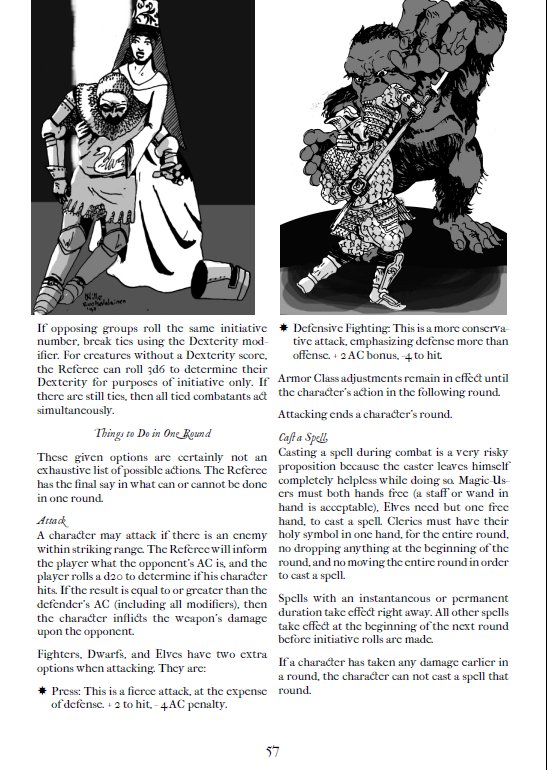
This submission from Wille Ruotsalainen leaves me doubly frustrated.  I want to see the whole illo free of the text and I sure as hell want the text without the illo under it.


Here's another one from Wille.  I like both pics.  Fantasy RPGs need both more princesses in pointy hats and more samurai throwing down with bigass apes.  And I love the choice of a swan on the tabard of the fallen knight.  The discarded helm is a nice touch as well.  The only thing I don't like is that there are two separate illos side-by-side.  If I was the publisher and Wille was hired for art on this page I'd want a redo combining the two pictures.

I love, love, love Jennifer Weigel's pic bugs crawling all over this page.  They remind me of this old Homestar Runner cartoon.  But I hate, hate, hate the idea of covering up the text.


This other Jennifer Weigel illo is just about the best thing ever.  It nicely illustrates one of the spells on the page as well as winking towards Call of Cthulhu.  Cutesifying Cthulhu has gotten really played out in the last decade or so, but Jennifer brings a freshness to the subject that I find irresistible.  And that's why she gets the blue ribbon for this category.

Congratulations Jennifer!  Send me an email with your mailing address and your choice of whether you want the Minibox of Mystery or the Preposterous Miscellaneous as your prize.

The Ten Rings of Qwaar the Axiomatic

These ten enchanted bands are much sought by arcane masters.  Each golden Ring of Qwaar has two functions, the greater of which requiring great wizardly skill to activate.

  1. Ring of Ice - Identifiable by eight small, oblong white stones. - Lesser power: Ice Blast, 3d6 damage, 30' range, 3/day - Greater power (MU 5+): Summon Ice Elemental, 8 HD, who remain and obey wearer for 2d6 turns, 1/day
  2. Ring of Mento-Intensification - One princess cut (square) pale blue stone - Lesser power: Charm Person (old 'no further save' version), 10' range, 1/week - Greater power (MU 3+): Full telepathic contact with Charmed victims at will
  3. Ring of Lightning - One oblong green stone mounted diagonally - Lesser power: Shocking Grasp, 3/day - Greater power (MU 4+): Lightning Bolt, 6d6 damage, 1/day
  4. Ring of Flame - Four oblong red stones - Lesser power: Burning Hands, 3/day - Greater power (MU 3+): Fireball, 6d6 damage, 1/day
  5. Ring of Light - Two small white stones - Lesser power: Light, 3/day - Greater power (MU 1+): Turn Undead as cleric of your same level, 1/day
  6. Ring of Darkness - Eight tiny blue stones - Lesser power: Darkness which wearer can see as if illumined by light, 3/day - Greater power (MU 6+): Summon 2d6 Shadows, who remain and obey wearer for 2d6 turns, 1/day
  7. Ring of Destruction - One square orange stone - Lesser power: Shatter any object the size of door/barrel/etc or smaller, 3/day, magic items allowed save - Greater power (MU 1+): Disintegration, 1/day
  8. Ring of the Vortex - One small blue stone - Lesser power: Floating disc sustain by tiny whirlwind, 3/day - Greater power (MU4+): Whirlwind as per a djinni, 1/day
  9. Ring of Invisible Force - One purple stone cut in the shape of a five-pointed star - Lesser power: unseen servant, 3/day - Greater power (MU 6+): Flamestrike erupts from inside foe, 1/day
  10. Ring of Alchemic Power - One small pink stone - Lesser power: Turn any metal into any other known metal, up to 10 coin weight, 3/day - Greater power (MU 6+): Turn anything of user's mass or less into anything else of user's mass or less, 1/day

Note that none of the Ten Ring of Qwaar the Axiomatic function if the wearer is employing any other type of magic ring, but that all ten Rings of Qwaar will function together just fine.
A rumor among certain sages indicates that the possessor of all ten rings may access the Secret Ultimate Power of Qwaar, but that's probably just scholars conflating the rings with the Rod of Seven Parts.