Polearms & Proust (or, In Search of Lost Biscuits)
-
A very silly role-playing game about introspective thugs with big pointy
sticks. Inspired by this BlueSky post, and written by someone who has never
read P...
Saturday, July 10, 2010
hey, remember this pic?
As I noted in my Gary Con II report, that's a videotape of the "D&D will make you crazy!" flick Mazes & Monsters and a hammer sold as a single lot in the auction. Well, I just found this:
Shatnerday
Mr. Shatner poses here with Ozzie, the character he voiced in the 2006 animated film Over the Hedge.
Friday, July 09, 2010
more morale, please
I can't really pretend to be objective about the '81 D&D Basic Rules. They're the rules I started with and the gold standard to which I hold all other RPGs. On the other hand I'm not so myopic that I can't see why some people would prefer 9 point alignment over Law/Neutral/Chaos, or a class system where an Elf can also be a Thief. Those are perfectly legit options on the broad spectrum of D&D.
Unlike some old schoolers I'm also willing to acknowledge that some WotC-era mechanics have merit. Feats or skills a la 3.x aren't deal-killers in my book. Putting them into the 3.x chargen system grinds my gears, but in isolation both are decent mechanics. And in my current Labyrinth Lord campaign I am seriously considering switching to either 3-fold saves (Fort/Reflex/Will). My group as a whole just doesn't seem to grok the old save system and I think Reflex +4, Target 20 would suit many of them a crapload more. Or maybe I'll go to the single save method from Swords & Wizardry. I dunno.
But Moldvay's morale rules is probably the one D&D Basic mechanic I don't think anyone has ever topped. It's clearly labeled an optional rule and it only takes up half a page (B27 if you want to look it up yourself), but man that half-page packs quite a wallop. I'll summarize for folks who don't have a Basic D&D or LL rulebook handy: Every monster has a morale score in their statblock, rated from 2 to 12. At the first casualty received in combat and at 50% casualties you role 2d6. If you roll over the critter's morale score, the bad guys retreat, withdraw or surrender as adjudicated by the DM.
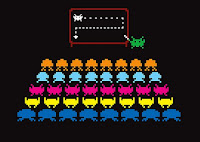
I probably don't need to tell you how big a difference that simple rule can make in play. Far fewer fights are to the death. Smart PCs will boldy strike large groups of scaredy-cats, alpha-striking one poor bastard in hopes of spooking the rest. And since 1gp = 1xp, you still get most of your experience even if the DM is a stingy bastard who holds back points on routed (as opposed to killed) foes. Personally I normally consider routed monsters as 'overcome', which per B22 means they're worth full XP, unless the baddies have a fall-back position nearby or an opportunity to regroup. Either way, the morale rules are a total game changer, especially back when we were all dumb kids and approached combat about as tactically as the aliens in Space Invaders.
In fact, I think the morale rules need to be used more than Moldvay indicates. I often make a morale check for lone monsters when they are first wounded, extrapolating that the initial hit is to single critters what the first man down is to groups. I also think that some monsters should be scared of things besides attrition. For monsters like orcs that have problem with sunlight, a cleric using a surprise round to throw continual light might be enough to scare the bejeesus out of them. And frankly, lycanthropes should run like hell the first time silver is on the playing field. The smart ones will strategically withdraw at the first sign of the stuff, while the dumb ones will be completely shocked that something actually hurt them and run home to their mommas. Similarly, an adventurers boldly brandishing a torch might be able to freak out an entire pack of trolls. In these cases I might not allow a morale check in the monsters' lair, but I treat a lot of wandering monsters as regular joes who happen to work for Chaos. What's their percentage in sticking around to face their one weakness?
And maybe weapons that grant a bonus versus certain monster types just hurt like hell. A sword +1, +3 versus giants may not seem like all that much when you're second level and staring down an 18' tall viking, but maybe it stings so bad that they just won't want to bother squishing you. Especially if the dude knows that the blade you are wielding was the weapon of choice of a long line of giant-slayers.
Heck, in a lowish magic campaign the party wizard might be able to force a morale check out of superstitious peasant or bandits with a minor demonstration of eldritch badassery.
Unlike some old schoolers I'm also willing to acknowledge that some WotC-era mechanics have merit. Feats or skills a la 3.x aren't deal-killers in my book. Putting them into the 3.x chargen system grinds my gears, but in isolation both are decent mechanics. And in my current Labyrinth Lord campaign I am seriously considering switching to either 3-fold saves (Fort/Reflex/Will). My group as a whole just doesn't seem to grok the old save system and I think Reflex +4, Target 20 would suit many of them a crapload more. Or maybe I'll go to the single save method from Swords & Wizardry. I dunno.
But Moldvay's morale rules is probably the one D&D Basic mechanic I don't think anyone has ever topped. It's clearly labeled an optional rule and it only takes up half a page (B27 if you want to look it up yourself), but man that half-page packs quite a wallop. I'll summarize for folks who don't have a Basic D&D or LL rulebook handy: Every monster has a morale score in their statblock, rated from 2 to 12. At the first casualty received in combat and at 50% casualties you role 2d6. If you roll over the critter's morale score, the bad guys retreat, withdraw or surrender as adjudicated by the DM.
I probably don't need to tell you how big a difference that simple rule can make in play. Far fewer fights are to the death. Smart PCs will boldy strike large groups of scaredy-cats, alpha-striking one poor bastard in hopes of spooking the rest. And since 1gp = 1xp, you still get most of your experience even if the DM is a stingy bastard who holds back points on routed (as opposed to killed) foes. Personally I normally consider routed monsters as 'overcome', which per B22 means they're worth full XP, unless the baddies have a fall-back position nearby or an opportunity to regroup. Either way, the morale rules are a total game changer, especially back when we were all dumb kids and approached combat about as tactically as the aliens in Space Invaders.In fact, I think the morale rules need to be used more than Moldvay indicates. I often make a morale check for lone monsters when they are first wounded, extrapolating that the initial hit is to single critters what the first man down is to groups. I also think that some monsters should be scared of things besides attrition. For monsters like orcs that have problem with sunlight, a cleric using a surprise round to throw continual light might be enough to scare the bejeesus out of them. And frankly, lycanthropes should run like hell the first time silver is on the playing field. The smart ones will strategically withdraw at the first sign of the stuff, while the dumb ones will be completely shocked that something actually hurt them and run home to their mommas. Similarly, an adventurers boldly brandishing a torch might be able to freak out an entire pack of trolls. In these cases I might not allow a morale check in the monsters' lair, but I treat a lot of wandering monsters as regular joes who happen to work for Chaos. What's their percentage in sticking around to face their one weakness?
And maybe weapons that grant a bonus versus certain monster types just hurt like hell. A sword +1, +3 versus giants may not seem like all that much when you're second level and staring down an 18' tall viking, but maybe it stings so bad that they just won't want to bother squishing you. Especially if the dude knows that the blade you are wielding was the weapon of choice of a long line of giant-slayers.
Heck, in a lowish magic campaign the party wizard might be able to force a morale check out of superstitious peasant or bandits with a minor demonstration of eldritch badassery.
Wednesday, July 07, 2010
microbyzantium
One of the oldest and oddest miscellaneous links on the ol' Gameblog leads to Ze Ball Breaker Micro-Heros. As far as I can tell, once upon a time some dude used one of the online virtual paper doll thing-a-ma-bobs and a paint program to make his own Spider Jersusalem avatar for a Warren Ellis forum. Some other people, mostly French people initially, thought that was the greatest idea ever and soon were making their own Micro-Hero avatars. Like this:
The poses are all stiff, most Micro-Heros are built off a small pool of body templates, and shading is generally limited to a single additional color. That's why they are hated by many serious comic nerds and precisely why I love the crap out of Micro-Heros. Like the programming magic of HeroMachine, the design ethos of Micro-Heros makes it braindead easy for normal non-artist types like me to participate in creating superhero visuals. Grab a template or one of the zillion already-made figures. Then open it up in MS Paint, hit the Zoom feature and get crackin'. YOU can make your own Micro-Hero. It's that easy. The figures are so small you can edit them one pixel at a time and it doesn't feel like superhard work.
So no more excuses as to why you don't have art for your superhero PC. Hell, there are a few sci-fi and fantasy MH's out there as well if you need help with that sort of thing. Though if you're looking for Starfleet personnel there's a cute little Star Trek paper-doll sort of thing out there that would be perfect. Damned if I can find the link right now.
But the Micro-Hero concept goes from 'dumb but cute' to 'totally insano' with the work of this guy named Razer. He does something called Byzantine style Micro-Heros. Just imagine the 1990's taking a big ol' dump on the costume of your favorite comics character:
Pretty much every Byzantine character sports shoulder spikes of some sort. Ridiculously long loincloths also seem mandatory, except for those rare characters who wear floor-length skirts for no discernable reasons. Weird-ass helmets and from-the-nose-down halfmasks are also common. This is transcendantal nonsense at its finest, my friends.
There's a real opportunity here for some enterprising supers GM. Like Paul Czege's use of alternative superhero naming conventions, adopting a Byzantine design ethos could be a great way to customize a supers campaign. No one would look a palette-swapped Superman, because in your world no self-respecting superhero would dress that way. "Briefs over tights? As if! Everyone knows real heroes wear loincloths!" Mix-and-matching parts from Razer's extensive body of work would make it real easy to come up with new character designs.
Tuesday, July 06, 2010
Monday, July 05, 2010
you gotta be kiddin' me
Everbody here familiar with Noble Knight Games? They're a great online vendor with a huge selection of out-of-print gaming crap. They also carry some new stuff produced by the old school scene, like Jim Raggi's cool stuff. One of the cool features of Noble Knight's website is a Finder service, where if they don't have what you want in stock they will automatically email you when they get a copy in. Their database of out-of-print junk is quite extensive.
So since 2007 I've had a search in place over at Noble Knight, for a crazy old book called Exotic Characters & Worlds. That link is to an old Gameblog post describing the exact place on the awesome/terrible axis you can locate this obscure old game manual. Just today, almost three years later, I get an email from Noble Knight letting me know they have a copy. The problem is, they want ninety-five freakin' bucks for this thing.
So since 2007 I've had a search in place over at Noble Knight, for a crazy old book called Exotic Characters & Worlds. That link is to an old Gameblog post describing the exact place on the awesome/terrible axis you can locate this obscure old game manual. Just today, almost three years later, I get an email from Noble Knight letting me know they have a copy. The problem is, they want ninety-five freakin' bucks for this thing.Now obviously rarity will have an effect on the price of any item, but a rare dog turd is still a pile of poop. And I've never seen anyone claim Exotic Character & Worlds is any good. Quite the opposite in fact. So I'm left wondering exactly how Noble Knight arrived at this $95 price. More specifically, I am now curious of the effect on the pricing of the fact that at least one person had a search out for this book.
I guess I can think of a couple of gaming items I would spend a hundred bucks on. This is not one of them. Maybe that makes me a cheapskate, but I think the real issue here is that despite the big pile of gaming crap I own I've never considered myself a 'collector'. I don't buy anything unless I am entertaining the notion that I might actually use the item at the table. My OD&D books are probably the most beat up copies you're ever likely to see, because I bought the cheapest, crappiest copies I could find. In my mind 'Mint condition' equals 'too good to play with' which equals 'no thanks, I'll wait for a more used copy'.
I suppose I'd spend a hundred bucks on a mint condition OD&D boxed set, but that's only because it'd be a bargain by an order of magnitude or so. The Wilderlands of High Fantasy boxed set is worth that kind of money, despite being a 3.x product. The Great Pendragon Campaign is probably another item I could see myself dropping that kind of dough on. Both of the latter are whole dang campaigns in a box, so I guess nigh-inexhaustible material is one criteria I'd use for top dollar prices.
Then there are the never-published rarities, like the pre-pub manuiscript for OD&D that briefly made the rounds in Lake Geneva while Gary and crew were working the kinks out of the rules. Or the pre-publication edition of the D&D Companion Rules meant to supplement the original '81 Basic/Expert duo. I've seen a grainy photo of a circa 1980 TSR convention display that looked like it had a D&D Companion book on a shelf, but that may be wishful thinking on my part and/or a cover mock-up with no content.
Saturday, July 03, 2010
Ay plegli ianectu flaggen, tupep like for stahn
The internet seems to be seriously lacking a good picture of Captain Kirk and the Yang flag in the same shot.
Subscribe to:
Posts (Atom)