Showing posts with label random charts. Show all posts

Tuesday, March 06, 2018

Let slip the dinos of war.

So here's a fun little chart.
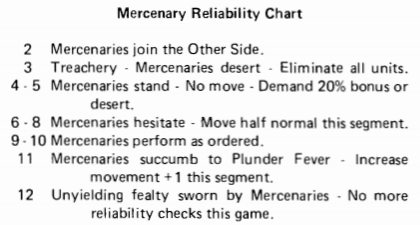
Members of the Mercenaries Guild are more professional than common merc rabbles, and add +2 to the roll.
This delightful chart is from City State Warfare, a boxed hex-and-chit wargame that's part of the original Wilderlands materials.  I've not played it, but a quick read-through of the rules suggests to me that it plays out mostly like an old Avalon Hill game.  Unlike most fantasy wargaming rules, spellcasting is totally abstracted as additional combat factors.  No fireballs lighting up armies, except as part of the math used to calculate attack ratios.  Do the math, roll one die, look at the Combat Results Table (CRT).  Wash, rinse, repeat.  The chart here is cruder than a typical Avalon Hill CRT; you won't find retreat, attacker casualty, or exchange results, only casualties to the defender.  But the principle is the same.

There are several other nice bits though, like the mercenary troubles above.


The triceratops with battle howdah on the cover is the mightiest unit in the game.  Seriously, these guys will wreck your shit.  A high level warrior equivalent to a fighter 8 can sustain 3 hits before going down and has an attack factor of 8.  A triceratops counter can take 5 hits and attacks at rank 30.  Wilderlands referees: if you don't have battle triceratops in your campaign then you've been doing it wrong all these years.  

I also quite like the recruitment charts, which are similar to those in Ready Ref Sheets, but there is a small percentage chance (one sixth of one percent or .00166666) that demons will answer your call to arms.  Then there's the 3d6 random chart for missile troops where a 3 gives you boomerang throwers and an 18 givens you dudes with repeating crossbows.  Centaur-mounted troops is also a random option on the chart for determining what your cavalry rides.  Add in the lovely Reason for Enlisting chart and you could end up accidentally recruiting a band of boomerang-throwing demons who ride centaurs into battle and the reason they signed up for your war is that they were all drunk.  How cool is that?  (I'm not saying that's a likely result, merely mathematically possible.)

 Although the abstracted combat system does take the spice out of wizards and whatnot, it also allows for this lovely chart to account for a number of additional factors.

There's also rules for night fighting that account for the phase of the moon, rules for press gangs (including the delightfully named Goon Squad Antics table), and a chart for determining the fate of eliminated units (i.e. a killed chit doesn't mean everyone in the unit is dead).  Sadly, the Leader Recovery Chart does not include a 1 in 36 chance that a demon stole their soul and now you have to mount an expedition to Hell to get it back.  That's my favorite thing about the similar table in Ral Partha's Chaos Wars rules.  But the Leader Recovery Chart here does the possibility of losing an eye or limb as well as a chance that they were captured and can be ransomed for 2d6 times their monthly salary.  Then there's a nice page of charts for when your PCs are not yet army commanders but of high enough level they can be sent out on special missions of various sorts.

The scenarios section includes more historical battles than fantasy ones.  This product came out in 1982, just as D&D was busting out big as a media franchise.  It was still possible in this period to imagine that someone who needed rules for triceratops versus wizard battles might also want to play out Charley Martel stomping on the Arabs at Tours or Bill the Bastard conquering England.

But let's take a peak at the fantasy scenarios.  I'm going to transcribe the intro to the Battle of Pipeweed Farm in its entirety:

Pipeweed Farm

The engagement took place in the Decatur Fantasy Campaign World between the forces of the Chang of the Ryne and Warlord Marchan of the Northern Empire.  This day-long battle witnessed the capture of the Chang and the destruction of over one half of his army.  These events led to the siege and capture of the capital, Jasmire.
The relationship between the Decatur Fantasy Campaign World and Bob Bledsaw's Wilderlands material is obscure to me.  I'm no Wilderlands expert by any means.  Can one travel from the City State to the Changdom of the Ryne?  Is the relationship like that of the Lake Geneva campaign setting and the later World of Greyhawk?  I just don't know.

Here are the forces involved, if you want to recreate this battle with another ruleset.

Forces of the Northern Empire

The Immortals
10x Cataphracts (heavy cav w/bows)
10x Horse Bow (light cav w/bows)
1x High Level Warrior (the Warlord Marchan, presumably) (mounted, plate)

Group Tor
8x Triceratops
8x War Elephants
1 x High Level Warrior

Main Body
20x Heavy Foot
10x Armoured Foot
10x Crossbowmen
10x Longbowmen
10x Light Cavalry
10x Medium Cavalry
10x Heavy Cavalry
8x Heavy Crossbow
2x Onagers
4x Ballista
2x Medium Level Warriors (equivalent to ~F4) (mounted, plate)
2x High Level Wizard (~MU8) (mounted)

Forces of the Chang of the Ryne

The Black Flowers
16x Ogres
16x Trolls
4x Hill Giants
1x High Level Priest (~C8) (mounted, plate) (The Chang?)

Goblin Horde
20x Goblin Foot
20x Goblin Bow
20x Goblin Wolf Riders (with bows)
1x High Level Warrior

Main Body
20x Light Foot
10x Heavy Foot
6x Armored Foot
20x Shortbow
10x Crossbowmen
10x Horse Bow
10x Heavy Cavalry
2x Low Level Warrior (~F2) (chain, on foot)
1x Medium Level Warrior
1x High Level Warrior (or is this the Chang?)

According to earlier in the rules, one counter represents 20 soldiers, 10 cavalry, 10 ogres, 10 trolls, 2 elephants, 2 triceratops, 1 leader, 1 giant, or 1 warmachine.  That means there are 160 trolls and 160 ogres in this battle!  Yikes!

Somewhere there's got to be a Games
Workshop elf that looks like this guy.
The other fantasy battles are more recognizable to a Wilderlands fan.  If you're going to play a fighter in a Wilderlands campaign, maybe you could put in your background that you fought in one or more of these three battles.

The Battle of Jarmoco features the Vasthost of the Invincible Overlord repelling an invading horde of goblins.  The goblins have a surprising number of hero figures (2 low level warriors, 2 medium level warriors, 1 high level warrior, 2 high level wizards).  The text does not specify the race of these figures, so I assume they are meant to be above average gobbos.  The Battle of Bellystone Ford is a rematch, as the Goblin King attempts to gain revenge for his defeat at Jarmoco.  The Battle of Ukrak Morfut pits the Invincible Overlord against his liege/rival, the World Emperor.  Is there a place called Tenoch on one of the Wilderlands campaign maps?  The intro mentions they met near this location.  The order of battle also notes that the World Emperor's longbowmen get a one pip bonus when shooting.  Since attacks are on a d6 combat matrix, those guys must be legendarily good.  Also worth mentioning, the Overlord's armies include 10 goblin foot and 10 goblin warg riders.  Maybe the defeated Goblin King owes the Overlord a feudal obligation now?  The intro states that "historically" that the Overlord lost this battle and was forced to pay tribute to the World Emperor that year.

Finally, I should note that none of the three Wilderlands battles actually feature triceratops troops, so those may be a holdover from the earlier Decatur Fantasy Campaign World mentioned above.  I was just kidding about you doing it wrong anyway.  But still, don't you think the Wilderlands could use some battle triceratops stomping about the place?

TSR would get into the battle dino business 3 years later.

Monday, May 13, 2013

Vanthian Prior Career Charts

WARRIOR
01-05 God City Starmerc
06-10 member of a Blackhawk Free Company (50% license revoked)
11-15 survivor of General Zo's Thunder Legion (34% suspected of treachery)
16-20 member of disbanded Steel Warlords Bastard Band (choose instrument)
21-25 Knight in service to the Lord of Crane
26-30 Knight in service to the Lord of Noth
31-35 Knight in service to the Hoarfrost King
36-40 Knight in service to the Zombie Princess
41-44 soldier in the Invincible Hosts of the Hobling Emperor
45-48 Viraxian Stormtrooper
49-52 God City Militia (half starting money)
53-56 Waepetian Palisade Guard
57-60 Sulduku Dervish (5% hunted by Holy Assassins)
61-63 Shunned Towns Axe Murderer (25% license revoked)
64-67 Phasic Swampwretch
68-70 Bleak Mountains Maniac
71-73 God City Sewer Psycho
74-77 Forbidden Wastes Road Warrior (12% bike)
78-80 Dino Islands Ape Cultist
81-87 Parathaxian Horde survivor (7% scarred)
88-93 Northern Mountain Hillbilly
94-00 Funfair Nomad

WARLOCK
01-03 Shunned Towns Unholy Roller (3% unicycle)
04-07 Phasic Swampwitch
08-11 Bleak Mountains Hermit
12-14 God City Voice Hearer (11% others can hear)
15-18 Dino Islands Kongpope
19-22 Forbidden Wastes Omega Zealot
23-25 Parathaxian Schismatic
26-29 Northern Mountain Wendigo Whisperer
30-33 Funfair Tent Revivalist
34-40 studied under an Ape Vizier
41-46 washed out of Waepetian College of Sorcery
47-53 Associates Degree for the Mystic Arts, Blackhawk Community College (8% fake)
54-60 Viraxian Illuminati (77% renegade)
61-67 studied at the Nothian Tower of Ensorcelment (54% outcast)
68-75 God City Computomage
76-83 Suldukan Glyph Master
84-91 Dreamer at the Angel Barrows
92-00 Funfair Tattoomancer

CRIMINAL
01-09 Minor scion of a Slaver King (6% legitimate)
10-17 Funfair Freak Wrangler
18-25 Limbjacker (7% d3 spare limbs)
26-33 Ice Pimp
34-39 Suldukan Hashisheen (d6 doses)
40-47 God City Made Man
48-55 Blackhawk Thieves Guildman
56-63 Viraxian Killsquadder
64-68 West Road Toll Collector
69-73 Blacksteel Buccaneer
74-78 Spineywood Merryman
79-84 Unknown Highwayman
85-88 Bloodhaven Sausage Maker
89-92 God City Punker
93-96 Funfair Roustabout
97-00 Faerie Smuggler

DOXY
01-05 God City Socialator
06-10 Icy Lake Houri
11-15 Blackhawk Streetwalker
16-20 Surprise Limb Lady (d3 random limbs)
21-25 Bloodhaven Wench
26-30 Iron Kingdom Beardlass (free false beard if needed)
31-36 Viraxian Harem Girl
37-42 Waepetian Nymphomancer
43-50 Suldukan Nun (2% flying)
51-55 Priss Class Replicant (cyaborg if not robodroid)
56-61 Galaxinoid Astrobabe (cyaborg if not robodroid)
62-67 Rogue Fembot (cyaborg if not robodroid)
68-75 Recalled Massage Droid (cyaborg if not robodroid)
76-80 Suldukan Blessed Ballerina (57% tutu)
81-85 Dino Islands Hula Girl
86-90 Funfair Tattoo Lady
91-95 God City Valley Girl
96-00 Junktech Gypsy Hootchie Mama

PIONEER
01-07 Fissure Guide
08-13 Cave Unhider
14-20 Iron Poacher
21-27 Grounded Spacehopper
28-33 Astro-Scout
34-40 God City Upstation Techno
41-47 Mountaineer, Northern
48-53 Mountaineer, Bleak
54-60 Deadly Mountaineer, Southern
61-65 Salty Bay Seadog
66-70 Dino Islands Paddleboater
71-75 Icy Lake Kayaker
76-80 Sailor on the Sea of Great Peril
81-87 Junktech Gypsy
88-93 Galactic Hitchhiker (50% towel)
94-00 Mysterious Strider (34% hooded cloak)

PSI WITCH
01-15 True Psi Witch
16-29 Esper Corps Cadet
30-43 Vulkinian Academy washout
44-60 Psychic Wars veteran (12% wanted for mindcrimes)
61-75 Hedge Psychic
76-92 squire to a Galactic Psiknight (3% phasic prismatic sword)
93-00 Hypermind Fragment

Tuesday, June 19, 2012

The Mutant with the Bionic Nose


Here's a crazy chart from Brian Blume, written for when your Metamorphosis Alpha mutant wanders into an operational bionics lab.  This is one of those tiny little quarter page articles that appeared in the earliest issues of the The Dragon.  In this case, it's issue #13, April 1978.

Die Roll/Replacement/Hit Points/Effect
1-3 One Arm 10 Increases strength. +1 die of damage
4-6 One Leg 10 Increases strength. -1 for opponent to hit. Double speed if both legs.
7-8 One Eye 5 Infra Red & Ultra Violet vision. As Heigh. vision if both eyes.
9-10 One Ear 5 May hear above & below normal ranges. As Heigh. hearing if both ears.
11 Nose 5 As Heigh. smell.
12 Heart 5 Reduces fatigue. 
13 Lungs 5 May extract oxygen from water.
14 Digestion 5 May live on rocks, sand, etc.
15-17 Brain 10 50% chance to forget any given fact or item’s operation each occasion (defect).
18-20 Torso 30 -2 to hit for both player and his opponents.

I don't have a copy of MA in front of me, but Heightened Vision, Hearing and Smell are undoubtedly on the mutations charts.

Does anyone else love how getting a bionic brain is a bad thing?

Monday, June 18, 2012

"WHY CAN'T YOU KILL THE VILLAIN A NORMAL WAY?" TABLE (d12)

As requested by Zak's Magic RPG 8-Ball.

1. SIDEWAYS IN TIME - Always reincarnates into new form d6 turns after death. Perhaps a Time Lord can assist in cleaning this mess up?
2. ALREADY DEAD - Not a lich, this S.O.B. actually clawed his way back from UltraHades.  Will have to be escorted back to the realm of the dead and incarcerated in Hellking Plutodaemon's Black Adamantine Prison.  But will the Hellking let the PCs back out?
3. DOOMBOTS - The real villain is safely in his lair in the middle of their own personal postage stamp country, somewhere across the ocean.
4. HYPERDIMENSIONAL BODY - What the PCs see is simply the 3-D limb of some fourth or higher dimensional jerkwad.  The 3D body has no vital organs in it.  Perhaps True Seeing or Etherealness can help find a stabbable hyperspleen lurking in N-space.
5. EVIL VIRUS - As villain dies they cough up blood on nearest PC, who becomes the new villain after 2-3 days of flulike symptoms.
6. TRANSGENDER NAZGULISM - Prophecy says villain can be killed by neither males nor females.
7. THAT KRISHNA IS SUCH A CUT-UP - Villain is actually some high-ranking cosmic being trying to teach one of the PCs some obscure point about karma or honor or the circle of life or some crap like that.
8. SOME CRAZY POMO META STUPIDITY - Villain removes mask to reveal he is a fictional character from some novel.  PCs will be unable to kill the villain until they come to terms with their own fictionality.
9. SERIOUS X-MEN SERIOUSNESS - Villain is secretly one of the PC's ancestors, brought to the present by giant time-travelling robots or something.  Kill the villain and the PC ceases to exist, totally wrecking the whole dang campaign world.
10. ACHILLES' JAZZ - Only a critical strike to one secret place will actually hurt this dillweed.  You ever see the kung fu movie Invincible Armor?  The villain could use his kung fu to pull something similar and actually chose to leave his nutsack vulnerable.  That did not end well.
11.  ME AND MY VILLAIN - The villain is actually the shadow of the beardy old wizard or whatever that sent the PCs on this crazy mission seven sessions back.  Maybe they will need to figure out a way to sharpen the shadows of their swords, create spells like shadowball and shadow missile, etc.
12. AWWWWW - Villain is secretly a cute little puppy.

Thursday, June 07, 2012

Giants in the Dying Earth

Once upon a time there was a great gaming magazine called The Dragon, published by a long defunct game company called TSR.  Although its main focus was D&D, in its heyday The Dragon was the definitivee magazine for the entire RPG hobby. Man, those were the days.  During this long-gone golden age there was a regular feature in the mag called "Giants in the Earth".  The title is a Biblical reference, in Genesis chapter 6 these mysterious giants in the earth father a race of half-humans, "the same became mighty men who were of old, men of renown". The articles, which ran from about the mid-twenties to issue fifty-something, as I recall, did not deal with literal giants. Rather they statted up legendary figures from the popular fantasy novels of the era. Nowadays you couldn't get away with that in a legitimate journal, what with our society's growing obsession with intellectual property.  But those were different, weird times.

Anyway, today I wanted to share with you selections from a couple installments in the GitE series, particularly the two instances where Jack Vance's characters are written up in D&D terms.  Since Vancian magic is and pretty much always been a hot button topic in D&D fandom, I find it interesting how some actual Vance characters, and, more importantly, their magical abilities, end up translated into D&D terms.

That's a friggin' Napoleonics
game featured on the cover.
Truly, 'tis a lost era.
First up is Cugel the Clever, star of the third book in the Dying Earth series, Cugel's Saga.  He also appears in Eyes of the Overworld, I believe.  I've never read that one.  Cugel's uncredited (probably by Lawrence Schick and/or Tom Moldvay) write-up in The Dragon #26 (June '79) pegs him as a Thief level 14 with 18 Intelligence and Dexterity.  I believe this article might be the first installment and it really sets the high-power standards for the series.  Also in the article is a version of Karl Edward Wagner's Kane, done as a Fighter 30/Magic-User 20/Assassin 14 with 2 eighteens, a seventeen and a nineteen in his stats.  Anyway, dig this neato passage:
Cugel once had access to the notebooks of lucounu, the Laughing Magician, and managed with great effort to memorize three spells. These are: Felojun’s Second Hypnotic Spell (treat as a hold person), Phandaal’s Mantle of Stealth (by which the caster can be neither seen, heard, nor smelled) and Thasdrubel’s Laganetic Transfer (or The Agency of Far Despatch, which places a hold person on the target until a demon comes and carries him away to some specified far land). Unfortunately, Cugel doesn’t always get the spells right and there is a 50% chance that any spell he uses will backfire and cause the opposite of the intended effect. Every time he blows the Laganetic Transfer he himself gets carried away somewhere else, which is probably how he came to the D&D universe in the first place.
Dig those neato spell names.  Cugel's peek at Iocounu's spellbooks is one of the origins of the thiefly Read Scrolls ability, along with similar shenanigans from the Grey Mouser, if I recall correctly.  The other thing to note here is that not only are the spell descriptions super-brief, they have no level assigned to them.  For an oddball NPC thief that may or may not even have these spells in memory when encountered, this isn't exactly a big deal.  But I always look at articles like this for things to steal for my campaign, so as a kid this lack of detail annoyed me.


Issue #29 follows up with stats for Iucounu the Laughing Magician himself.  This wee git is represented by Lawrence Schick and Tom Moldvay as an MU 20 with an Int 18.  More importantly, despite his level he will only know five spells when encountered, rolled up from the following kickass chart:
1-2: The Charm of Forlorn Encystment: this is the same in all respects as the 9th level magic-user’s spell imprisonment.  
3: The Charm of Untiring Nourishment: by speaking this charm, the magic-user need not breathe, eat or drink while the spell lasts. Duration: 1 turn/level. Casting time: 2 segments.  
4-5: The Excellent Prismatic Spray: This is the same as the illusionist’s 7th level spell in all respects save casting time, which is only 3 segments.  
6: Felojun’s Second Hypnotic Spell: a paralysis spell. Range: 1”/ level. Duration: 1 round/level. Area of effect: 4” diameter sphere. Casting time: 1 segment. Saving throw: neg.  
7: Gilgad’s Instantaneous Galvanic Thrust or the Instantaneous  Electric Effort: this is the same as a lightning bolt in all respects save  casting time, which is only 1 segment.  
8: Houlart’s Blue Extractive: this spell is used to remove a being from its refuge or concealment. If the target fails to save, it will simply fly from its hiding place and land at the feet of the caster. Any being so treated will be stunned for 2-12 rounds. Range: 1”/level. Casting time: 5 rounds. Saving throw: neg.  
9: Houlart’s Visceral Pang: the recipient of this spell will be totally incapacitated by excruciating pains in the abdomen for 1-3 rounds. Range: 9”. Area of effect: 1 creature. Casting time: 2 segments. Saving throw: none.  
10: Lugwiler’s Dismal Itch: the recipient of this spell is cursed with a continual itching over every square inch of his or her epidermis. When in this condition, armor class is two levels worse, all fighting is done at -5, and spell use is impossible. Range: 6”. Duration: until dispelled (remove curse will also work.) Area of effect: 1 creature. Casting time: 3 segments. Saving throw: neg.  
11: Phandaal’s Critique of the Chill: this is the same as the cone of cold spell in all respects save casting time, which is only 3 segments.  
12: Phandaal’s Gyrator: the unfortunate target of this spell is levitated into the air and spun about at any speed the caster desires. At the fastest possible rate of spin, the spinner will take 10 hit points of damage per round due to the centrifugal forces involved. Controlling the spell requires great concentration on the part of the caster. If the concentration is broken, the spell dissipates. Range: 6”. Duration: 1 round/level.  Area of effect: 1 creature. Casting time: 5 segments. Saving throw: none.  
13-14: Phandaal’s Mantle of Stealth: the caster of this spell is rendered invisible, inaudible and odorless; virtually indetectable save to true seeing, a robe of eyes or a gem of seeing (and touch). Any attempts at offensive action on the part of the recipient instantly negate the spell (as with invisibility). Duration: 1 round/level. Area of effect: creature touched. Casting time: 2 segments.  
15: Rhialto’s Green Turmoil: the recipient of this spell is overcome with a violent nausea which totally incapacitates him or her for 2-20 rounds. Range: 5”. Area of effect: 1 creature. Casting time: 2 segments. Saving throw: neg.  
16: Spell of the Macroid Toe: in this specialized polymorph spell, the big toe (or similar extremity) of the creature affected grows to the size of a small house. Range: 4”. Duration: until dispelled. Casting time: 4 segments. Saving throw: neg.  
17: Spell of the Omnipotent Sphere: this combines the effects of the magic-user’s spell anti-magic shell with those of a cube of force. It is a near-total (but non-mobile) protection for the caster. Duration: 1 round/level. Area of effect: 10’ diameter sphere. Casting time: 9 segments.  
18: Spell of the Slow Hour: this spell is similar to the magic-user’s spell, slow, except that it is twice as efficient, and slows the affected creatures to one-quarter the normal or current rate. In all other respects (range, duration, etc.) it is the same.  
19: Temporal Stasis: this spell duplicates the 9th level magic-users’ spell time stop in all respects save name.  
20: Thasdrubel’s Laganetic Transfer or the Agency of Far Despatch: when this spell is uttered, the recipient is bound as if by a hold person spell. A nycadaemon appears (i.e., is gated in), grasps the held recipient and flies him or her either to a point designated by the caster or 10-100 miles in a random direction. Range: 3”. Area of effect: 1 creature. Casting time: 1 round. Saving throw: none. 
This part of the article was obviously written by Law Schick, as that guy is the only person I ever heard of who ever really cared about segments of action.  Well, maybe Len Lakofka liked 'em, too.

Some, off the top of my head uses for the chart:
  • Spells for Encounter Critical, which eschew levels already.
  • Third level spells for a Holmes-only campaign.
  • Spells that appear on ancient scrolls that pre-date spells being divided up into levels.
  • Random crap bad guy wizards can throw at the party, the same sort of jerks who use the coolest random chart ever written.
Any other ideas?

Monday, May 28, 2012

not spellbooks, books about spells

Dragon #82 (Feb '84) has one of my all-time favorite random charts, located in Bruce Heard's pretty dang cool article on spell research, "Spells Between the Covers: Details for Delving into Magical Research".  The chart that I love is this d100 list of what I tend to think of as "almost spellbooks".  Each entry is an academic treatise written by a famous or not-so-famous wizard.  Each book lists a few spells that are mentioned in the book or that the books might be helpful in developing.  These spells are not simply sitting in these books in complete form, waiting to be copied out by eager PC magic-users.  Rather the books contain clues that can aid in research, to the tune of up to +10% bonus to your research roll.  Dig up the original article for all the details.  Any, here's the chart in full.  Below the chart I'll offer an alternative use for it.  Dig it:

01-02. Idioms & Rare Cryptographs by Elminster (message, write, illusionary script, tongues, audible glamer, magic mouth)
03. Legendry of Phantoms and Ghosts by Evard (phantom armor, phantom steed, phantom wind, Evard's black tentacle, wraithform)
04. Lore of Subtle Communication by Tasha (ventriloquism, message, comprehend languages, legend lore, Tasha.s uncontrollable hideous laughter)
05-06. Ancient Cryptomancy by Phandal (sending, wizard mark, secret page, sepia snake sigil)
07-08. Extreme Powers of Observation by Kwalish (detect magic, detect illusion, identify, detect invisibility, glassee, locate object)
09. Eyes, Vision, and Arcane Sight by Alphon (infravision, clairvoyance, blur, vision, blindness, wizard eye, eyebite, ultravision)
10. Theories on Perception by Kuroth (detect evil, clairaudience, true sight, deafness)
11-12. Manual Powers Beyond the Life by Bigby (burning hands, Bigby's interposing hand, Bigby's forceful hand, Bigby's grasping hand, Bigby's crushing hand, Bigby's clenched fist)
13. The Seven Skies of The Universe by Casimur (gust of wind, whispering wind, rainbow pattern, precipitation, cloudburst, wind wall)
14-15. The Forgotten Arts of Oratory Magnetism by Leomund (fascinate, taunt, irritation, truename, Leomund's lamentable belabourment)
16. Theory of the Invisible Forces by Tenser (push, unseen servant, strength, Tenser's floating disc)
17- 8. Displacements and Modelling the Milieu by Thurl (shatter, enlarge, mending, stone shape, massmorph)
19. Creation and Modification of Matter by Caterpillar (move earth, dig, telekinesis, statue)
20-21. Influence on Solid Corpus by Mentor (fool's gold, transmute rock to mud, stone to flesh, plant growth, animal growth, shape change)
22. Subconscious Repercussions of Pyromancy by Quaal (fire trap, wall of fire, firewater, flaming sphere)
23-24. Dissimulation and Obscuration by Tzunk (blink, invisibility invisibility 10. radius, improved invisibility darkness, continual darkness, vacancy, avoidance, mass invisibility)
25-26. Life of Nature, Its Secrets by Caligarde (feather fall, levitate, spider climb, web, fly, mount, Caligarde's claw, bind)
27. Alterations of Tangibles and Intangibles by Yagrax (melt, transmute water to dust, item, material, fabricate, crystalbrittle)
28. Encyclopaedia of the Non-Substances by Asmiak (erase, non-detection, misdirection, improved phantasmal force)
29-30. Components and Reactions of Phosphorus by Daern (affect normal fires, dancing lights, fire charm, fireball, delayed blast fireball, incendiary cloud)
31. Legendry of Great Arms and Fabulous Heroes by Kas (armor, phantom armor, stoneskin, protection from normal missiles, shield, forcecage)
32. Sulphur, Influence and Actions by Arbane (pyrotechnics, flame arrow, fire charm, fire shield)
33-34. Tome on Influences and Suggestions by Arunsun (charm person, ray of enfeeblement, scare, suggestion, antipathy/sympathy, mass suggestion)
35. The Multiple Applications of Perceptomancy by Laeral (alarm, detect illusion, mislead, dream, dolor, sequester, Laeral's dancing dweomer)
36. Occult Magnetism by Nolzur (friends, hold person, charm monster, hold monster, charm plants, mass charm)
37-38. Arcane Manipulations of the Entourage by Otto (sleep, scare, fumble, geas, Otto's irresistible dance, confusion)
39. The Deep Fears of Humanity by Hallo-ene (shout, spook, scare, fear, chaos)
40-41. Art of Communications and Sigils by Flamsterd (explosive runes, power word stun, power word kill, power word blind, symbol)
42. Echo & Resonance of the Great Void by Whisper (find familiar, monster summoning I - V)
43. The Foundations of Secret Authority by Ill-Oominoty (binding, demand, torment, dismissal)
44-45. Epic Saga of the Great Conjurers by Mordenkainen (Mordenkainen's faithful hound, conjure animals, monster summoning VI, cacodemon)
46. Repertoire of Illustrious Conjurations by Drawmij (conjure elemental, Drawmij's instant summons, monster summoning VII, summon shadow, invisible stalker, guards and wards)
47. Architecture by Leomund & Mordenkainen (Leomund's secure shelter, Leomund's tiny hut, forcecage, Mordenkainen's magnificent mansion)
48-49. Doors and Passages of Parallel Worlds by Lethchauntos (hold portal, knock, jump, wizard lock)
50. Theories on Converging Transitions by Lhegrand (dimension door, passwall, gate)
51. The Unknown Movements of the Universe by Arnd (run, shadow walk, teleport without error, succor, vanish)
52. Thesis on Conditional Ruptures by Archveult (teleport, phase door, shadow door, maze, Archveult's Skybolt)
53. Luminescence and Coloration by Nchaser & Tulrun (light, color spray, continual light, darkness 15' radius, prismatic spray, project image, projected image, chromatic orb, Nchaser's glowing globe, Tulrun's tracer)
54. Spherogenesis of the Multiverses by Otiluke (Otiluke's resilient sphere, Otiluke's telekinetic sphere, Otiluke's freezing sphere, globe of invulnerability, flaming sphere, prismatic sphere)
55. The Powers of the Spiritual Will by Phrandjas (emotion, chaos, feeblemind, confusion)
56. The Transcendental Impenetrabilities by Leomund (Leomund.s tiny hut, minor globe of invulnerability, globe of invulnerability prismatic sphere)
57. Cosmogony of Magnetic Fluids by Mordenkainen (chain lightning, volley, energy drain, Mordenkainen's disjunction)
58-59. Arcane Resistance of Dwarves and Halflings by Serten (dispel magic , remove curse, Serten's spell immunity, anti-magic shell, dispel illusion, dispel exhaustion)
60. Manual of Magnetic and Electric Waves by Gee-Eeh (shocking grasp, lightning bolt, repulsion, reverse gravity)
61. The Dark Sides of the Memory by Mordenkainen (banishment, Mordenkainen's lucubration, ensnarement, contingency)
62-63. Treatise on Cabalistic Protections by Krest (protection from evil, shield, protection from evil 10' radius, protection from normal missiles)
64. The Trance of the Intellect by Aspirin (feign death, contact other plane, limited wish, wish)
65. The Representations of the Sentient Plane by Rialissom (phantasmagoria, weird, mirage arcane, advanced illusion, delude)
66-67. Intelligence and Intuitive Domination by Zagy (ESP, trap the soul, spiritwrack, magic jar)
68-69. Arcane Puissance of the Memory by Rary (Rary's mnemonic enhancer, forget, mind blank, hypnotic pattern)
70. The Origins of the Hour Glass Symbology by Nulathoe (preserve, tempus fugit, Nulathoe's ninemen, haste)
71-72. Variations on the Visual Perception by Mhzentul (hypnotism, hallucinatory terrain, paralyzation, veil)
73. Mental Impressions of the Retina by Johydee (phantasmal force, improved phantasmal force, permanent illusion, programmed illusion)
74. Treatise of Sublimated Oneiromancy by Tasirin (sleep, dream, feign death, Tasirin's haunted sleep)
75-76. Theory of Occult Visual Shock by Ye'Cind (fear, minor creation, phantasmal killer, major creation)
77-78. Libram of the Great Paravisual Emanations by Nystul (Nystul's magic aura, shadow magic, demi-shadow magic, shades, Leomund's trap)
79. The Minds of The Unknown by Lum (feeblemind, mind blank, dismind, forget)
80-81. Repertoire of Subconscious Apparitions by Gaxx (spectral force, shadow monsters, demi-shadow monsters, simulacrum)
82. Thesis on the Planes of Anti-Matter by Leomund (rope trick, distance distortion, astral spell, disintegrate, Leomund's secret chest, duo-dimension, deeppockets)
83-84. Clouds and Fog by Dahlver-Nar (stinking cloud, fog cloud, cloudkill, wall of fog, death fog, solid fog)
85-86. Gazette of the Norse Climates by Otiluke (gust of wind, ice storm, control weather, Otiluke's freezing sphere, cone of cold, wall of ice)
87. Science of Temporal Waves by Leuk-0 (haste, slow, extension I - III, permanency)
88-89. Tome of Studies on the Fourth Dimension by Seik-O (temporal stasis, time stop, imprisonment)
90-91. Occult Observations on Fluids by Koorz (water breathing, airy water, lower water, part-water, sink, grease, Spendelarde's chaser)
92. Evolution of the Arcane Will Power by Tenser (polymorph self polymorph other, polymorph any object, Tenser's transformation)
93-94. Alterations of the Intrinsic Absolutes by Math (change self, alter reality, massmorph, shape change, alter self)
95-96. The Bricks of the Spiritual Fortification by Webster (wind wall, wall of fire, wall of force, wall of iron, wall of stone, prismatic wall, glassteel)
97. Ordinary Necromancy by Vecna (animate dead, death spell, reincarnation, clone)
98. The Weapons of the Ether by Melf & Mordenkainen (whip, Melfs acid arrow, magic missile, enchant an item, enchanted weapon, Mordenkainen's sword)
99. Treatise of Universal Astronomy by Melf (Melf's minute meteor, meteor swarm, fireball)
00. Inexplicable Reflections by Bucknard (mirror image, magic mirror, gaze reflection)

Obviously some of the author names used above are gags.  Eg. Koorz, master of fluid magic, is based upon Coors, a brand of cheap American beer.

Anyway, to get another use out of this chart, set aside the book concept for a moment.  What we have here are a list of wizards, most of whom probably lived centuries ago, and what spells they were into.  Assume wizardry works by wizards passing knowledge to apprentices over the generations, a sort of apostolic succession as opposed to the Hogwart's model of mass magical education.  This means you could roll on this chart for each MU in your campaign.  What the spell list afterwards means would depend on how generous you are with spells in your game.  They could be free spells added to the book, or PCs could get a bonus to researching them since they have been taught the proper theoretical background info.

Plus it would be super-neat to assign each PC and NPC a school of wizardry that mostly exists to color the campaign.  Do the disciples of Ye'Cind constantly seek out that archmage's lost Recorder?  Are the members of the school of Vecna all unrepentant jerks, or do they get a bad rep because their founder went bonkers in his elder years?  Are the Sons of Koorz all beery swine?  Or "Hey, DM, I really want to learn lightning bolt."  "Then seek ye a student of the ancient master, Gee-Eeh."  Instant adventure hook.

If you've got the late AD&D1 tome Greyhawk Adventures by Jim Ward you can use the Bigby, Drawmij, Mordenkainen, Nystul, Otiluke, Otto, Rary and Tenser-branded spells therein as secret teachings for these wizards.  These spells and the teachings attached to them never made it into publication, so only the apprentices of the apprentices of the apprentices of these great bygone masters know them.

And just to keep the PCs on their toes, pick a few of the authors on the list above to be alive and active in the campaign.  The reputations of these living masters could precede them in the form of these treatises, encounters with apprentices and evidence of heavy duty magic in use.

Monday, April 02, 2012

Caves of Myrddin: Everybody get out your d20.

What happened this morning in +Jeff Rients' Wessex campaign?

Roll 1d20
1 - Ool the Dandy, loyal henchman to +Taurus Hell's Heart, was imprisoned.
2 - No one is quite sure, but +Philip the Bloody has a new hydrocephalitic goblin mounted outside his cabin.
3 - +Sir Hugo le Bâtard now bears a hideous scar on his back from one of +Philip the Bloody's infamous phaser blasts.
4 - The party returned with a huge pirate-style chest filled with treasure. Some of it even had the mark of King Arthur.
5 - There are now two less vampires in the dungeon (both were pro-wrestlers).
6 - Several of the party members have horrible acid scars covering their face. They don't want to talk about it.
7 - +Philip the Bloody's new tattoo reads "True Stanist" under a picture of a golden orb spider.
8 - The party encountered strange, mummy-like creatures encased in glass.
9 - The party did battle with a mighty dung-golem. There were no survivors.
10 - Ooluu tested the power of Dagon over the undead. The results were inconclusive.
11 - The dragon has returned, and he is angry.
12 - Rakshasas were actually encountered on the Rakshasa level.
13 - +Philip the Bloody's trusty phaser ran out of batteries.
14 - The goblin henchmen of +Sir Hugo le Bâtard now possess strange, steel gloves mounted with dental equipment.
15 - They party actually entered the caves deep below the castle. There they encountered hideous crabmen.
16 - The party killed a gargoyle using a clever trick.
17 - The things without a face are highly susceptible to fire.
18 - A magic item was discovered (1-3 Excalibur itself 4-5 Merlin's wand 6 something far more stange)
19 - Add moving rocks to St. Serpentor's list of posthumous miracles.
20 - Roll twice, disbelieving both results.

Evan Elkins wrote this in lieu of a standard session report.  Some of it is even true!

Friday, March 16, 2012

A cool chart missing from B/X & LL

If I had to guess I'd venture that most fans of the non-Advanced versions of D&D have a mechanic or two found in AD&D that they cherish.  For me, it's the chart that comes right after determining that a wandering monster has appeared but before rolling on charts for wandering monsters by level.  I'm not normally a fan of introducing extra steps into simple procedures like the wandering monster check, but I really like that little chart in AD&D and OD&D that you check to see what level wandering monster shows up.  Instead of third level monsters wandering solely on level three, you can get monsters visiting from above or below.  This adds variety and keeps the players on their toes.

So here's the chart I made for Basic/Expert D&D and/or Labyrinth Lord.  I hope the formatting works.

Level of Monster Chart Consulted
Depth Below
1
2
3
4-5
6-7
8+
1
1-4
5
6
-
-
-
2
1
2-4
5
6
-
-
3
-
1
2-4
5-6
-
-
4
-
-
1
2-5
6
-
5
-
-
-
1-4
5-6
-
6
-
-
-
1
2-5
6
7
-
-
-
-
1-4
5-6
8
-
-
-
-
1
2-6
9+
-
-
-
-
-
1-6

The BX/LL wandering monster charts have this oddity where there's just one chart for levels four and five and another chart for levels six and seven combined, which throws off just swiping the AD&D chart.  Also, the AD&D chart is d20 based and I wanted a d6 chart.  Dungeon level 2 on this chart represents the ideal I was shooting for: a 50% chance of using the monster table for the level you're on, and a 1 in 6 chance of using the chart for monsters one above, one below or two below the level.

The DMG notes that number of critters appearing should be scaled by level.  First level monsters found on level 2 will generally appear in twice their usual numbers, fourth level monsters slumming on the third level will have half as many as in their usual group, etc.  A single third level wandering monster will probably be enough to scare the beejesus out of the newbies on level one.

If you use custom wandering monster charts the same effect is easy to achieve.  Just put "Roll on the level 2 chart" onto the level one chart and stuff like that.  That's what I did with this monster chart for one of my con games.

Saturday, March 10, 2012

The Hargrave Descriptionator, part 4

Here's the last piece of random room features inspired by the Arduin modules.  By request, here's all four pieces in a single Google doc.  And while you're grabbing some random charts, here are some quicky gem and jewel charts I whipped up a while back.

d100 OTHER FEATURES
01-02 air glows pale green
03-05 bitter, metallic odor
06-08 blood splattered about
09-11 chandelier(s) with oil lamps
12-13 crystal chandelier
14-15 darkness spell only counterable with a wish
16-18 doors of brass bound oak with ivory skull-themed knockers
19-21 doors of brass bound seasoned oak 18" thick
22-24 doors of burnished copper
25-27 doors of dull iron
28-29 doors of fire-blackened iron
30-32 doors of highly polished bronze
33-34 doors of iron sheathed in tarnished copper
35-36 doors of silver-plated steel
37-39 dust covering everything
40-42 every surface painted with horrible cabalistic designs
43-45 filled with giant toadstools
46-47 glass globe containing neon red gas, illuminating room
48-49 glass orb glowing with daylight equivalent
50-51 green malachite steps up to an altar
52-54 huge masses of cobwebs in corners
55-56 odor of burnt pepper
57-59 odor of rotting meat
60-61 oily quality to the air
62-63 pale blue haze smells of licorice
64-66 pile of bones and rusted weapons/armor
67-69 room filled with glowing golden fog
70-72 room smells of cinnamon and fried chicken
73-75 shattered and partially dissolved bones
76-79 shiny polished sconces every 3'
81-83 smell of licorice
84-85 smell of lilys
86-87 smell of peppermint
88-90 smell of sulphur
91-92 tinkling sound like windchimes
93-96 torches in brass sconces
97-00 white marble pillars

Friday, March 09, 2012

The Hargrave Descriptionator, part 3

d100 FLOOR
01 3' deep very dry old straw
02-03 3' of brown, mucky water
04-05 4' of dirt over stone
06-07 black basalt with silver and gold flecks
08 black basalt with silver inlay in spiral pattern
09-10 black marble
11-12 black obsidian
13-14 blue marble
15-16 blue painted concrete
17 brilliant green crystal with flickering, dancing points of light
18-19 dry, crumbly red sandstone
20-21 dull red quartz
22-23 dusty granite
24-25 dusty, cracked, crumbling basalt
26 fine red crystal sand
27 fine wool oval rug
28 fire pit with eerie green flames
29-30 fired brick
31-32 glittering mica with strange swirls of green copper
33-34 granite covered with silver leaf
35-36 green nephrite
37-38 green obsidian
39-40 grey granite covered by 4" thick glass
41-42 grey-green malachite
43-44 iron ore
45-46 lavender marble
47-48 loose dirt on rough, grey granite
49-50 low ground fog (3' or so) over slippery wet grey granite
51-52 magical mirror surface
53-54 milky white marble
55-56 mirror polished steel
57-60 nondescript grey stone
61-62 nondescript stone painted pale blue
63-64 old grey iron
65 pale red translucent glass
66 pale violet marble with white swirls and golden flecks
67-68 pale yellow marble
69-70 pearl grey stone
71-72 pitted, corroded, acid-etched bronze
73-74 red carnelian
75-76 red marble with silver swirls
77-78 red, crumbly sandstone
79 rough white quartz with iron pyrite sparkles
80-81 rusty red iron
82 rusty, flaking iron
83-84 shiny steel
85-86 slippery smooth pale blue marble
87-88 smooth pale golden sandstone
89-90 smooth red marble
91 solid granite
92-93 tile mosaic depicting demons slaughtering elves
94-95 tile mosaic of reds whites and blues in a floral pattern
96-97 translucent black obsidian
98 unfinished diamond
99-00 yellow marble with puddle of blood

Thursday, March 08, 2012

The Hargrave Descriptionator, part 2

d100 CEILING
01 6" wide bars of glowing crystal (illuminate room)
02-03 black basalt with red jade inlay depicting giant fanged mouth surrounded by swirling tentacles
04-05 black basalt with silver and gold flecks
06-07 black marble
08-09 black obsidian
10-11 black onyx carved with obscene pictograms
12-13 brilliant green crystal with flickering, dancing points of light
14-15 carved & arabesqued white marble
16-17 copper plated with silver
18-19 covered with lichens, moss & slime
20-21 cracked tan sandstone, dust and debris crumbling down
22-23 crumbling pale golden sandstone
24-25 deep purple marble
26-27 dull red quartz lit from within, filling room with pinkish glow
28-29 dusty granite
30-31 dusty, cracked, crumbling basalt with large, cave-in prone crack
32 eerie green glow
33 fired brick with small jets of blue flame (very hot in here!)
34 granite covered with silver leaf
35 green nephrite painted with hieroglyphs faded into illegibility
36-37 green obsidian
38-39 grey granite covered by 4" thick glass
40-41 grey-green malachite
42 iron ore
43 magical mirror surface
44-45 milky white marble
46-47 mirror polished steel
48-49 natural stone with stalactites so long some nearly reach the floor
50-51 nondescript stone painted pale blue
52-53 old grey iron festooned with spider webs
53-54 old, faded pentagram
55-56 pale blue marble
57-58 pale green marble
59-60 pale red translucent glass
61-62 pale violet jade
63 pale violet marble with white swirls and golden flecks
64-65 pale yellow marble
66-67 pale yellow marble
68-69 pale, streaked green jade
70 patches of slightly phosphorescent lichen
71-72 pearl grey stone
73-74 pitted, corroded, acid-etched bronze
75-76 polished copper
77-78 red marble with silver swirls
79-80 red sandstone
81-82 red, crumbly sandstone
83-84 rough, grey granite
85-86 rusty, flaking iron with faded cabalistic design
87 sequin sparkle stars
88-89 solid granite
90-91 tan granite
92 thick, clear quartz with glowing lava above
93-94 translucent black obsidian
95 unfinished diamond
96-97 wet grey granite slowly dripping water
98 yellow marble with dripping bloodstain on ceiling
99-00 yellow pointed granite

Tuesday, March 06, 2012

The Hargravian Descriptionator, part 1

I made this after going over the room descriptions in a couple three of Dave Hargraves' Arduin modules.  Tables for ceilings, floors and miscellany to follow.

d100 WALLS
01-02 black basalt
03 black basalt with silver and gold flecks
04-05 black marble
06-07 black obsidian
08 black onyx carved with obscene pictograms
09-10 blood red jade
11 blue fur!
12-13 blue marble
14 brilliant green crystal with flickering, dancing points of light
15-16 burnished copper
17-18 coal
19-20 covered with lichens, moss & slime
21-22 cracked, crumbling tan sandstone
23 deep red carnelian
24 dry, crumbly red sandstone
25-26 dull red quartz
27-28 dusty granite
29-30 dusty, cracked, crumbling basalt
31-32 fired brick
33-34 glittering mica with strange swirls of green copper
35-36 granite covered with black velvet drapes
37-38 granite covered with silver leaf
39-40 granite covered with tapestries depicting pastoral scenes
41-42 granite painted purple
43-44 green nephrite
45-46 green obsidian
47-48 grey granite behind purple silk drapes
49-50 grey granite covered by 4" thick glass
51-52 grey-green malachite
53-54 iron ore
55 magical mirror surface
56-57 milky white marble
58-59 old grey iron festooned with spider webs
60-61 old, dry pine paneling
62-63 pale blue marble
64-65 pale golden sandstone
66-67 pale red translucent glass
68-69 pale violet marble
70 pale violet marble with white swirls and golden flecks
71-72 pale yellow marble
73-74 pale, streaked green jade
75 paneled with polished cherrywood
76-77 pearl grey stone
78 phosphorescent blue plastic (emits deadly gas if burned)
79-80 pitted, corroded, acid-etched bronze
81-82 polished copper
85-86 polished granite
85-86 red marble with silver swirls
87-88 red painted limestone
89-90 red, crumbly sandstone
91 rough white quartz with iron pyrite sparkles
92-93 rough, grey granite
94 rusty, flaking iron
95-96 solid granite
97 translucent black obsidian
98 unfinished diamond
99-00 wet grey granite with lots of moss

Friday, February 17, 2012

Wandering Fumbles

Howzabout a post wherein my commenters do all the heavy lifting?  That sounds like a nice lazy-ass way to start the weekend.

A while back I made an off-handed remark about wanting a fumble chart for non-combat situations.

Lasgunpacker asked "Jeff, when would you apply non-combat fumbles?"

Whether Mr. Moscrip still lives
under this bridge is unknown at
the time of this writing.
Michael Moscrip, a.k.a. migellito, a.k.a. The Grumpy Old Troll replied with what I would have said:

I think I'd use the Generic Fumble table as an entry on a wandering monster chart. I always have several non-monster events on my wandering monster tables.

Other things besides monsters that sometimes appear on my Wandering Monster charts include sounds, smells, odd sensations, and dungeon events ("d6 orcs from room 54 go take a leak in hallway 7").

In response to me request Will Douglas, the Coffee Swillin' Analog Gamer, wrote this d30-based Random Mishap chart.  He has some empty slots on his chart, either to be filled in by DM's or left empty for fewer fumbles per session.


And here's Uncle Matt's Generic Non-Combat Fumbles (d12)

1) Torch dropped for no good reason.
2) Stumble and break nose on flagstone.
3) Nasty spores infect the rations.
4) Hip-deep in guano.
5) One of your flasks or bottles breaks and leaks through.
6) A boot dies. Got a replacement?
7) You drop it. Loud, loud clang. Like a dinner bell.
8) Cloak gets tangled in someone's weapon.
9) Spilled backpack.
10) As you stagger, your coins roll out in every direction.
11) Mishandled torch sets someone's Typical Fantasy Hair/Beard on fire.
12) You stumble over an imaginary unseen deceased turtle. Have a good laugh, dust yourself off, and get back out there. Lucky thing this system doesn't have lethal fumbles, eh?

Thanks for the charts, fellas!

Monday, January 02, 2012

number 20 assumes actual pants pockets...


Earlier today Gameblog reader Logan Smith contacted me looking for a random chart detailing what you found while searching dead humanoids. I know I've seen such things before, but I didn't have one handy. So I whipped this up instead.

What's In the Dead Orc's Pockets? (2d10)
2. mysterious gem inscribed with rune, radiates magic
3. horrifically spiky sex toy
4. membership card for the Faceless Goons Union, Local 342
5. orcish-gnollish phrasebook
6. a dwarf beard or elf scalp
7. scrap of paper marked in orcish “I.O.U. fiddy gold - Hrunk da Ogre”
8. pet rat (2 in 6 chance bitten for 1 dmg, 50% diseased)
9. key to a nearby door or chest (50/50 chance)
10. d6 gold pieces
11. 3d6 silver pieces
12. half eaten onion, turnip, parsnip, etc.
13. pair of knucklebones (50% chance loaded)
14. vial of vile hooch
15. holy symbol of some evil religion, wooden
16. thumbscrews
17. small tin of black lotus powder (d6 doses, the cheap knock-off variety that still gets you high but tends to kill repeat users)
18. treasure map (35% chance ineptly made)
19. small pot of pepper (worth d4gp or so in some pseudo-medieval campaigns)
20. hole in pocket; you just accidentally touched orc nuts, dude!

Wednesday, September 28, 2011

Carousing in Wessex

I'm pretty sure my carousing rules (reprinted below the break) are the most widely-used idea I've come up with here on the ol' Gameblog.  If you use them or something similar, it might do you some good to think about what that gold spent actually buys you within the context of the campaign.  Different campaigns will have different luxuries and debaucheries based upon differing economies and extent of trade.  For example, in a game where gold flows freely and a thousand items are imported from across the world, that 100 to 600gp may buy you just enough Black Lotus Powder for the lone carouser to get blasted out of their skull for a single evening.

Looking at the Caves of Myrddin outings, set in fake Cornwall A.D. 1140, a carousing roll basically buys you a large multi-day feast/festival.  Peasants from miles around bring buckets of ale, baskets of bread, armfuls of veggies, strings of fresh fish, and whole beasts poached off some lord's land.  More than a few show up with live animals: chickens, pigs, sheep, etc.  Some of this food is shared with the brothers of the abbey, as any food preparation beyond simple heating by the fireplace requires that it be sent to the abbey kitchens.  Wagons bearing tuns of wine trundle their way across rough Cornish trails.  Additionally, the guest house of the abbey is inundated by minstrels, jugglers, mimes, storytellers, dancers and other entertainers of various levels of skill.

Sometimes, but not always, stronger stuff than wine and ale are available.  Merwik has a line on Welsh whiskey and can occasionally obtain aqua vita (brandy) from an alchemist.  Sometimes a nearby halfling community will send a delegation carrying clay pipes and bundles of pipeweed.  Apple cider and mead are available when in season.  Maybe Dremelza the Witch shows up with her famous henbane homebrew.  If it doesn't kill you it's quite a trip.

Extra candles must be procured for the late nights, as well as replacement furniture and dishes for whatever is broken.  Occasionally a temporary stage needs to be built or a Maypole obtained.  Ewella the Alewife and Merwik the Merchant try their best to manage these affairs, as it allows them to claim some portion of the money exchanged.  In fact, they will happily act as go-between for a large portion of the affair, allowing them to claim even more of that 100 to 600gp.

Merry lads and lasses of several types attend these affairs.  Outright prostitution is uncommon, but some of the travelling performers are subject to improved reaction rolls when showered with gifts, if you catch my drift.  Ewella the Alewife tries to keep her kin away from the drunken embraces of the adventurers, but some of the country youths sneak into the party anyway.  Some of these enthusiastic lads and lasses are 'adventure groupies' seeking secondhand excitement but some of the craftier ones are looking to marry up.

So carousing in Wessex is a public, community affair.  The PC spending the money has a good time, but so do all the other adventurers in the vicinity as do many other people who crash the party (including a few brothers of the abbey who sneak out of there cells).  Anyone carousing even once will be remembered by many in that hex of the overland map as a right worthy old so-and-so.  Once the whole debauch peters out, most folks spend the next day attending Mass in the abbey church.  Some do this to repent the various sins committed during the previous night(s), others just like to keep the abbot on their good side.  Whatever of the 100 to 600gp is unspent by this point goes into the collection box.

Incidentally, the carnival nature of carousing in Wessex is the reason I feel free in blabbing adventure details whenever anyone uses the rules below.  Everyone knows you got the gold for the feast from the dungeons.  You're asked constantly to relate the tale of derring-do that resulted in your riches.  You're already the life of the party, since you're paying for everything.  You're drunk on God knows what.  And this sweet young thing you've been chatting up is gazing at you with that look that tells you you're almost there.  How many days in a row do you think you could resist bragging about your exploits under these circumstances?

Wednesday, September 14, 2011

random Cornish names

Since the action in my Wessex campaign has moved to Cornwall, I decided to do a thimblefull of research on Cornish names.  Listed below is what I came up with.  The results aren't as well-targeted on the medieval period as my work on Norman names, but it's good enough for some D&D characters.

Cornish names, male (d100)

1. Aedan
2. Alan
3. Anaoc
4. Benesek
5. Boult
6. Branek/Branok
7. Cadan
8. Cador
9. Carasek
10. Carlyon
11. Casvelyn
12. Carne
13. Clemo(w)
14. Colan
15. Conan
16. Corentyn
17. Cubert
18. Daveth
19. Denzel/Denzil/Danzel
20. Derrick
21. Digory
22. Dofagan
23. Donyerth/Donyarth
24. Edern
25. Ennor
26. Enyon
27. Gawen
28. Gerens
29. Gorran
30. Gurcant
31. Gurcon
32. Guriant
33. Gryffyn
34. Gwithyen
35. Hammitt
36. Hedrek
37. Hedyn
38. Hendra
39. Howel
40. Jacca
41. Jago
42. Jermyn
43. Jory
44. Jowan
45. Keby
46. Kenan
47. Kenver
48. Kenwyn
49. Kernick
50. Kevern
51. Kitto
52. Lanyon
53. Lewyth
54. Locryn
55. Maban
56. Madern
57. Margh
58. Massen
59. Mawgan
60. Medrod
61. Melor
62. Menadue
63. Meriasek
64. Merryn
65. Morcum
66. Myghal
67. Nadelek
68. Neythen
69. Pasco
70. Padern
71. Pasco
72. Peder
73. Pedrek
74. Penrice
75. Perran/Piran/Peran
76. Petrok
77. Remfry
78. Rowse
79. Ruan/Rewan
80. Sithny
81. Talan
82. Talek
83. Tomas
84. Treyfusis
85. Trelawney
86. Tre(y)mayne/Tre(y)main(e)
87. Tresco
88. Trethowan
89. Teudar
90. Treeve
91. Trevelyan
92. Tristan
93. Tyack
94. Ust
95. Vyvyan
96. Wella
97. Wendron
98. Yestin
99. Ythel
100. Zennor


Cornish names, female (d100)

1. Aedoc
2. Arranza
3. Anaguistl
4. Bennath
5. Berlewen
6. Bersaba
7. Beryan
8. Blejan
9. Bronnen
10. Bryluen
11. Caja
12. Chesten
13. Colenso
14. Conwenna
15. Crewenna
16. Delen
17. Demelza
18. Derowen
19. Ebrel
20. Elestren
21. Elowen
22. Endelyon/Endellion
23. Eseld/Esyld
24. Eva
25. Ewella
26. Hedra
27. Jenna
28. Genna
29. Gloiucen
30. Gunnoda
31. Gwen
32. Gwenna
33. Gwennap/Gwenep
34. Gwenneth
35. Gwenno
36. Gwenora
37. Gwin/Gwynne
38. Ienipa
39. Jena
40. Jenifry
41. Jowna
42. Kayna
43. Kelynen
44. Kensa
45. Kerensa/Karenza
46. Kerra
47. Kew
48. Lamorna
49. Loveday
50. Lowenna
51. Mabryn
52. Medguistl
53. Mellyn
54. Melwyn
55. Melyor
56. Meraud
57. Merryn
58. Morenwyn
59. Morva
60. Morvoren
61. Morwenna
62. Newlyna
63. Onwen
64. Pasca
65. Rosen
66. Rosenwyn
67. Rosevear
68. Senara
69. Sidwella
70. Sowena/Sowenna
71. Steren
72. Talwyn
73. Tamsin
74. Tanguistl
75. Tecca
76. Tegen
77. Tressa
78. Ursell
79. Wenna
80. Ygerna/Igerna
81. Ysella
82. -100. reroll


Cornish surnames
 
Like most folk in the period, surnames identify either a parent or a place.  In the first case use [roll1] son of [roll2] or [roll1] daughter of [roll2].  For men you can also use the patronymic 'map', the Cornish equivalent to the 'mac' of Scotland or the "O'" of the Irish, so Talan map Keby might work as a Cornish name.  I don't know the female equivalent.
 
For place-based surnames use the construction "X of Y".  To get the Y part, roll d8 on the chart below:
 
1. Tre-
2. Ros(e)-
3. Pol-
4. Lan-
5. Car-
6. Pen-
7. Nan-
8. Saint [roll another first name]
 
The prefixes need to be attached to something.  I recommend rolling again on one of the first two charts, but truncating or otherwise mangling the results.  E.g. "Lan-" plus "Morvoren" becomes "Lanvoren" or "Lanmor" or something like that.

Tuesday, July 26, 2011

Lifestyles of Long-Lived and Pointy-Eared

random architectural features of elf villages (d12)

1. buildings (and most furniture) composed of living trees patiently twisted into useful shapes
2. huts on stilts, the river nearby floods every millennium or so
3. village plan incorporates ruins built by titans
4.  town hall is big Noah-style ark built just prior to sinking of Atlantis, washed inland by tsunami
5. stone buildings made of volcanic rock and carefully arranged dolomite channels, 'dormant' volcano nearby
6. built on incline, series of waterfalls and tiny streams actually eons-old natural plumbing system designed to deliver sufficient water to every household
7. bomb shelter type bunker, actual village destroyed by orcs forty or fifty years ago, new village blueprint still under review by planning committee
8. large number of lifelike statues, volunteers who agreed to petrification for a few centuries until harvests are back up to normal yields
9. numerous crystalline globes on pedestals, somewhat like modern streetlights except that they magically capture and rebroadcast both sunlight and moondark, keeping light levels in the village at a constant twinkling twilight
10. a series of large stone stelae in town square gives minutes of once-a-century village board meetings going back to a week after Creation
11. buildings laid out in specific plan, when wind blows through town the buildings act as large musical instruments, playing a different tune based upon wind direction and speed
12. village composed of tents and carts like a gypsy camp, village officials may ask directions to a far off location, as they intend to resume their journey after a few more decade's rest

Saturday, June 04, 2011

revised Boot Hill PC generation charts

2nd edition Boot Hill has this weird glitch when generating PCs.  The issue is that the stat charts are designed for generating ordinary, non-kickass inhabitants of the the wilden west.  For PCs you roll percentile dice like everyone else, but then if you roll a low score you get a bonus to the roll.  The bonus is on a sliding scale, so that the lower you roll the bigger the bonus.  The idea seems to be that Blume and Gygax were okay with a random NPC having a Slow speed or Very Poor accuracy, but they had a certain minimum awesomeness in mind for PCs.

I'm okay with this set-up, though I'd be okay with sucky PCs as well.  The problem is in the execution.  Rolling an 01-25 for any stat nets you a whopping +25 bonus, turning the roll into a 26 through 50.  But rolling a 26-50 gets you a +15.  So someone who rolled a 26 ends up with the result of a 41, while someone who rolled lower can end up with a 42 or higher.  That's arbitrary, unfair and dumb. And I hate having extra unnecessary steps in chargen. It makes me feel bad when I slaughter the PCs. The solution is to sit down and write separate charts for the PC-types only.

SPEED

01-10  Above Average +2
11-35  Quick +4
36-55  Very Quick +6
56-75  Fast +9
76-85  Very Fast +12
86-95  Lightning +15
96  Greased Lightning +18
97  Greased Lightning +19
98  Greased Lightning +20
99  Greased Lightning +21
00  Greased Lightning +22


ACCURACY (roll one for GUNS and once for THROWING)

01-10  Average +0
11-35  Above Average +2
36-55  Fair +5
56-65  Good +7
66-80  Very Good +10
81-95  Excellent +15
96-98  Crack Shot +18
99-00  Deadeye +20


STRENGTH

01-15  Average 13
16-45  Above Average 14
46-65  Sturdy 15
66-78  Hardy 16
79-85  Strong 17
86-95  Very Strong 18
96-98  Powerful 19
99-00  Mighty 20


BRAVERY

01-10  Average +0  +0
11-55  Above Average +1  +3
56-75  Brave +2  +6
76-85  Very Brave +3  +10
86-98  Fearless +4  +15 
99-00  Foolhardy +5  +15


EXPERIENCE

01-10  No Experience -10
11-40  One Gunfight -5
41-60  Two Gunfights -5
61-75  Three Gunfights +0
76-85  Four Gunfights +0
86-91  Five Gunfights +2
92-95  Six Gunfights +2
96  Seven Gunfights +6
97  Eight Gunfights +6
98  Nine Gunfights +8
99  Ten Gunfights +8
00  You Done Lost Track +10

As you can see, the stat mods in Boot Hill can jump around.  Apparently surviving that seventh gunfight is a big deal, but the difference between Fearless and Foolhardy is minimal.  I'm tempted to smooth them out a bit with some intermediary results but that would produce some egregiously long charts.  I like giving players brief chargen handouts, not vast sheafs of overwrought charts.  I keep the overwrought charts behind the screen.

Wednesday, May 11, 2011

random gunslinger names

Roll d100 twice, or once if you are lazy.

d% first last

01 Adam Adams
02 Andrew Allison
03 Benjamin Anderson
04 Boone Baker
05 Brack Barnes
06 Burt Bass
07 Butch Bassett
08 Camillus Blake
09 Capehart Bogan
10 Charles Borne
11 Christopher Boswell
12 Clay Brown
13 Cole Bullion
14 Connor Burnham
15 Cornelius Burris
16 Crawford Burts
17 Cullen Canton
18 Cyrus Carrillo
19 Dallas Carver
20 Daniel Christie
21 David Clay
22 Davis Clayborne
23 Dillon Clifton
24 Edward Collins
25 Elijah Cortez
26 Emmett Cortina
27 Enrique Courtright
28 Floyd Cullen
29 Francis Dalton
30 Frank Daniels
31 Frederick Daugherty
32 Friedrich Desmond
33 George Dillon
34 Grant Donahue
35 Gratton Doolin
36 Gregory Dunn
37 Harold Fisher
38 Harvey Flores
39 Hendry Ford
40 Henry Garrett
41 Ike Glanton
42 Isaiah Goldsby
43 Jackson Gossett
44 James Harper
45 Jeffrey Hart
46 Jesse Helm
47 Joaquin Henry
48 Joel Higgins
49 John Hite
50 Jose Hodges
51 Joshua Ingram
52 Josiah Johnson
53 Juan Kidder
54 Jules Kilpatrick
55 Kimball Kimball
56 Leander Kinney
57 Lee Logan
58 Luke Long
59 Martin Longley
60 Matthew Madsen
61 Michael Mason
62 Milton Mathers
63 Morgan McMasters
64 Nathaniel Middleton
65 Newton Miles
66 Owen Miller
67 Paden Milton
68 Pancho Murphy
69 Patrick Musgrove
70 Percival Newcomb
71 Pio Newton
72 Pliney O'Neil
73 Porter Owens
74 Procopio Pickett
75 Randolph Pico
76 Reuben Reed
77 Richard Riley
78 Robert Ringo
79 Roy Rockwell
80 Rufus Roseberry
81 Russell Ruggles
82 Samuel Russell
83 Sandy Scurlock
84 Scott Short
85 Seaborn Skinner
86 Seth Smith
87 Sherman Sparks
88 Sidney Stilwell
89 Simeon Storms
90 Solomon Taylor
91 Steven Thompson
92 Theodore Tracy
93 Thomas Tucker
94 Virgil Walters
95 Warren Webb
96 Wesley Williams
97 William Wilson
98 Wilson Woodson
99 Woodson Yarberry
00 Wyatt Zachary

The first and last names on these charts are taken from real Old West gunfighters.  Obviously you might want to change Samuel to Sam or add a colorful nickname like Warren "Mule Poop" Rockwell.  Lady shootists were in short supply in the 5 minutes I spent on research, so here's the rather brief results:

d10 first

1 Ann
2 Elizabeth
3 Jane
4 Josephine
5 Laura
6 Maybelle
7 Myra
8 Pearl
9 Rose
0 Shirley